Yi Kai
Yi Kai is an internationally recognised artist with an extensive career spanning several decades, exhibiting his work in the United States, China, Hong Kong, Singapore, Europe and Japan. He has held numerous solo and group exhibitions at prestigious galleries and museums, including the National Art Museum of China, Alisan Fine Arts in Hong Kong and Claremont Graduate University. His work has received several awards and has been featured in various art publications and catalogues. In addition to his artistic practice, Yi Kai has extensive teaching experience, having served as a faculty member at Claremont Graduate University and lectured at various universities and art institutions internationally.
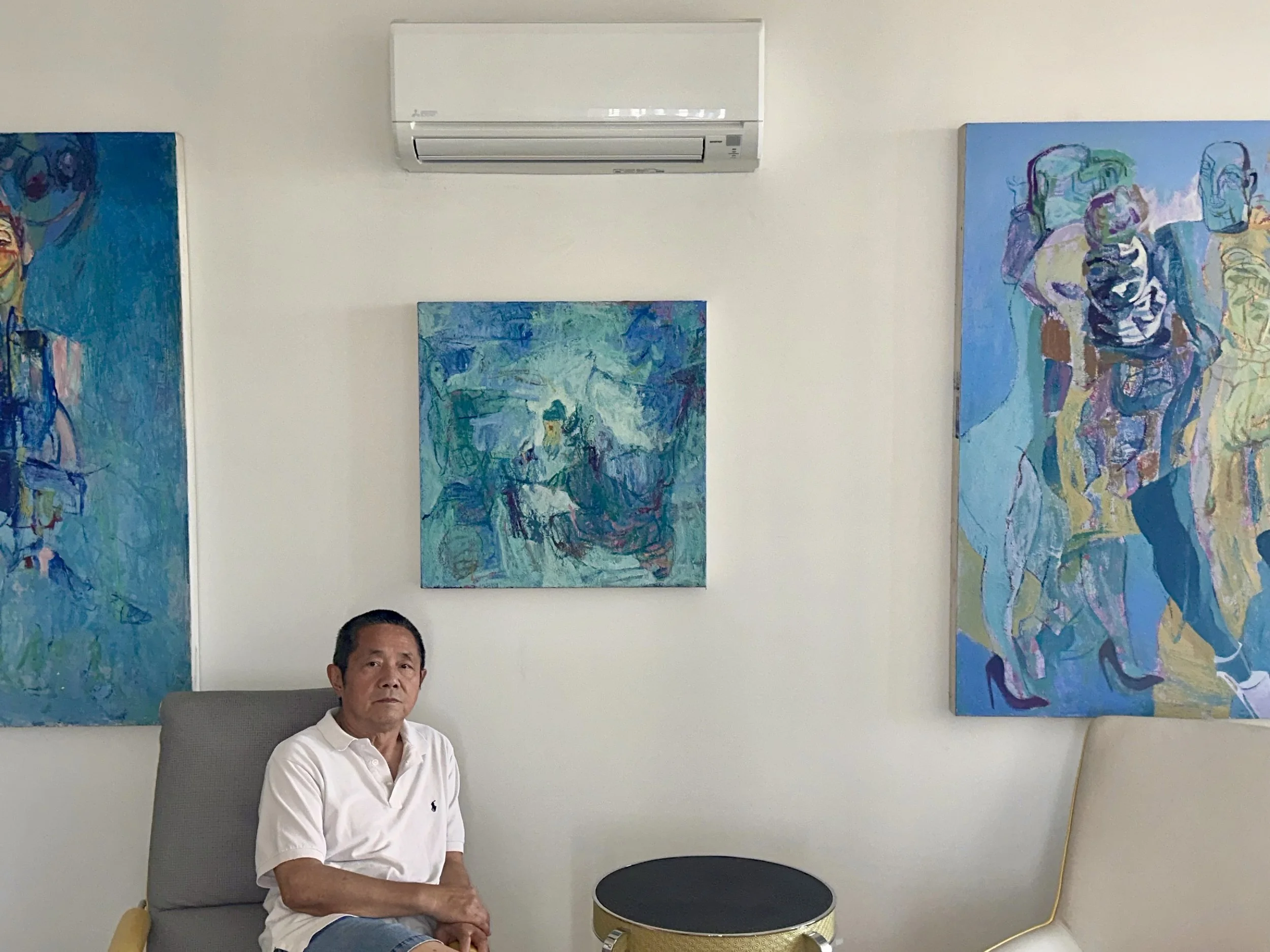
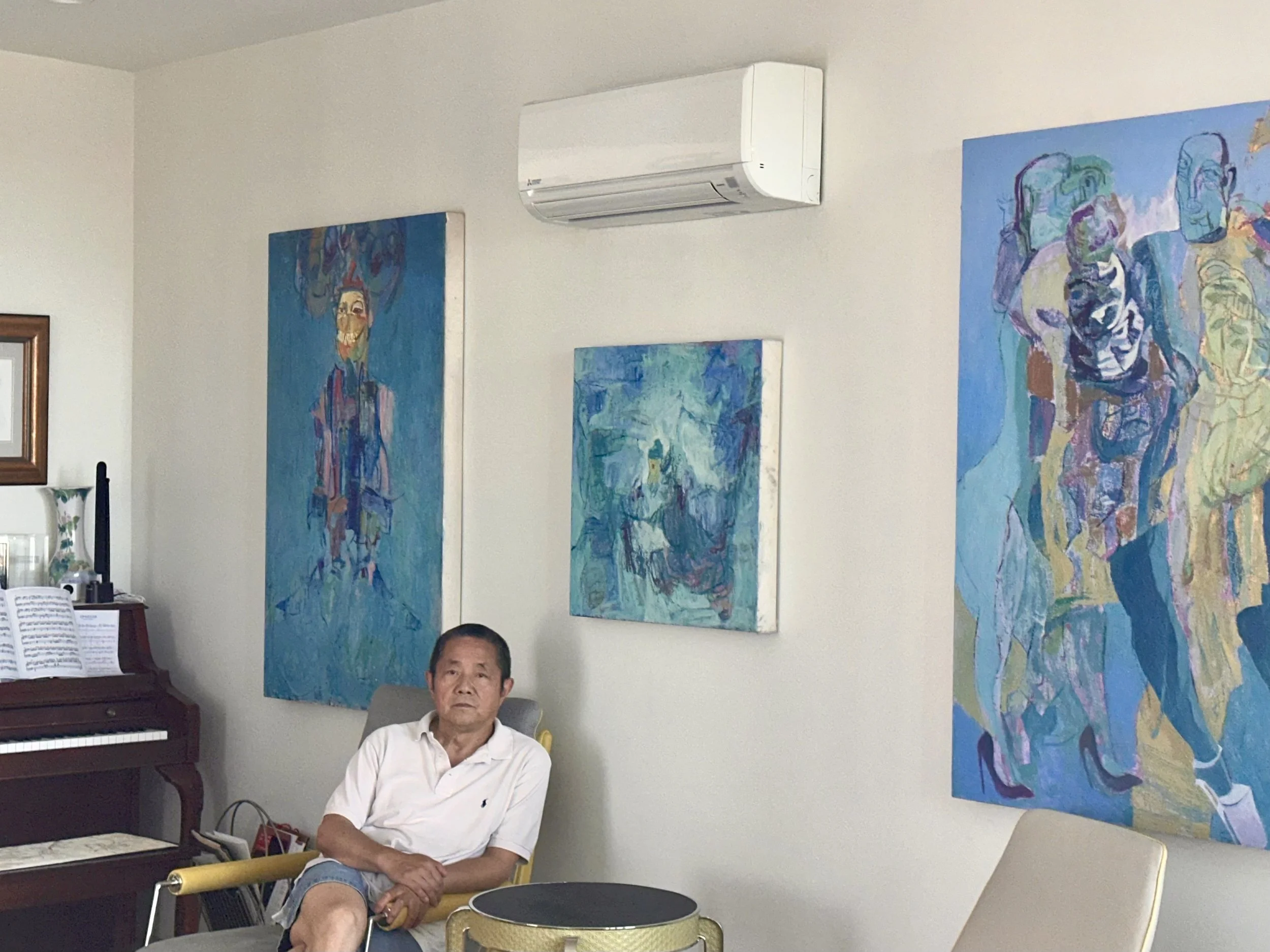
What is your background and how did you start your journey in the art world?
“In 1966, when the Cultural Revolution began, I was eleven years old and in the fourth grade of elementary school. With schools closed, my formal education was interrupted for a year and a half. After repeating grades and completing only two years and three months of middle school, I entered the military at the age of fifteen. For a young man in China at the time, military service felt like both a fortunate opportunity and a respected path. I served for nine years in the Railway Corps of the People’s Liberation Army. The early years were particularly arduous. One of my most enduring memories is being asked to draw a portrait of an eighteen-year-old fellow soldier who had died, so the portrait could be displayed at his memorial service the following day. In those years, drawing was my only pleasure outside of work. With no teachers or art books available, I taught myself by studying closely the propaganda illustrations published daily in the newspapers.”
What inspires you?
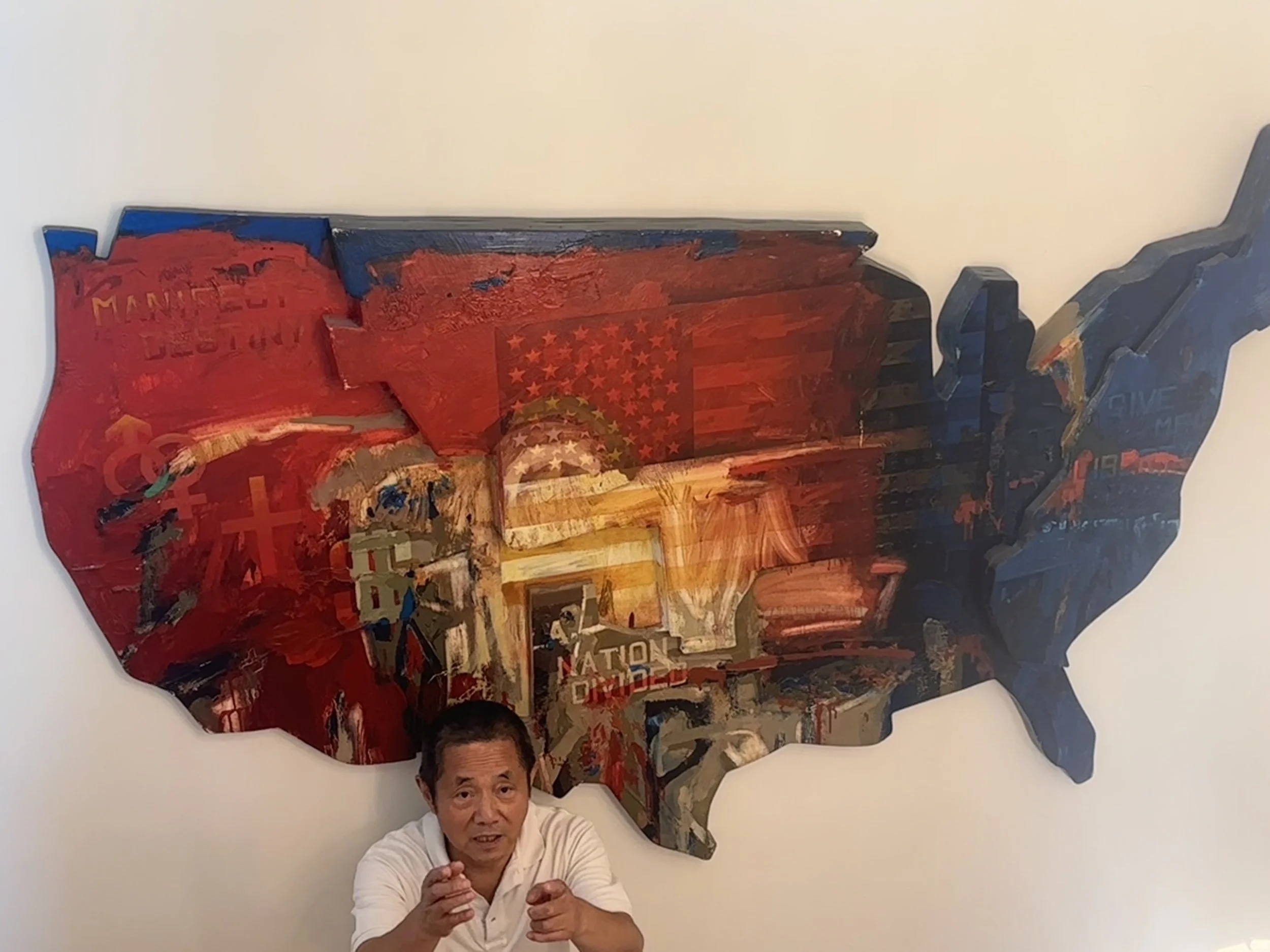
“As a multi-disciplinary artist, my work is deeply informed by the juxtaposition of my 34 years in China and the 36 years I have spent in the United States. This unique life journey has shaped my perspective and provides a rich tapestry from which I draw inspiration. Through the mediums of paint, ink, and found objects, I explore the intricate concepts of humanity, reflecting on my immigration experience and the myriad of emotions intertwined within it. My artistic journey began in 1975, and over the decades, drawing and painting have become my primary means of self-discovery and understanding the world around me. The creative process for me is not a linear path; it is characterized by continuous revision, negation, and refinement. Each work evolves, reflecting my thoughts and feelings as they shift and change. This process enriches my art and provides me with profound intellectual and spiritual fulfillment. I invite viewers to engage with my work and join me in a dialogue about the human experience, shaped by diverse backgrounds and shared narratives. Through my art, I seek to bridge cultures and foster connection, illuminating the beauty and complexity of our shared humanity.”
What themes do you pursue? Is there an underlying message in your work?
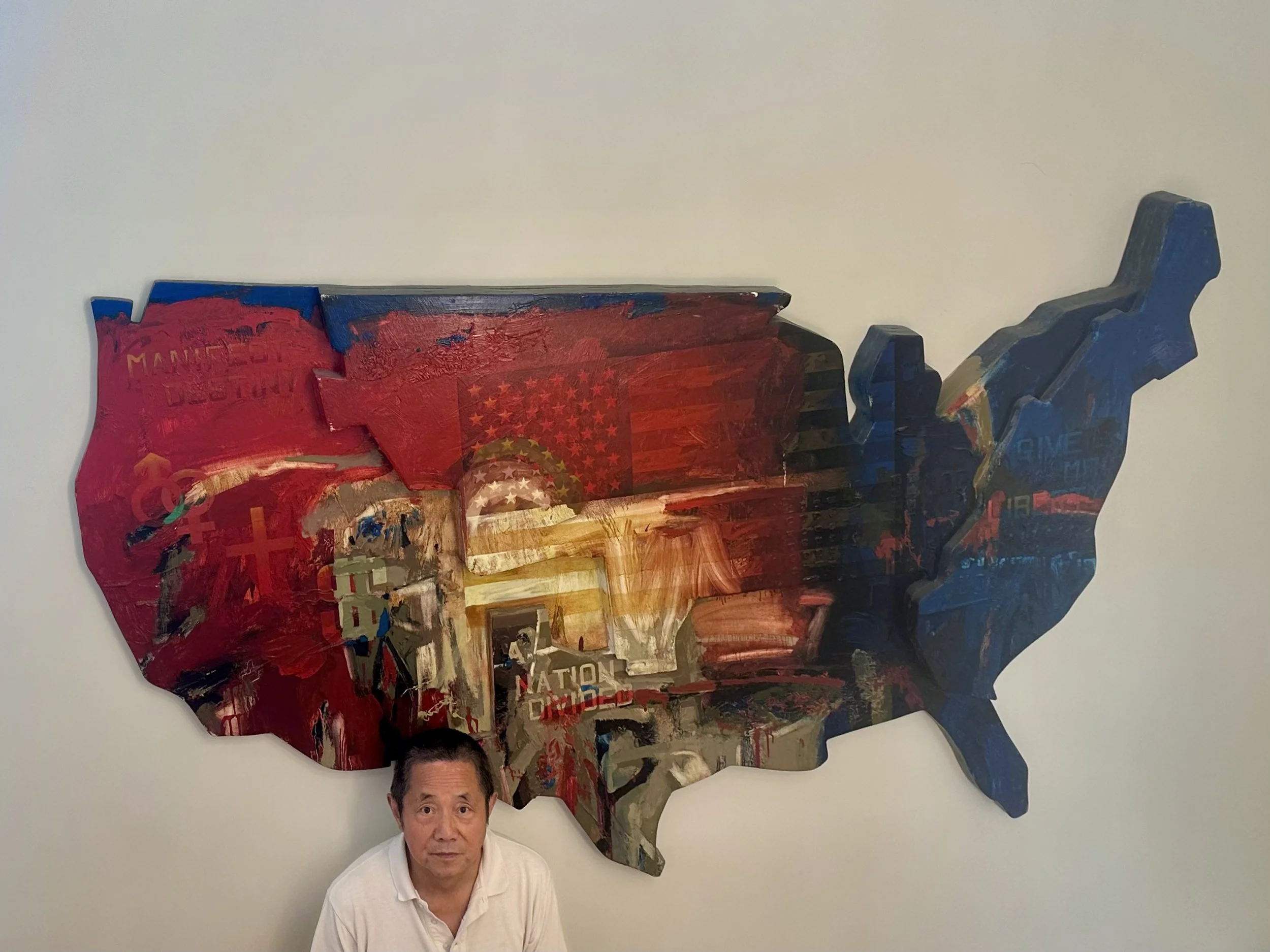
“My life experience, together with my longstanding engagement with history, literature, and philosophy, has led me to continually examine Chinese and American cultures in relation to one another, considering their respective strengths and limitations, achievements and failures. My artistic practice has developed in parallel with these reflections and with the questions they continue to generate.
For me, culture is a way of life created by a people over generations within a particular place and historical context. Every culture contains both what is valuable and what is flawed, and every culture possesses, to varying degrees, an instinct to exclude what lies beyond its boundaries. No matter how accomplished a culture may be, no single cultural tradition can meet the needs of humanity as a whole. Human progress, I believe, has always depended on cultures learning from one another, absorbing the finest elements of other traditions while building upon their own strengths.
Through such encounters, I believe humanity creates new ways of life better suited to its evolving needs. These innovations may take the form of values, institutions, science, art, or countless other forms of human achievement. Together, they constitute what we commonly understand as civilization.
Having lived more than thirty years in China and more than thirty years in the United States, I feel both a responsibility and an aspiration in my work: to bring the traditions of Chinese culture into meaningful dialogue with Western civilization and, through that encounter, to create something new. Looking back on my decades in America, I regard them as years devoted fundamentally to this pursuit.
My artistic and cultural practice is rooted in the study of humanity’s most significant cultural achievements—ancient and modern, Eastern and Western—paired with sustained reflection on the conditions of contemporary human existence. I understand this as a creative journey capable of occupying an entire lifetime. Along the way, one conviction has become increasingly clear to me: understanding ideas and concepts is far more important than the blind imitation of technique.”
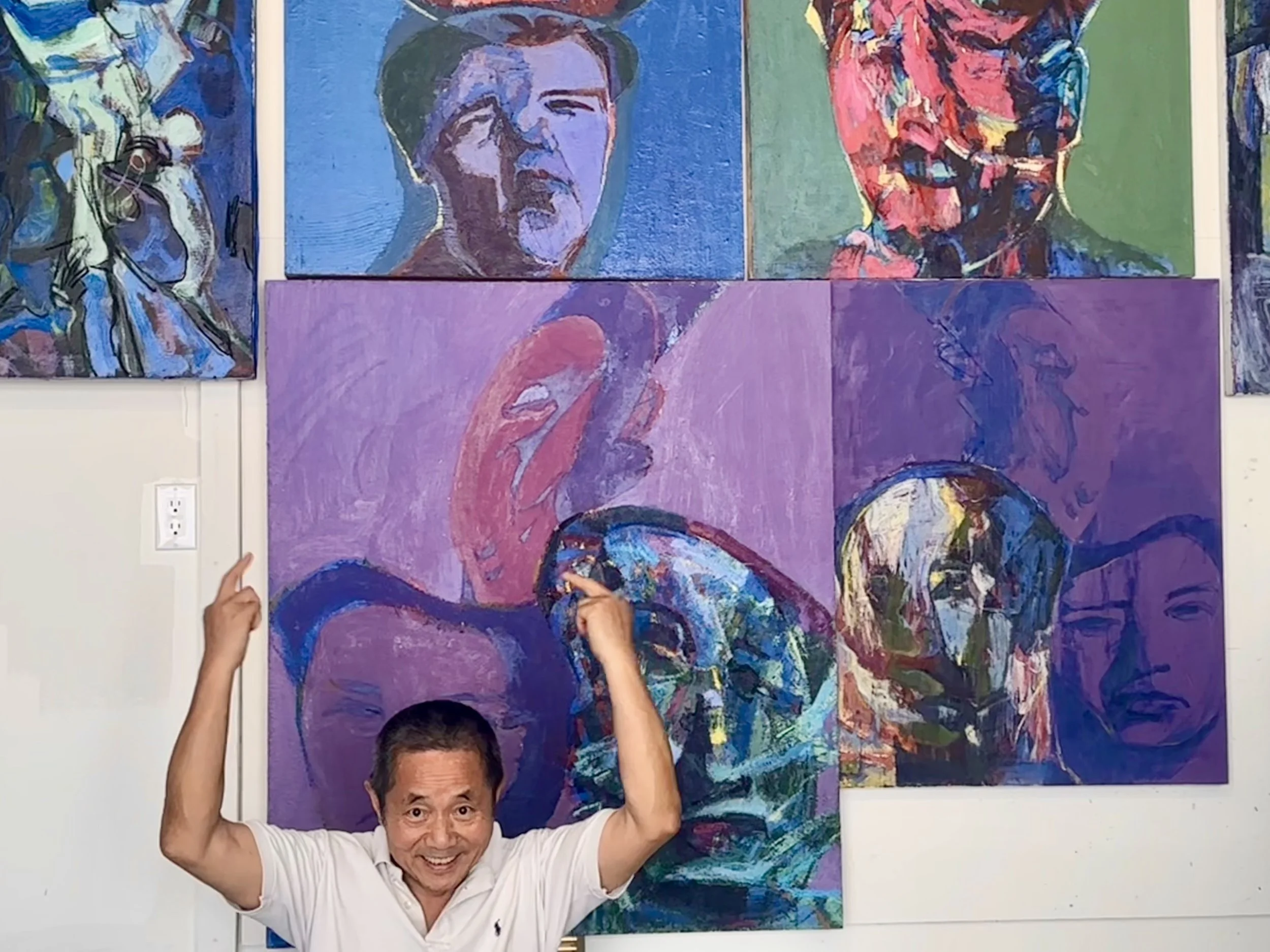
How would you describe your work?
“Among serious artists of my generation, technical training was rigorous. I spent seven years in formal academic study of Chinese painting and oil painting in mainland China, then immersed myself for more than thirty years in the American art world. At this stage of my career, technique itself is no longer the central challenge. The languages, methods, and physical disciplines of painting have become deeply internalized.
One conviction remains absolute for me: painting is not dead, and painting must remain rooted in the human hand. I do not adopt artistic forms simply because they are favored by the market. Each work begins with careful thought and demands the concentration of my entire being, drawing on decades of experience, reflection, observation, and artistic understanding.
Because my work is strongly conceptual and my ideas continually evolve through new insights, one of the most difficult questions I face is which visual language can most truthfully embody a particular subject. For me, painting is a creative process that requires the integration of mind, intellect, body, eye, and hand. An artist’s cultivation, personality, perception, judgment, and physical ability must work together in the making of a piece. Achieving this unity, and continually deepening it, constitutes my lifelong discipline as an artist.”
Which artists influence you most?
“I spend a lot of time studying all the masters in the history. I like Jasper Johns most.”
What is your creative process like?
“Leaving room for the unknown
With every painting, from the first stroke until the moment I consider the work complete, I deliberately leave approximately twenty to thirty percent unresolved. By doing so I force myself into territory where the outcome remains unknown.
Exploration. Revision. Transformation.
The process is demanding. At times it is frustrating; at others, exhilarating. The intellectual and emotional experience of exploration, discovery, repetition, revision, and transformation has become a state of mind I seek to enter every day. That practice continues to produce new possibilities.
Now approaching seventy, I feel the quality of my work deepening and improving. This remains one of the greatest sources of satisfaction in my artistic life.
The subjects of my paintings emerge from close observation of social reality and the innumerable conditions of human existence, considered through philosophical reflection and from broader historical and cultural perspectives. These subjects change and deepen according to time, place, and circumstance.
Some are eventually abandoned, while others continue to occupy him over many years. Such decisions are governed by thought and artistic necessity rather than by the demands of the market or commercial considerations. His art website presents works created across different periods of his life. Taken together, they offer the clearest commentary on his personal and artistic journey: what he has experienced, what he has thought, and what he has painted. It is precisely this freedom, both of thought and of artistic expression, that has at times enabled his work to anticipate aspects of social reality before they became widely apparent.
I recently discovered an artist whose work felt like a conversation I’d been waiting to join. Their canvases are layers of memory and improvisation, colors that recede and return like familiar voices. When I stand in front of a painting, I don’t just see technique — I feel the artist’s decisions, the quiet negotiations between control and chance.
I’m drawn to how they embrace imperfection. Brushstrokes that could be labeled “mistakes” become focal points, and textures that read as accidents turn into deliberate punctuation. That willingness to allow the unexpected makes the work feel alive; it reminds me that art, like life, is shaped by unplanned moments.
I appreciate when an artist’s practice reflects curiosity as much as skill. Their processes are hybrid: sketches, found materials, and digital fragments mingle with traditional media. They experiment without abandoning discipline, and that balance keeps their output unpredictable yet cohesive. Each series reveals new priorities — sometimes composition, sometimes color relationships, sometimes the tension between figure and abstraction — but a consistent sensibility ties everything together.
What moves me most is the emotional clarity beneath the aesthetic play. The pieces are not mere exercises in formalism; they carry an intimacy that invites empathy. Whether the work deals with solitude, memory, or urban rhythms, it does so in a voice that feels honest rather than confessional. I come away with questions and impressions instead of ready-made answers, which is exactly what I want from art.
When I write about artists, I look for that intersection of craft, curiosity, and heart. This artist embodies it, offering work that rewards slow looking and thoughtful listening. I’m eager to see where their practice goes next — and to keep following the subtle shifts that mark genuine growth.
As Stewart Turnquist, then a curator at the Minnesota Museum of American Art, observed of my work in 1999: ‘His paintings not only explore how Chinese and American cultures can be brought together; they also point toward how we might enter the next century.’”
What is an artist’s role in society and how do you see that evolving?
“Artists need to study life and express my feeling and thoughts on paintings or any other art firms. Their work needs to let people not only have physics excitements, but also needs the audience involved into to recreative and thinking about.”
Website: www.yikaistudio.com
Instagram: @yikaistudio