Interview
Giovi
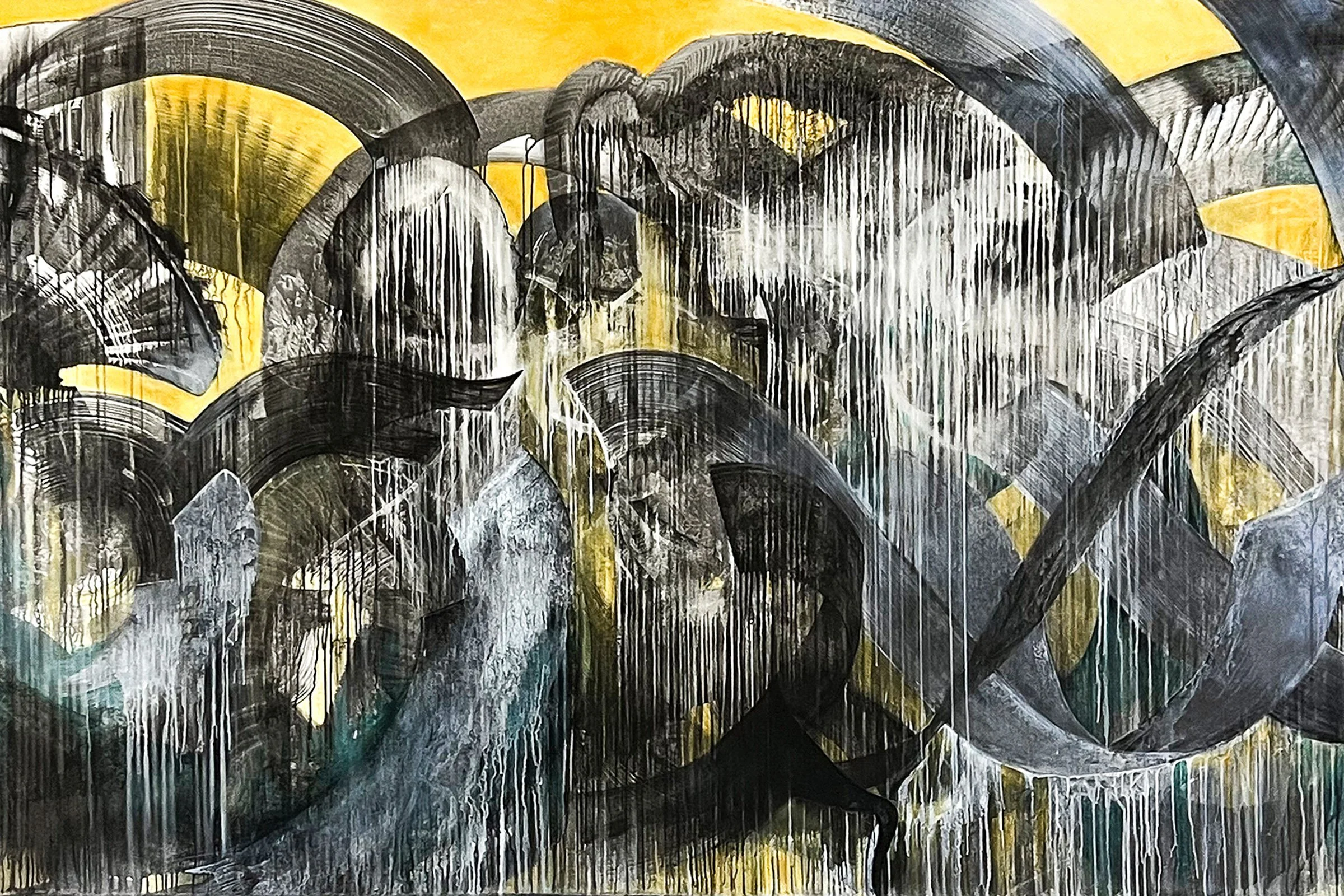
Giovi (Johannes Löberbauer) is an Austrian artist based in Grünau im Almtal (Salzkammergut). He works across painting, sculpture and multi‑media formats—but the engine is always the same: movement, friction, pressure, drift. He paints large panoramic canvases in acrylic/mixed media, where bold, decisive gestures collide with drips, abrasion, scratches and translucent veils. It’s a constant tension field between control and surrender—until, for a moment, a clear line appears: a rhythm, a course. Sailing is his inner model for making images: you don’t see the wind, you only see what it does to everything. You read invisible forces—gusts, currents, timing—and decide in real time while everything keeps moving. In the studio, those impressions from “out there” are distilled and recomposed: not as illustration, but as the same physics translated into paint. Alongside painting, Giovi has built sculptures and objects for theatre and public contexts (including work for the Salzburg Festival production Idomeneo), and he returns repeatedly to collaborative, time-based situations where image, sound and light meet.


What is your background and how did you start your journey in the art world?
“I was born in 1979 in Vöcklabruck, Upper Austria, and I grew up in Grünau im Almtal in the Salzkammergut region. I began my journey through formal arts education: HBLA for artistic design in Linz (1995–2000), followed by Multi Media Art studies in Salzburg (2001–2005) with a focus on illustration, photography and film, and I completed my diploma (Mag.(FH)) at FH Salzburg in December 2006. My diploma project ‘Zeitgast des Zufalls’ (2005–2006) explored chance in painting both practically and theoretically. Over time my practice expanded across paintings, sculptures and photography, and the works grew in scale—often panoramic—driven by an obsession with forces like water, wind, pressure and gravity and how they leave traces.”

What does your work aim to say? Does it comment on any current social or political issues?
“My work aims to hold tension without collapsing into chaos. I’m interested in systems—loops, routes, pressure, resistance—and in how gravity and time leave traces. The paintings are not illustrations; they are states: like weather, currents, or a course correction. If there is commentary, it’s indirect rather than slogan-like: a focus on attention, endurance and orientation. In a world of speed and noise, the work insists on the physical truth of making—layer by layer—until a new order appears.”
Do you plan your work in advance, or is it improvisation?
“It’s a balance: I enter with a clear direction—scale, a main rhythm, a structural idea—but the real work is improvisation guided by experience. I think of it like navigation: you plan a course, but you respond to wind, current and what the surface gives back. Some decisions are immediate and physical; others happen later, when I step back and read the painting like a map.”
Are there any art world trends you are following?
“I don’t follow trends in a literal sense—I follow questions. I’m drawn to practices that treat painting as material thinking: process-driven abstraction, works that keep the trace of making visible, and approaches that blur boundaries between painting, object and installation. I’m also interested in how contemporary artists handle scale and the relationship between the body and the image—when painting becomes spatial and architectural rather than purely pictorial.”
What process, materials and techniques do you use to create your artwork?
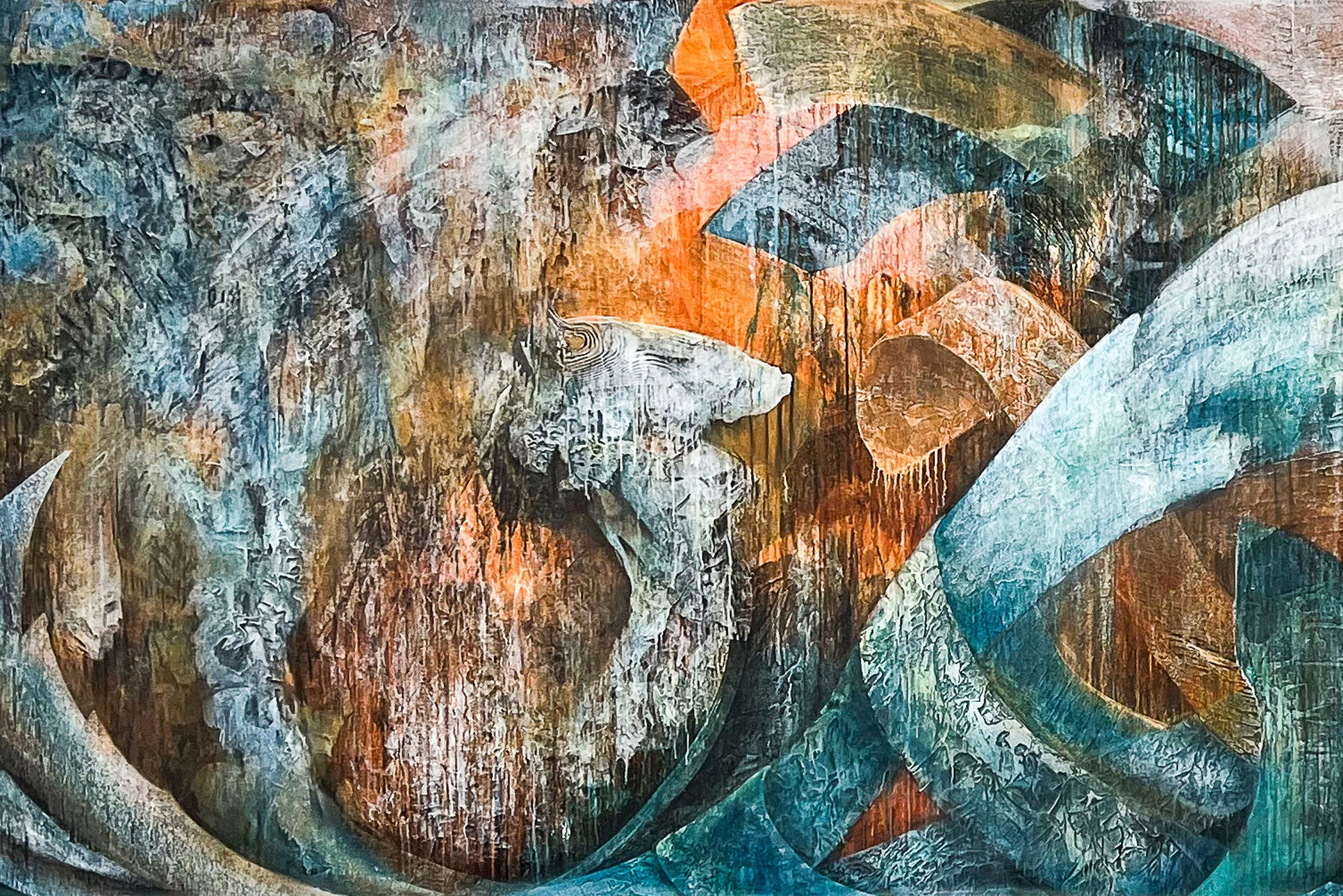
“The process is layered and physical. I work large, often in panoramic formats, building a framework of sweeping gestures and structural arcs. Then I push and pull the surface through abrasion, overpainting, scraping and washes. Gravity is part of the technique: drips and runs are not accidents but a time-line—evidence that the painting happened. I often keep the palette reduced (black/graphite/white), with occasional sea-tones and warmer fields to create pressure and depth. Materials/techniques: Paint: acrylic/mixed media on canvas Tools: brushes, rollers and scrapers; layering, abrasion, overpainting, washes, controlled drips. Surface: canvas.”
What does your art mean to you?
“It’s my way of staying in motion while making something tangible. Painting is where intensity becomes readable—where experience compresses into form. It’s also a practice of trust: to work through resistance until a new order appears. The studio is where I return to recalibrate—like coming back to a harbour—before going out again.”
What’s your favourite artwork and why?
“A current key work for me is ‘Möbius’ because it holds the central logic of my practice: loops, return and transformation without a clear beginning or end. It feels like a closed circuit that keeps generating movement—structured, but alive. If I had to describe it in one sentence: it’s a painting about continuity under pressure.”


Have you had any noteworthy exhibitions you'd like to share?
“I haven’t focused on conventional exhibitions recently. Instead, a project I found especially noteworthy was s’ Sophal—an audio-visual collaboration that brought painting, live music and digital drawing/light into one shared moment. In the project, I worked analog on a 2×4 m canvas using self-made tools, while a digital artist interpreted and deconstructed the monochrome ‘association surface’ and expanded it through an animated light layer. The process stayed in permanent dialogue with the music, which strongly shaped what emerged. What fascinates me about this format is the moment itself: we didn’t fully know what the whole would become, and yet it worked—almost like a collective navigation. For everyone involved, it felt genuinely magical; the video can only hint at what was present in that live momentum.”
Website: www.giovi.at
Instagram: @giovi_artworks