Interview
Eric Polins
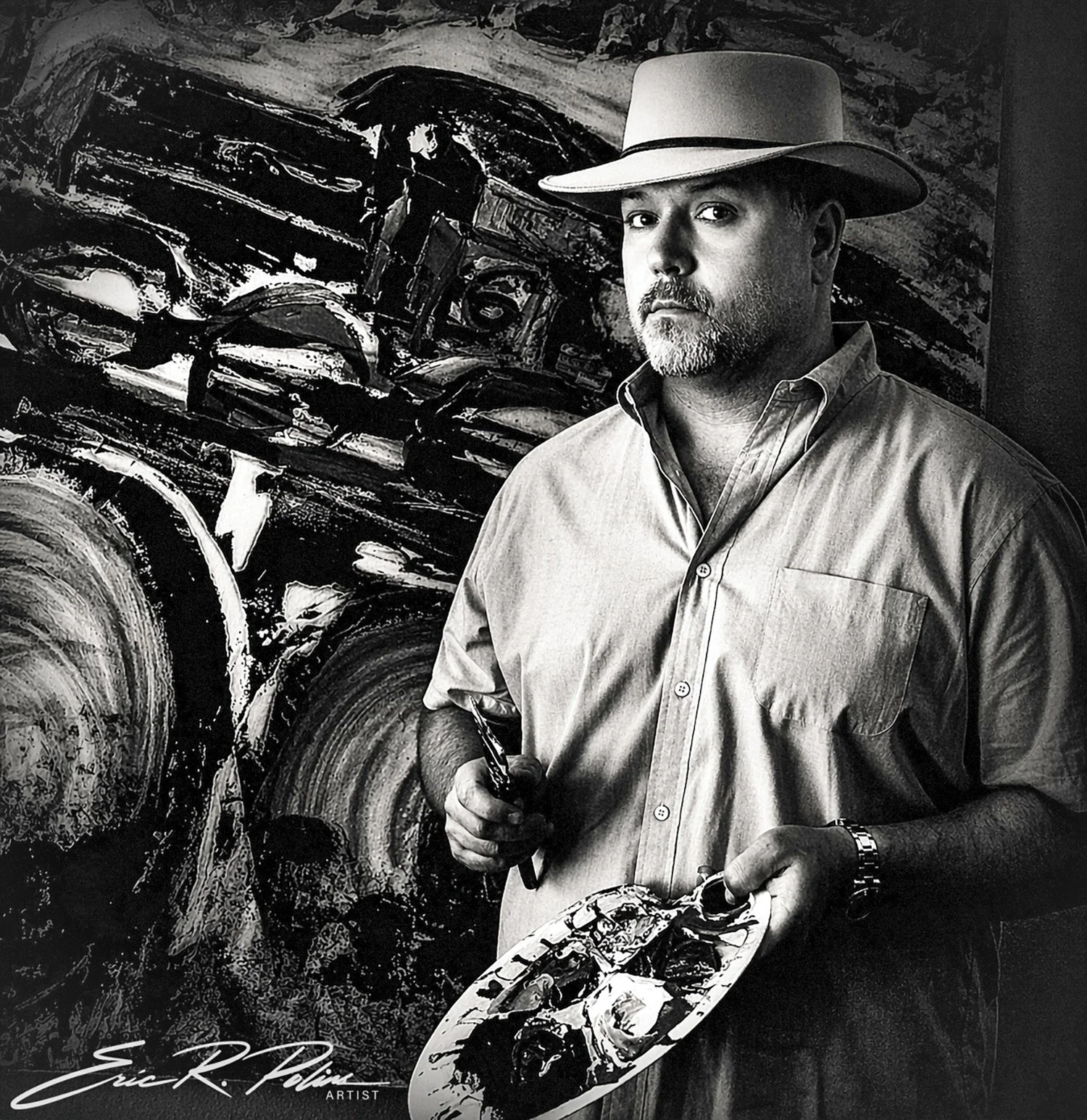
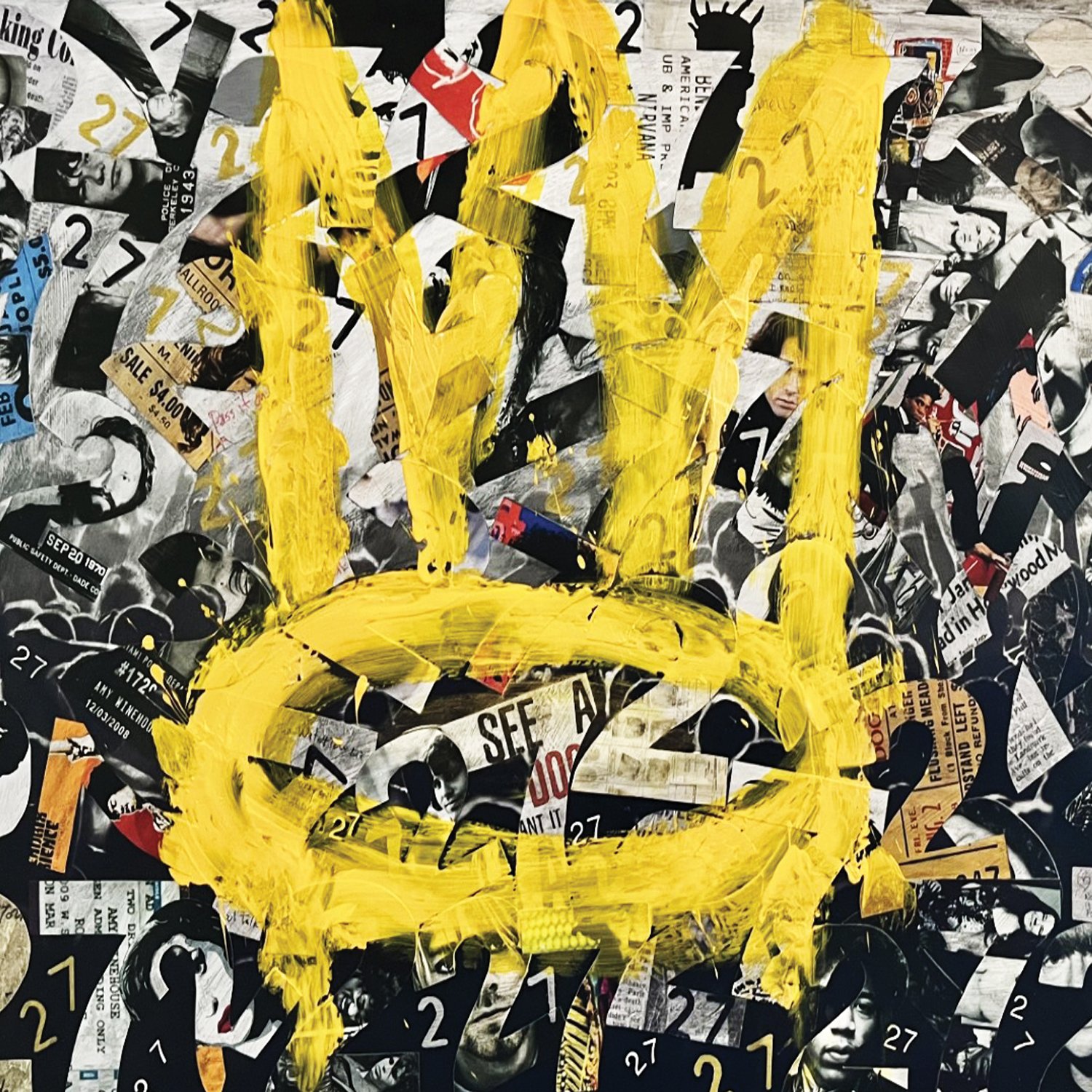
Eric Polins is a mixed-media artist working in acrylic, collage, and resin, creating layered compositions that merge culture, memory, and sound. With more than 25 years as a writer, creative director, and filmmaker, his work is rooted in storytelling translated into visual form. Raised by a fashion illustrator and an engineer, he developed a balance of creative instinct and structural precision, later shaped by early work in web development and animation. His process builds through layers of archival imagery, typography, and cultural reference, forming compositions that feel both chaotic and exacting. Music drives both subject and structure, with rhythm, repetition, and contrast guiding the viewer. His background in branding informs a disciplined approach to clarity and impact, while metallic elements like gold leaf introduce emphasis and depth. His work reflects how identity is built through accumulation, influence, and experience.
What is your background and how did you start your journey in the art world?
“I was born in Pennsylvania, but my family moved frequently throughout my childhood, exposing me to different places, people, and experiences. Looking back, those constant changes helped shape my fascination with memory, identity, and storytelling, subjects that continue to influence my work today. Creativity was present from the beginning. My mother was an illustrator and my father was an engineer, so I grew up with both artistic and analytical influences. I often describe myself as a left-brain/right-brain person. From my father came an appreciation for structure and problem-solving; from my mother came a love of drawing, imagination, and visual expression. While both have influenced me throughout my life, I've always leaned heavily toward the creative side.
As a child, I spent countless hours drawing, creating comic strips, and immersing myself in art, music, movies, and popular culture. After my father passed away, I returned to Pennsylvania to help my mother and attend Penn State, where I earned a degree in journalism. My professional career has taken many creative turns. I've worked in filmmaking, web development, animation during the early dot-com era, and for the past twenty-six years I have co-owned a branding, marketing, and communications firm in Tampa, Florida. While those disciplines may seem very different from fine art, they all share a common foundation: understanding people and telling meaningful stories. Throughout every stage of that journey, I continued creating art. Over time, drawing, painting, collage, and visual storytelling evolved into the mixed-media practice I pursue today.
My work combines original illustration, painting, vintage imagery, and hand-cut collage to create layered narratives that explore memory, nostalgia, identity, and the passage of time. In many ways, becoming a professional artist was not a reinvention of myself. It was the natural convergence of everything that came before it, a lifetime spent balancing creativity and structure, art and communication, imagination and storytelling.”
What inspires you?
“I am inspired by memory and the stories we carry with us throughout our lives. Much of my work explores the intersection of personal experience and collective cultural memory, those moments, images, songs, places, and objects that shape who we are and how we understand our past. I am fascinated by the layers that exist beneath everyday life. An old photograph, a comic book, a movie, a childhood toy, a piece of music, or a forgotten artifact can instantly transport us to another time and place. Those connections between memory, emotion, and identity often serve as the starting point for my work. I am also inspired by visual storytelling in all its forms. My background spans journalism, filmmaking, animation, branding, and communications, so I am naturally drawn to narratives and symbolism. I enjoy finding ways to combine images, textures, and fragments from different eras to create something that feels both familiar and unexpected. Perhaps most importantly, I am inspired by the passage of time itself. As I've gotten older, I've become increasingly interested in how experiences accumulate, how memories evolve, and how our personal stories connect to larger cultural narratives. Much of my work is an attempt to capture those layers and preserve them in a visual form.”
What themes do you pursue? Is there an underlying message in your work?
“Many of my works explore themes of memory, identity, nostalgia, and the passage of time. I am fascinated by the layers of experiences, influences, and cultural references that shape who we become. Whether drawing from childhood memories, music, film, comic books, vintage imagery, or personal experiences, I often use familiar visual elements as entry points into deeper conversations about how we remember and assign meaning to our lives. My work is intentionally layered, both physically and conceptually. Original illustration, painting, collage, and found imagery are combined to reflect the way memory itself functions, not as a single linear narrative, but as a collection of fragments, emotions, and moments that overlap and evolve over time. If there is an underlying message in my work, it is that our stories matter. The people, places, objects, and experiences that shape us never completely disappear. They remain part of us, influencing how we see ourselves and the world around us. Through my art, I hope to create moments of recognition that encourage viewers to reflect on their own memories, relationships, and personal histories. Ultimately, I am interested in the connections between individual experience and collective cultural memory. While each piece begins from my perspective, my goal is for viewers to find pieces of their own story within the work.”
How would you describe your work?
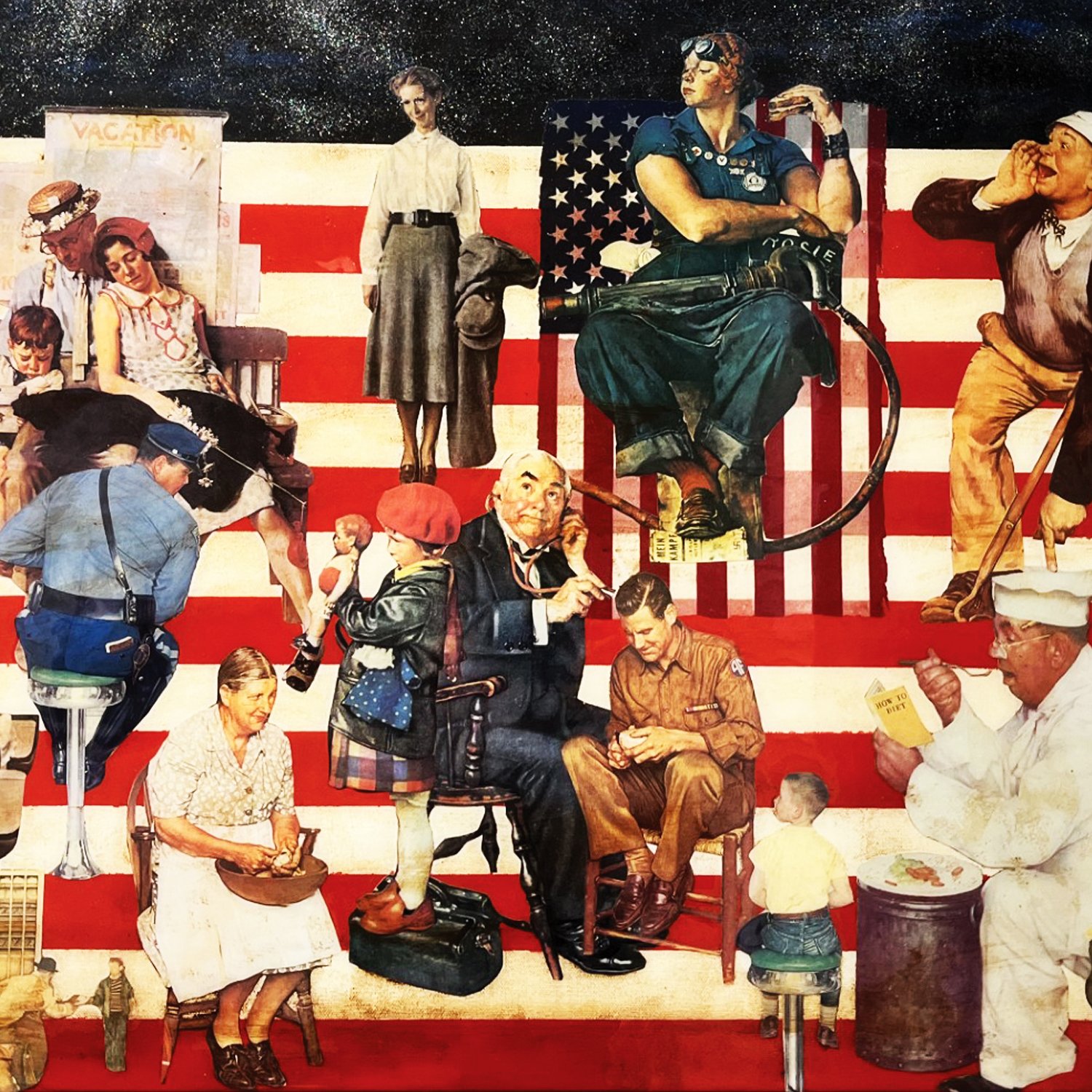
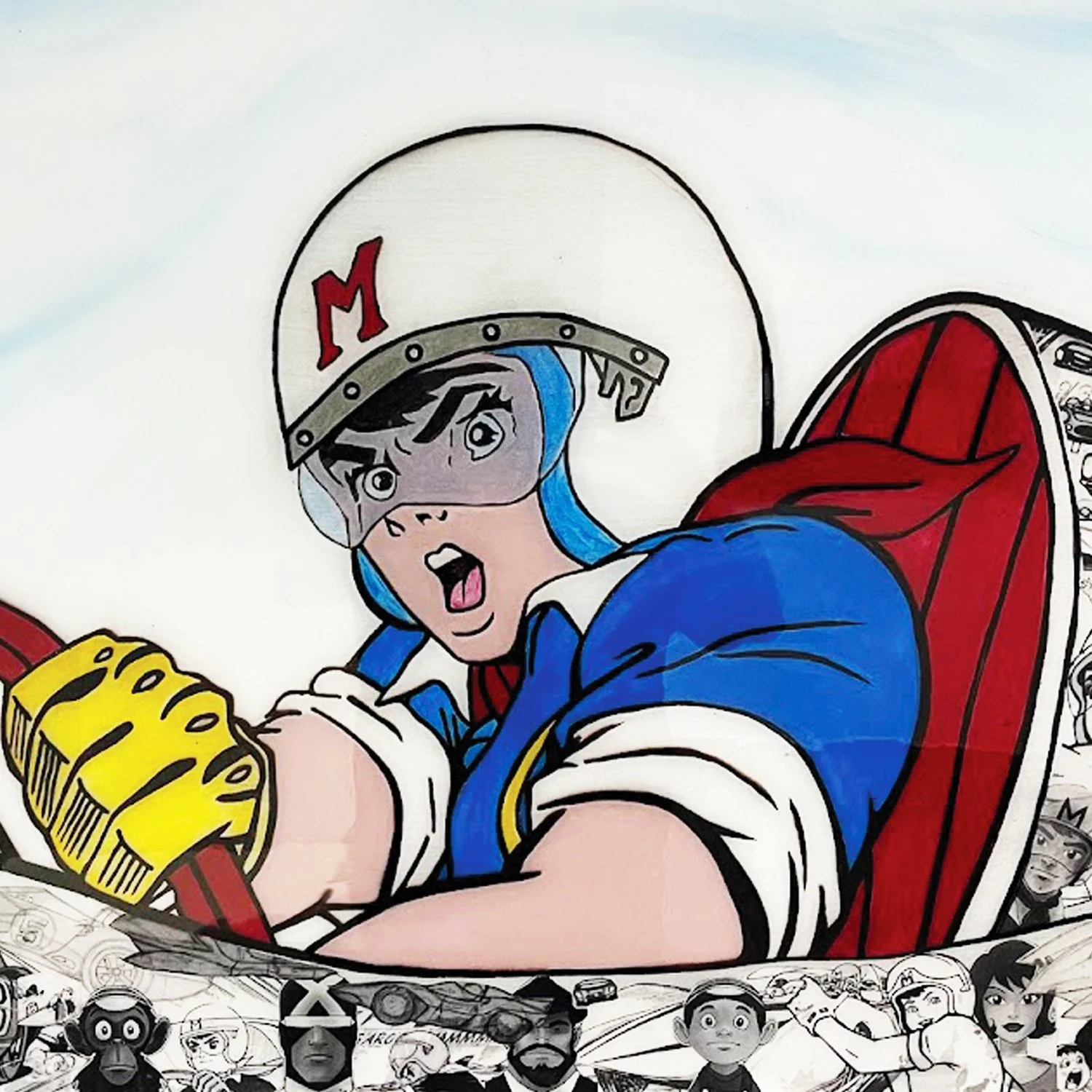
“I would describe my work as layered mixed-media storytelling designed to be emotionally sticky. I want my pieces to stay with people after they walk away. The work often functions as a kind of visual time capsule, preserving fragments of memory, culture, music, history, and personal experience in a way that invites viewers to reconnect with their own stories. My pieces combine original illustration, painting, hand-cut collage, vintage imagery, and found visual elements to create layered narratives that explore memory, identity, nostalgia, and the passage of time. I am drawn to the artifacts we collect throughout our lives: comic books, photographs, films, songs, advertisements, and cultural icons and the emotional weight they accumulate over time. The layering process is central to the work. Images are assembled, obscured, revealed, and reinterpreted much like memory itself. What emerges is part autobiography, part cultural archaeology, and part visual storytelling. While every piece begins with something personally meaningful, my goal is to create emotionally sticky time capsules that allow viewers to find pieces of their own lives within the work. If someone sees a piece and is reminded of a person, a place, a song, or a moment they thought they had forgotten, then the work has done its job. Ultimately, I want the work to spark curiosity, invite reflection, and remind us that the stories that shape us never really disappear.”
Which artists influence you most?
“My influences come from both the art world and the people who shaped me personally. The most important influence was my mother, who was an illustrator. She passed away recently, but her impact on my creative life remains profound. Long before I understood what it meant to be an artist, I was watching her draw, create, and communicate through images. She taught me that art was not simply decoration, it was a way of seeing, interpreting, and engaging with the world. Many of the creative instincts I rely on today can be traced directly back to her. Among visual artists, I am particularly drawn to Marc Chagall and Jean-Michel Basquiat. Chagall's dreamlike imagery and ability to blend memory, emotion, and symbolism have always resonated with me. Basquiat's fearless layering of text, imagery, culture, and personal expression continues to influence the way I think about visual storytelling and composition. I am also inspired by voices outside traditional fine art. One of those is Jim Morrison, whose work explored themes of identity, mortality, mythology, and self-discovery.
What connects all of these influences is their willingness to challenge convention and create work that continues to resonate long after the moment in which it was created. More broadly, I draw inspiration from music, film, comic books, journalism, popular culture, and the visual artifacts people leave behind. A vintage photograph, an old comic book, a handwritten note, or an album cover can be just as influential to me as a painting hanging in a museum. Ultimately, I am drawn to creators whose work endures; artists and storytellers who leave an emotional imprint across generations. That idea has become even more meaningful since losing my mother. In many ways, my own work is an effort to preserve memories, celebrate connections, and create emotionally sticky time capsules that continue the conversation long after we're gone.”
What is your creative process like?
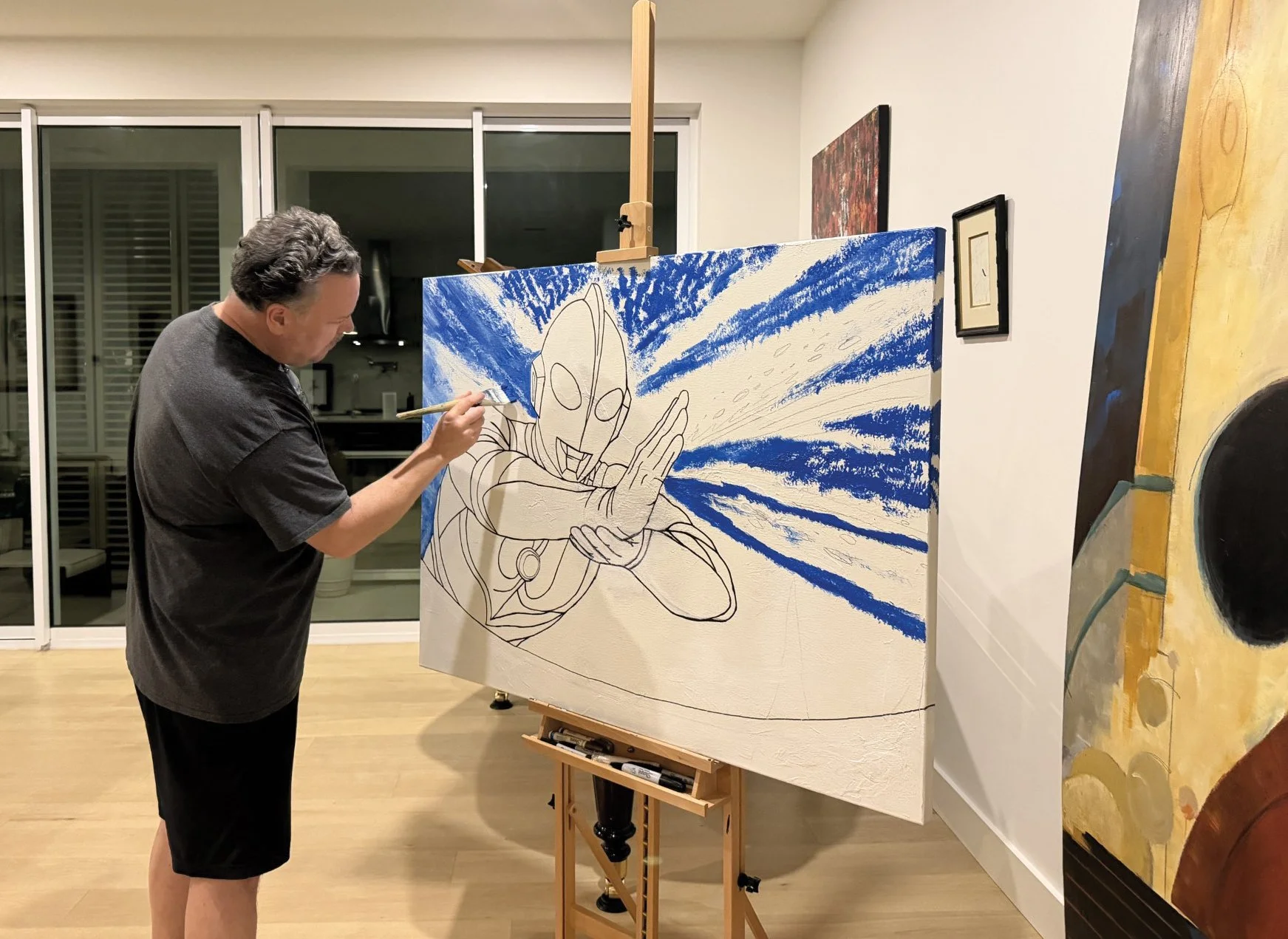
“My creative process usually begins with an idea, a memory, or a visual fragment that refuses to leave me alone. It might be a photograph, a song lyric, a childhood memory, a cultural icon, or simply a question I find myself thinking about repeatedly. From there, I begin collecting and organizing visual elements. I often sketch ideas by hand and then search through my own archive of imagery, photographs, vintage materials, and references. Because much of my work explores memory and storytelling, research and discovery are important parts of the process. The pieces are built in layers. Original illustration is typically the foundation, followed by painting, collage, hand-cut imagery, and other visual elements that gradually evolve into a larger narrative. I rarely know exactly what the finished piece will look like when I begin. While there is structure and intention behind the work, there is also a great deal of experimentation, improvisation, and discovery.
My studio process can best be described as chaotic and messy, but ironically organized. To an outside observer, it might appear that I am surrounded by piles of images, sketches, notes, clippings, and reference materials. Yet somewhere within that apparent disorder are connections waiting to be discovered. I often find that the most interesting ideas emerge unexpectedly when unrelated elements collide and begin to tell a story together. I think my background in journalism, filmmaking, animation, branding, and visual communications has influenced the way I work. I tend to approach each piece as both a designer and a storyteller, thinking about composition, symbolism, pacing, and emotional impact. Perhaps the best way to describe my process is that I am constantly searching for connections. I enjoy taking seemingly unrelated images, memories, and ideas and assembling them into something that feels cohesive and meaningful. When the process works, the finished piece becomes more than the sum of its parts—an emotionally sticky time capsule that invites viewers to discover their own connections within it.”
What is an artist’s role in society and how do you see that evolving?
“I believe an artist's role is to help people see differently. Art has the unique ability to make us pause, reflect, question, remember, and connect. In a world increasingly dominated by speed, distraction, and endless streams of information, artists create opportunities for deeper engagement with ideas, emotions, and experiences that might otherwise be overlooked. Historically, artists have served as storytellers, documentarians, provocateurs, and cultural mirrors. They preserve moments in time, challenge assumptions, celebrate beauty, and help societies process both triumph and hardship. While the tools and mediums may change, I believe that fundamental role remains the same.
As someone who has spent much of my career in journalism, filmmaking, branding, and crisis communications, I have seen firsthand how narratives shape public perception. Art offers something different. It doesn't have to persuade or explain. It can simply invite people to feel, interpret, and discover meaning for themselves. Looking ahead, I think the role of artists will become even more important. As technology, artificial intelligence, and digital media continue to transform how we communicate, authentic human creativity will become increasingly valuable. Information can be generated instantly, but genuine perspective, lived experience, emotional insight, and imagination remain uniquely human. My hope is that artists continue to create work that fosters curiosity, empathy, and connection. In my own practice, I strive to create emotionally sticky time capsules that encourage people to slow down, reflect on their own stories, and recognize the shared experiences that connect us all.”
Have you had any noteworthy exhibitions you'd like to share?
“One exhibition that was particularly meaningful to me was being selected for exhibition through Singulart, which helped introduce my work to a broader international audience. As an artist, there is something rewarding about seeing deeply personal work connect with people from different backgrounds and cultures. More recently, I was honored to advance in The People's Artist competition, a national art competition benefiting The Art of Elysium. What made that experience especially meaningful was my decision to pledge the entire $25,000 grand prize back to the organization if I were to win. The experience reinforced my belief that art has the power not only to inspire but also to create tangible impact for others. I have also exhibited work throughout my career in various gallery, community, and professional settings. I was a Quarter-Finalist in the People's Artist Competition. (Top 1%). While recognition is always appreciated, I am most interested in opportunities that create meaningful conversations around the work and allow viewers to form their own personal connections to the themes of memory, identity, and storytelling that run throughout my practice.”
Website: ericpolins.com
Instagram: @epolins4435
Brush Bio: www.brush.bio/ericpolins
Other links: www.southtampagallery.com