Interview
Carlos Bernar
An interdisciplinary artist focused on the integration of visual, narrative, and spatial languages. His work merges the pictorial tradition with tools from film, installation, museography, and the performing arts, constructing layered narratives that explore the connections between disciplines. In each project, he seeks to generate experiences in which emotion, idea, and form engage in dialogue from a contemporary perspective.
What is your background and how did you start your journey in the art world?
“My earliest memory connected to art takes me back to the age of eight, taking part in an open-air painting competition. That early experience left something in me that never went away: the intuition that looking at the world with intention is already a creative act. Later I studied Fine Arts at the Complutense University of Madrid, where I received a deeply academic training that gave me something I consider essential: discipline and a solid command of drawing and figurative painting as a foundational language. I then broadened that perspective by studying film at UCLA in Los Angeles, which opened up an entirely new dimension of visual storytelling for me. Since then, my career has been deliberately cross-disciplinary. I have worked in film, documentary, animation, painting, photography, museography and set design. I don't see this as scattered — rather, it reflects my understanding of art as something multifaceted: each discipline has taught me to look at the artistic act from a different angle, and those perspectives continually feed one another.
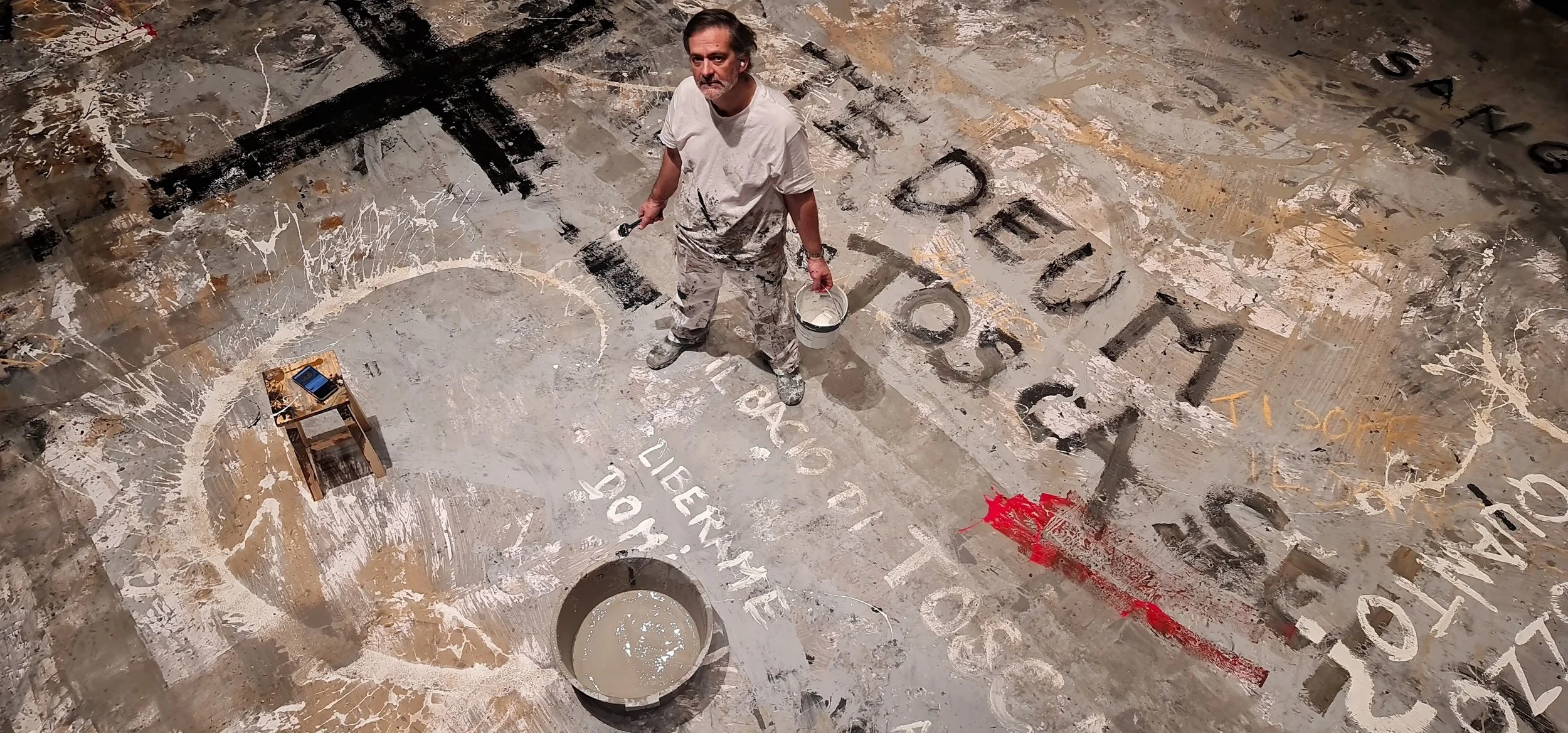
An essential part of that journey has been collaborating with professionals from other fields: set designers, architects, interior designers, decorators... Working alongside them has taught me that art doesn't live only on the canvas — it enters into dialogue with space, with function, and with the people who inhabit it. Those collaborations have profoundly shaped the way I approach every project. Over time I moved from figurative work towards abstraction, a territory in which I feel especially at home. What draws me to abstraction is that it doesn't close down meaning — it multiplies it. A single work can sustain very different readings, and that openness strikes me as one of the greatest gifts art can offer. A good example of how I work is my intervention for the opera Tosca: I created a large canvas of 120 m² for the stage floor. But the work didn't end there. Once the production closed, I dismantled it — breaking it down into independent fragments, each of which became an autonomous piece, a child of the original whole. What fascinated me was exploring that tension between the whole and the part — how each fragment stands on its own and, at the same time, carries within it the memory of a larger work. From that experience came several exhibitions that I consider among the most meaningful of my career.”
What inspires you?
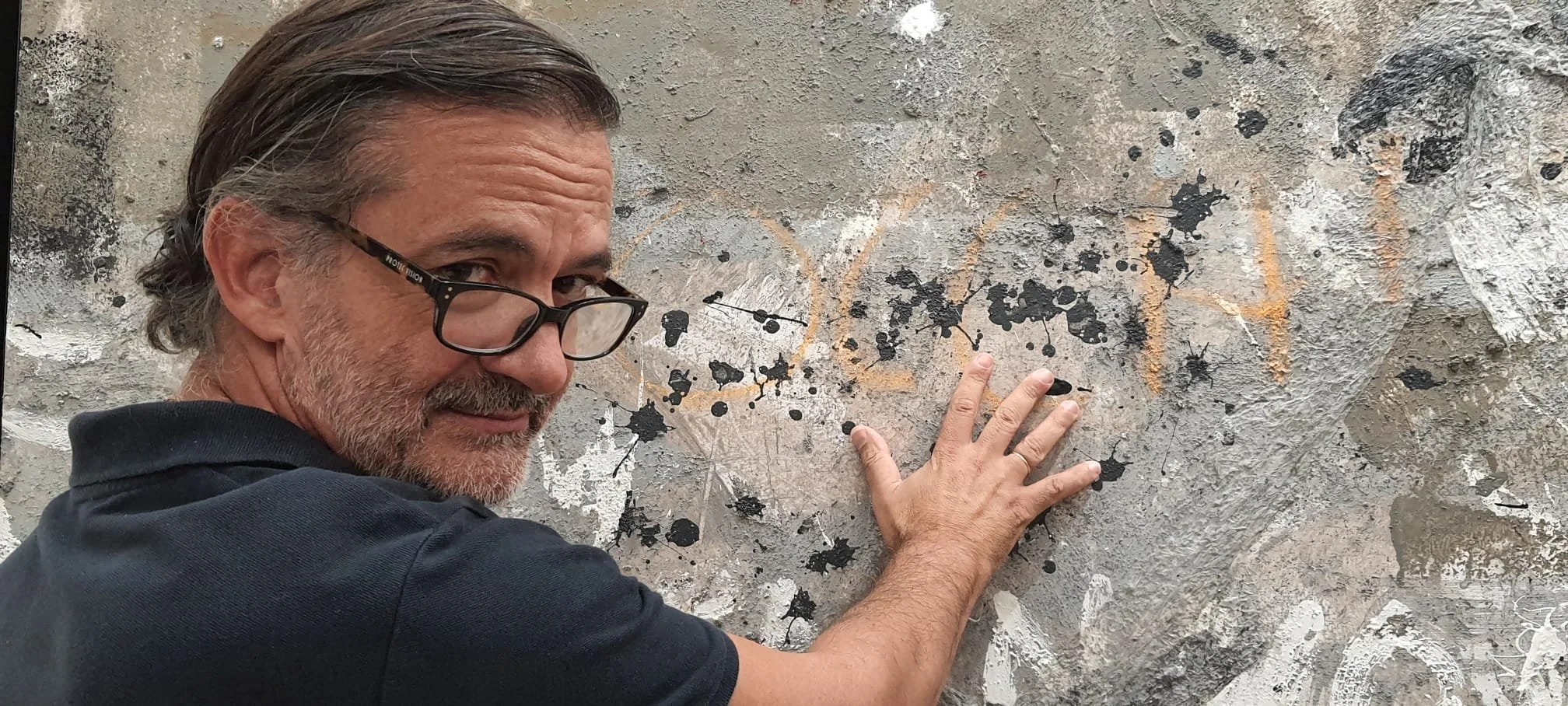
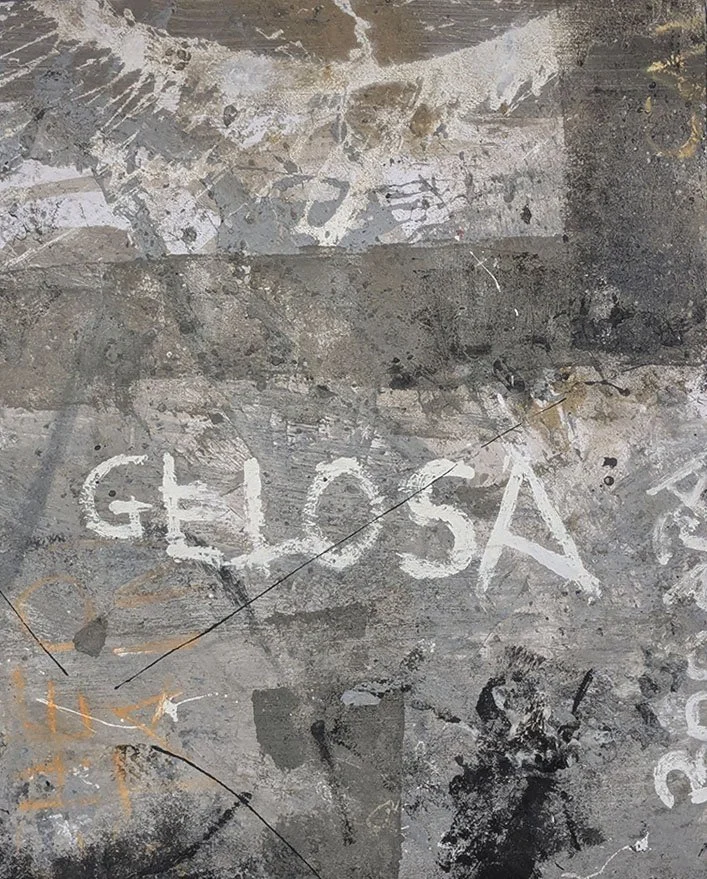
“Inspiration, for me, comes from everything around us. It is really a matter of learning how to look — of training yourself to see what is already there, often in the most unexpected places. I am fascinated by textures. I have always been drawn to urban environments — those streets that bend and twist, that lead you somewhere unknown, that accumulate layers of time and human presence. On some of my travels I have come across walls where graffiti had built up one on top of another like geological strata: some inscriptions dated back to the eighteenth century, others were far more recent, and yet they all coexisted on the same surface. There is something deeply artistic in that — almost archaeological: an unintentional, material narrative where each mark speaks of someone who passed by and left something of themselves behind. The same happens to me with letters and inscriptions that time has gradually transformed into timeless stories. You don't know exactly when they were made, or by whom, and that ambiguity gives them a density that few works consciously conceived as art manage to achieve. But inspiration is also a process of maturation. It doesn't arrive on its own or all at once — it builds slowly, through the accumulation of experiences, travels, conversations, and relationships with other people and other disciplines. It is a process that never truly ends, and I think that, at its core, is what keeps artistic practice alive.”
What themes do you pursue? Is there an underlying message in your work?
“I don't start from predefined themes. What drives me is the project itself: conceiving artistic propositions with their own identity, sometimes working alone and sometimes in collaboration with artists from other disciplines — set designers, architects, interior designers — where the result emerges from a narrative built together. That said, there is something that reappears constantly in my work, almost without my summoning it: time. Not time as measurement — hours, dates, chronologies — but time as experience, as mystery. What is time? Why does it affect us so deeply when we are barely conscious of it? We are immersed in space and time, yet we rarely stop to truly feel them. What fascinates me — and also challenges me — is that painting may be the least obvious medium through which to speak about time. In the performing arts or in cinema, time unfolds before the viewer in real time: change is visible, it is part of the work itself. In painting, by contrast, change is extremely slow, almost imperceptible. A canvas ages, transforms, accumulates layers — but that process exceeds us: we will most likely never witness it. And it is precisely that tension between the apparent permanence of the work and the transformation that unfolds beyond our perception that I find most compelling. Texture, in that sense, is not merely a formal device: it is time made material. Every layer, every mark, every visible sediment on the surface of a work is a trace of something that happened, that left its imprint. Working with texture is, for me, a way of making the invisible visible: the passing of time.”
How would you describe your work?
“My work is deeply material. I work with layers, with sediments, with physical marks embedded in the surface. But beyond the formal, what matters to me is honesty: that every stroke, every texture, every decision responds to something genuine — something of myself that I have left in the work. What I look for is not to deliver a closed message, but to offer an open space where the viewer can build their own narrative. I am interested in works that behave differently depending on who is looking, on the moment, on the light that falls across them. The same piece can produce very different sensations depending on the viewer's state of mind or the way light hits its surface. In that sense, texture is not merely a visual element — it is what keeps the work alive, what prevents it from ever being quite the same twice. I want my works to generate atmosphere. Not to stand out on their own, but to enter into dialogue with the space and the people who inhabit it, to contribute to an experience. This holds true whether the setting is a domestic interior, an opera stage or a theatre: the work must integrate, breathe with its surroundings and enhance them. In that, I believe, my training in film has played a significant role. When you work for the screen you learn to think constantly about the viewer: how they perceive each shot, each scene, what they feel at every moment. I carry that same awareness into painting. I want my works to be unimposing — not to assert themselves, but to accompany — and in that accompaniment, to produce something that makes the person looking at them feel good.”
Which artists influence you most?
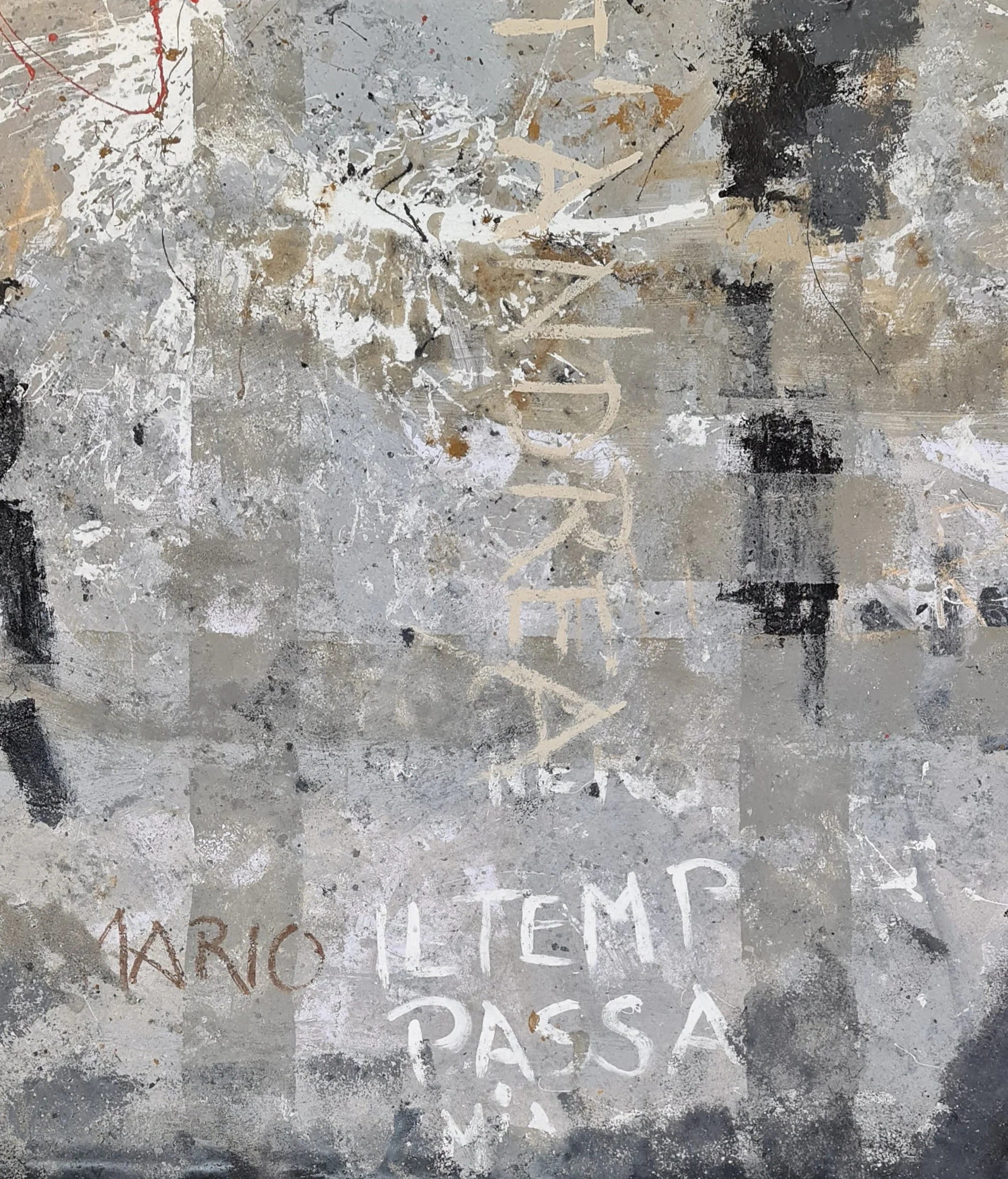
“Over the years I have been influenced by artists from very different disciplines and periods, and I think that says something about how I understand learning: not as a single allegiance, but as an accumulation of layers — much like the textures I work with in my own pieces. In painting, certain names have been fundamental. From my more figurative period, Sorolla marked me deeply: that loose, luminous brushstroke that draws directly from Velázquez taught me that gestural freedom and technical rigour are not contradictory. As I moved towards abstraction, other references came to the fore: Antoni Tàpies, with his material work and his ability to turn surface into memory; Cy Twombly, with that gestural writing that hovers between sign and trace; Franz Kline, whose energy and force of stroke I still find compelling; and Mark Rothko, whose capacity to generate atmospheres of extraordinary emotional depth through fields of colour strikes me as simply remarkable. Basquiat, with all his urgency and symbolic density, has also left something in me. Outside painting, cinema has been another constant source of influence. Fritz Lang, for instance, interests me not only as a storyteller but as a builder of visual atmospheres: that tension between light and shadow, between what is shown and what is concealed, resonates deeply in the way I think about pictorial space. If asked who my favourite artist is, I wouldn't be able to answer — and I think that is the most honest thing I can say. Each artist gives you something different, and often without you realising it in the moment: a figurative reference from the early twentieth century might suddenly surface in a completely abstract work. Influences operate in layers, just like paint.”
What is your creative process like?
“My creative process is, above all, cumulative. Each new work draws from everything that comes before it: experiences, readings, conversations, previous works. In that sense, a piece I'm working on today probably began to take shape years ago, without me fully realizing it. The phase that demands the most time and energy is the concept stage. I mull over an idea, let it rest, revisit it, and question it. If there isn't a solid concept behind it, everything else loses its meaning. It's like shooting a film without a script: the technique can be impeccable, but the work will be empty. In parallel with this conceptual maturation, I dedicate a lot of time to researching materials. I'm not interested in materials as decorative resources, but as expressive vehicles: I need to find the material that best embodies what I want to say, that survives the test of time and reflects it. This research can be lengthy, and sometimes it's the research itself that ultimately defines or enriches the concept. When all of that is ready, I get to work. And that's where I need space and freedom of movement. I like to paint in wide-open spaces, without constraints. I work interchangeably vertically or with the piece flat on the floor, depending on what the work demands at any given moment. This physical freedom is also expressive freedom: the body becomes part of the work, and that's noticeable. The result is a work that, although it may appear spontaneous on the surface, carries within it a long history of thought, of sedimentation, and of searching. That's what I want the viewer to intuit, even if they don't see it.”
What is an artist’s role in society and how do you see that evolving?
“An artist is, first and foremost, just another person inhabiting the world. I think it is important not to mythologise the figure of the artist: art doesn't need a pedestal to have value, and the artist is not a separate kind of being. That said, I believe that in the moment we are living — defined by a speed that barely gives us room to breathe — art can fulfil a particularly necessary role: that of inviting us to stop. To educate our gaze. To see what habit and hurry have made invisible to us. One of the things that defines us as human beings is our capacity to think, to reflect, to question ourselves. But that is only possible if we give ourselves time to do so, and art can be that trigger: a space for thought, for pause, for conversation. In that sense, art strikes me as a universal language of extraordinary power. It is something I experience every time I work with artists from very different backgrounds and cultures: almost immediately we find a common language that allows us to speak about the most important things in life, without the need for translation. Throughout history, art has always been a reflection of society. Today, however, I believe its most valuable role would be to go one step further: not merely to reflect what we are, but to help us become better. To be an instrument for reflection, for conscious slowness, for the humanity we sometimes lose in the noise.”
Have you had any noteworthy exhibitions you'd like to share?
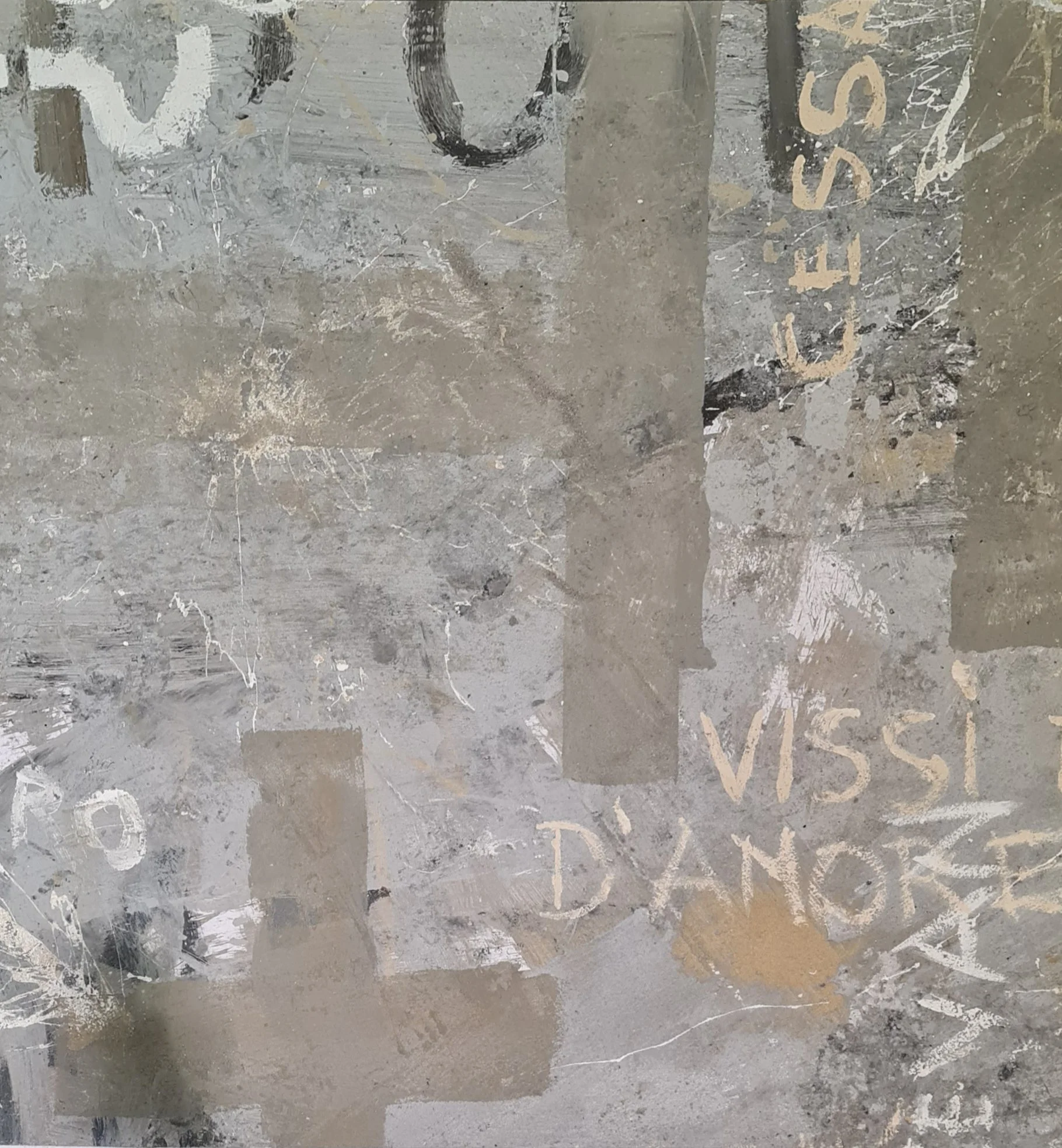
“In recent years, I have combined showing work in galleries and art fairs with artistic projects of a scenographic and museographic nature — which for me are also, in their essence, forms of exhibition: proposals conceived for a specific space, for an audience, and designed to generate an experience. On the more conventional side, I have taken part in the Salón de Otoño at Mombo Art Gallery (2021), the Artist 360º fair (2022 and 2025), SwissArt Expo (2024), a group exhibition at Occo Art Gallery (2025), and Discovery Art Fair Frankfurt (2025). Of all of them, perhaps the most rewarding was Frankfurt, where I presented a project born from my scenographic intervention for the opera Tosca. Each fragment of the original canvas — that 120 m² floor over which the singers performed — was exhibited as an autonomous work, but with a QR code embedded as an integral part of the piece itself. When scanned, it gave the viewer access to a video of the performance: they could locate their exact fragment within the original whole, watch the singers moving across it, and hear the music that was playing at that precise moment. The painted work and the theatrical work merged into a single experience. That concept — painting as living memory of the performing arts — resonated deeply with audiences at the fair.”
Instagram: @carlosbernar_art