Interview
Amanda van Gils
Amanda van Gils is an Australian contemporary artist whose career spans more than 25 years of sustained studio practice. Originally from Melbourne and now based in Brisbane, she has exhibited in more than 125 exhibitions across Australia and internationally. Her work has been exhibited in Berlin and New York as well and is held in public and private collections in Australia and overseas, including Monash University, Greenslopes Private Hospital and Gold Coast University Hospital. Working primarily in layered watercolour on linen incorporating landscape and text, her paintings reflect on perception, belief and the ways experience shapes identity. Amanda holds a Bachelor of Fine Arts from Monash University and a Postgraduate Diploma from the Victorian College of the Arts. Alongside her studio practice she is the founder of The Artists Business Lounge, a platform supporting visual artists in professional practice.
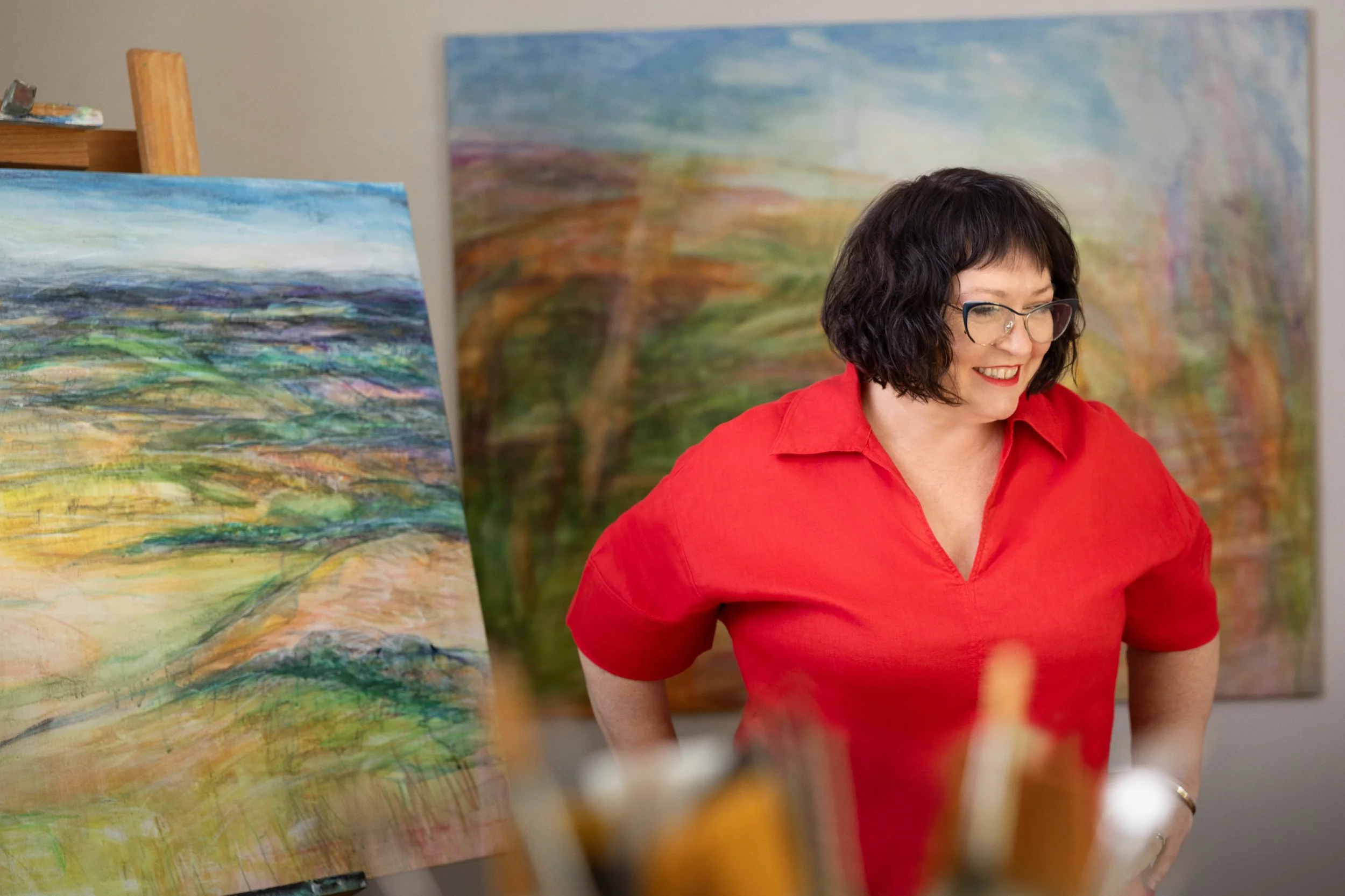
Artist - photography Lisa Ray
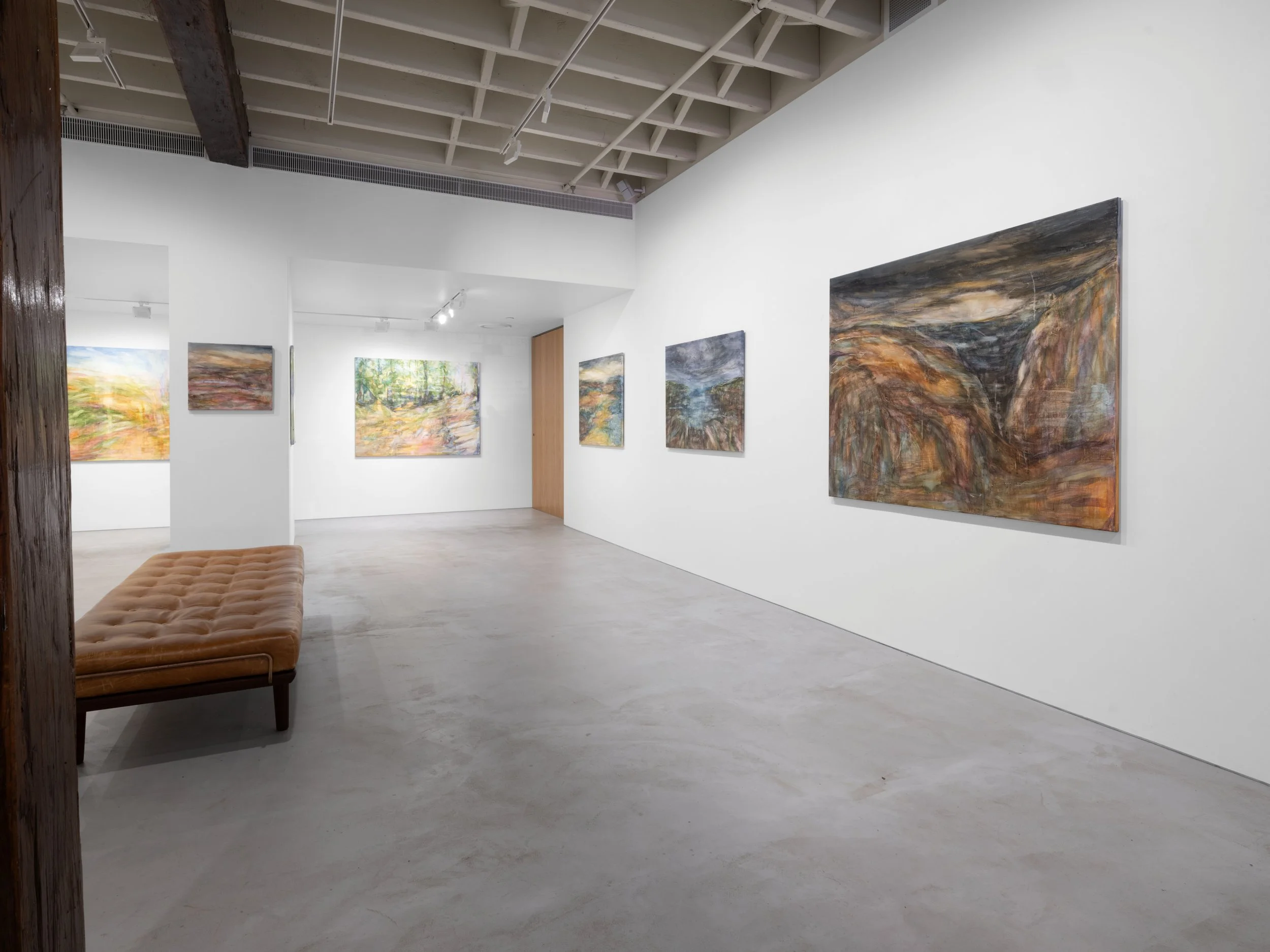
Paintings and installation photos Carl Warner.
What is your background and how did you start your journey in the art world?
“My path into art began quite unexpectedly. As a teenager, I went to a university open day with an older friend who wanted to study ceramics, wandered off on my own, and found myself in a painting room. It was one of those moments of complete clarity - an epiphany. Until then, becoming an artist had never consciously occurred to me, but in that instant, I knew this was my path. I went on to study fine art at Monash University and later at the Victorian College of the Arts (both in Melbourne, Australia). Those years gave me the foundations of a studio practice, though, like many artists, I think the real learning comes by continuing to make work, exhibiting, and sustaining a practice over time. I’ve been exhibiting since 2000, and over that time, my work has been included in more than 120 exhibitions, including numerous solo and touring exhibitions.”

What inspires you?
“I’m inspired by the human mind and by the ways people experience the world through their beliefs, memories, and lived experience. As a trained coach and as someone who has had to work through doubts and questions of my own, I find the inner workings of thought deeply compelling. I’m interested in how beliefs form, how they shape perception, and how experience accumulates to influence what we take to be true. That is where many of the ideas in the work begin. At the same time, I’m equally inspired by materials. Paint is never just a vehicle for an idea. The way watercolour moves, stains, layers, obscures, or reveals is central to the work. I’m interested in what happens when concept and material meet, and in the way those interactions can generate something I could not have fully anticipated at the start. Looking back now, I can see that ideas I was working with in 1999 and 2000 — landscape, fragments of language, and the presence of story within a place — have resurfaced in the paintings I’m making today.”
What themes do you pursue? Is there an underlying message in your work?
“The paintings revolve around perception, belief, and the ways people construct meaning from their experiences. Over time our thoughts, memories, and beliefs accumulate and form the ground from which we interpret the world. I’m interested in how those internal narratives shape what we believe to be true. This idea appears visually through layering. Colour, gesture, and fragments of text build across the surface of the painting, sometimes revealing something clearly and at other times obscuring it. Rather than presenting a single message, the work leaves room for interpretation. The fragments of writing are intentionally partial, allowing viewers to bring their own associations and meanings to the paintings.”
How would you describe your work?
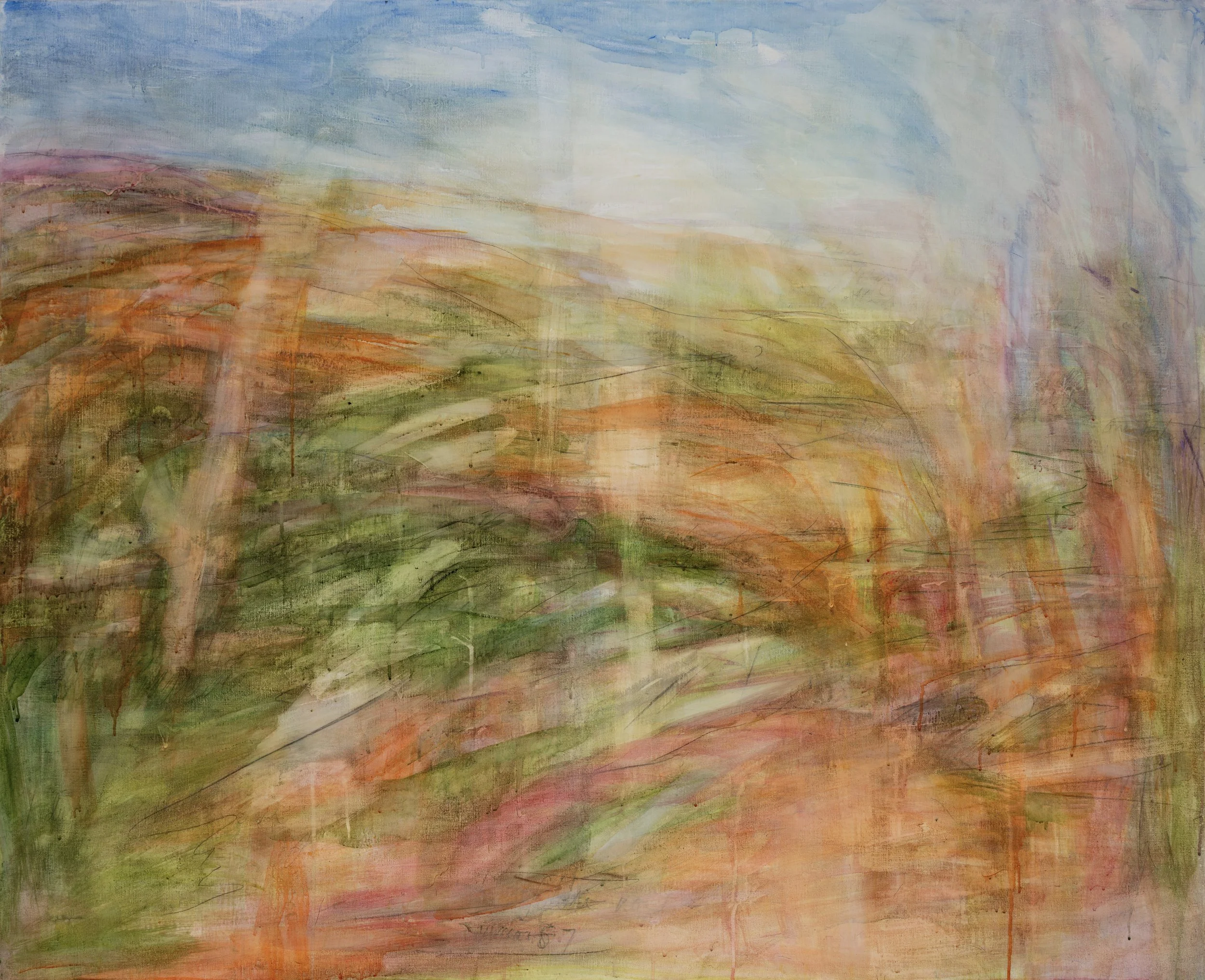
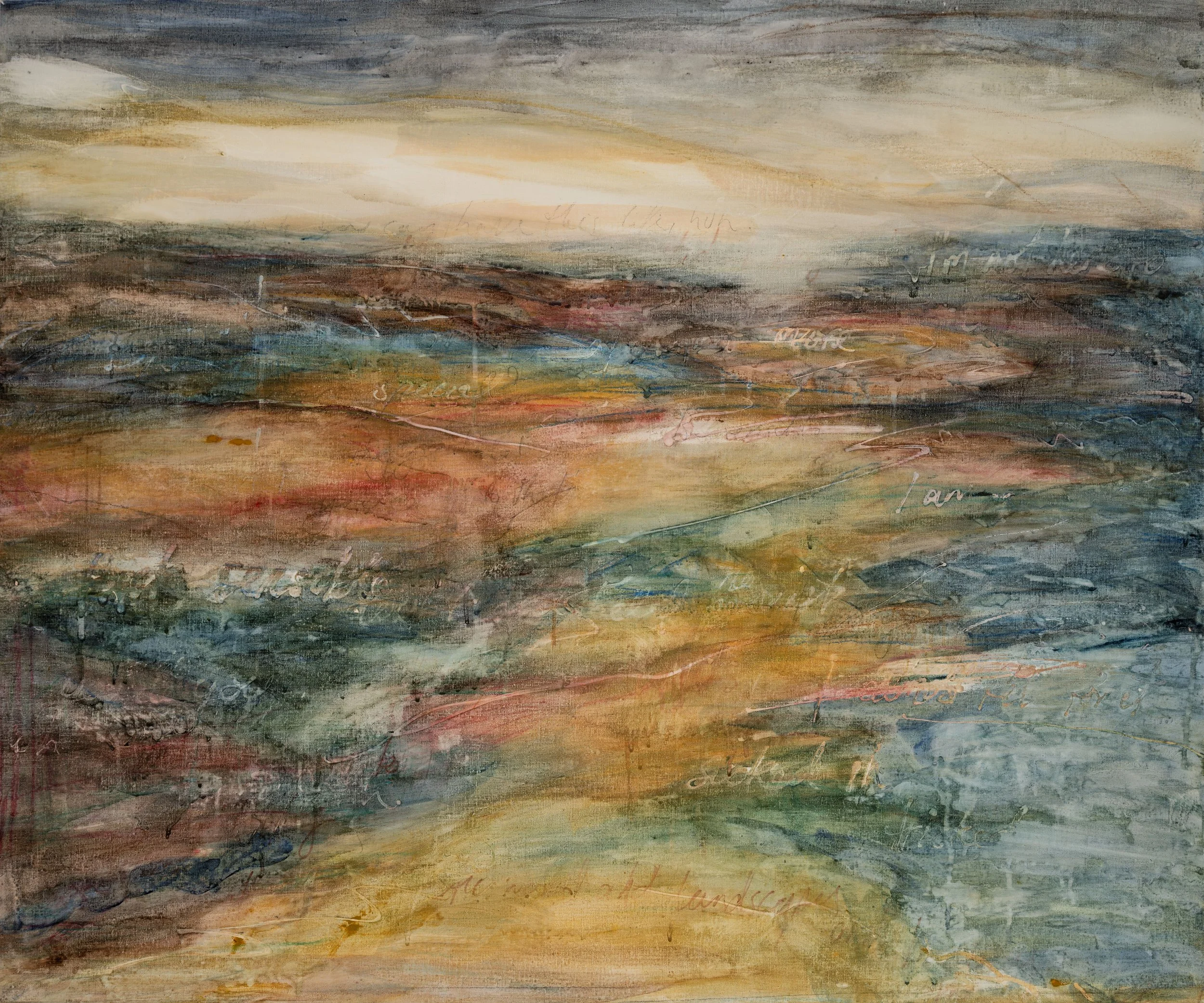
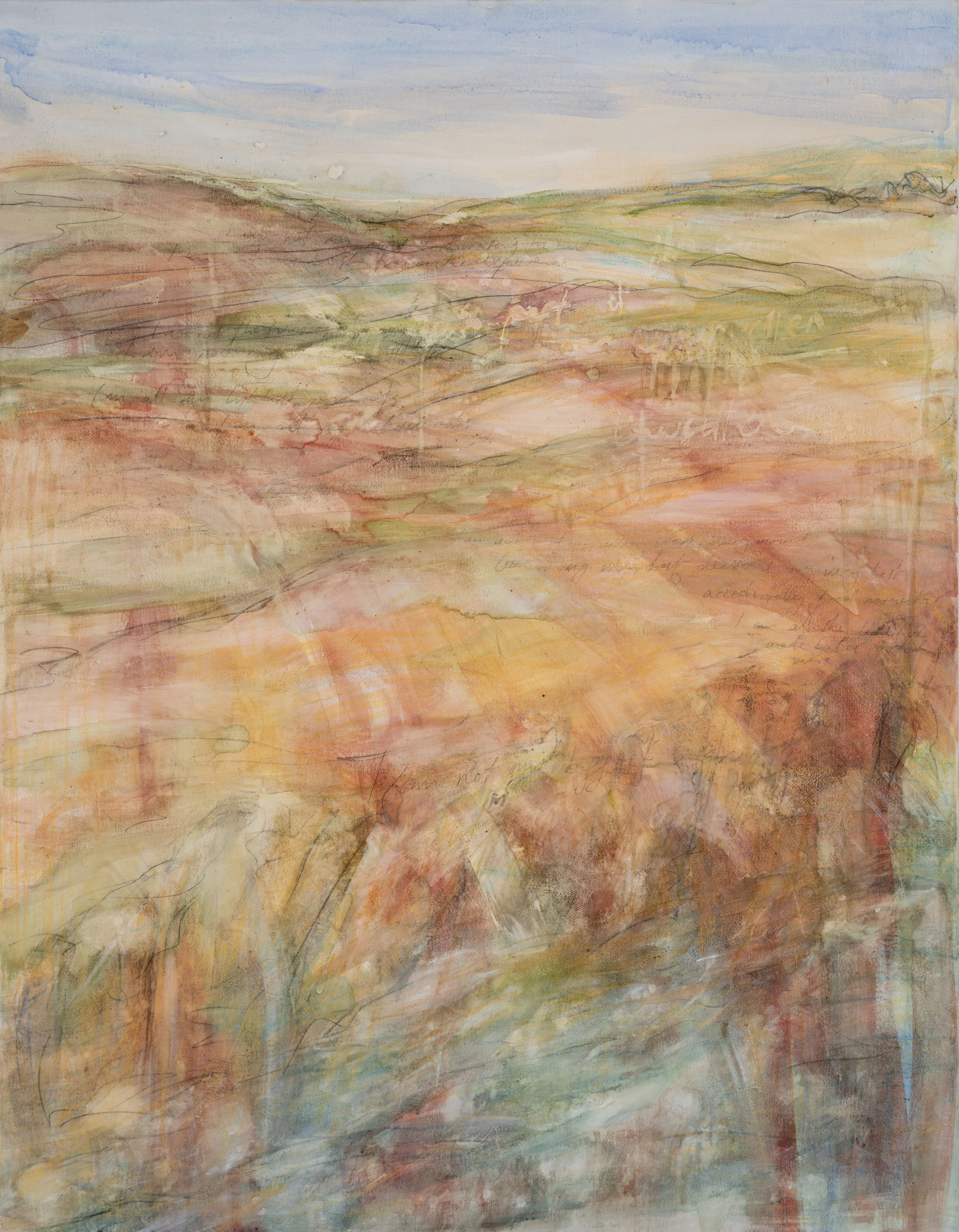
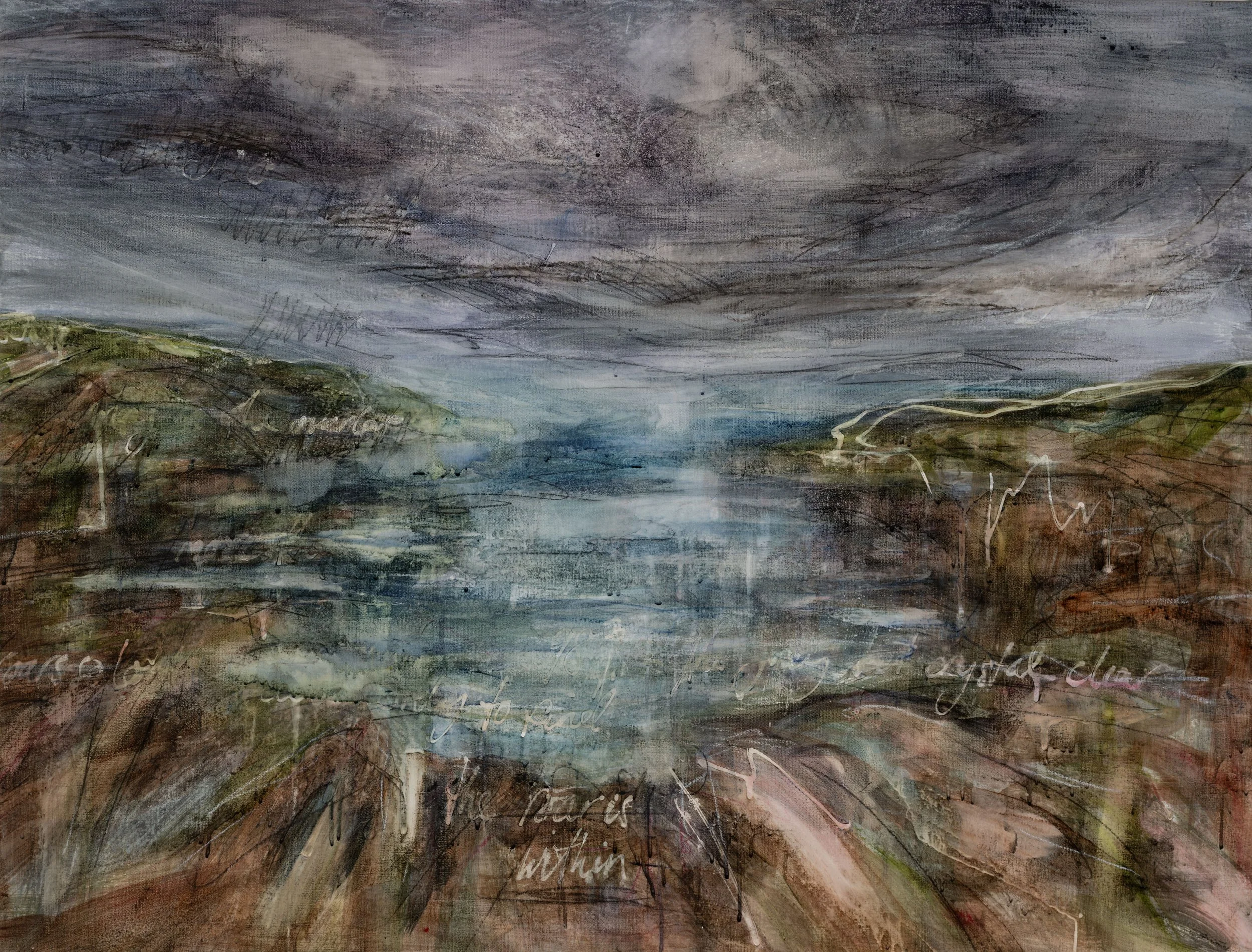
“I’d describe my current work as layered watercolour paintings on linen that incorporate landscape and text. Moody, contemplative, experiential, somewhat romantic. The paintings sit somewhere between abstraction and landscape. Elements of terrain or horizon may emerge, but they remain fluid rather than fixed descriptions of a particular place. Fragments of handwritten text move through these landscapes, sometimes visible and sometimes almost disappearing within the layers of paint. The writing is always my own, usually beginning as a phrase or fragment that develops alongside the painting itself. While the conceptual ideas are important, the work is strongly driven by materials and mood. I’ve been referred to as a ‘painter’s painter’ by other artists and gallerists, which I think reflects the emphasis on the physical qualities of paint — transparency, layering, luminosity, and movement — within the work.”
Which artists influence you most?
“More broadly, I’m drawn to artists whose artworks operate on several levels at once — visually, emotionally, and conceptually. Cindy Sherman and Gerhard Richter have long been favourites, particularly for the way their work challenges perception and the reliability of images. Jon Cattapan is an artist whose practice has inspired me for much of my career. His ability to hold multiple spatial and conceptual layers within a painting continues to resonate with me. More recently, I’ve been enjoying the work of Salman Toor, Australian painter Ben Crawford, and New Zealand artist Jennie De Groot. Each of them approaches painting in a way that allows atmosphere and ambiguity to remain present in the work. I could name many more.”
What is your creative process like?
“My process develops through layers and through working on multiple paintings at once. I rarely complete a single painting from start to finish before beginning another. Instead, I work across several works at the same time, allowing them to evolve together as a body of work. A painting often begins with a loose structure of colour and movement, allowing washes of watercolour to establish the atmosphere. From there, layers gradually build and fragments of text begin to enter the work. The process involves continual adjustment. Paint is added, partially removed, and layered again until the painting begins to settle into balance. I use watercolour paint, pencils and sticks, masking fluid, a special absorbent ground to ensure the watercolours adhere to the linen, as well as graphite pencil, and, of course, a rag and water. I never know exactly what a work will look like when I start. The painting tells me when it is finished. There is a moment when the work reaches a certain pictorial rightness, when it has achieved what it needed to achieve visually.”
What is an artist’s role in society and how do you see that evolving?
“Artists use visual language to bring something elemental to an idea and help people see things differently. Art can reflect the world back to us not only as it is, but through alternative perspectives and possibilities. Sometimes, this happens through direct responses to social or political issues, and other times through quieter reflections on how we experience the world. Art matters because the urge to make it persists across cultures, histories, and individual lives. That tells us it answers something fundamental in human experience. What visual art does particularly well is let people see, feel, and experience something in ways that words alone often cannot. An artwork can hold ambiguity, emotion, and layered meaning all at once, creating a space where an idea is not simply explained, but encountered. The most meaningful artworks create a subtle shift in perception. They leave you seeing something slightly differently than you did before.”

Have you had any noteworthy exhibitions you'd like to share?
“Several exhibitions stand out across my career. One important project was the touring exhibition The In-Between Places, which travelled through four regional galleries in Queensland before its final presentation at a commercial gallery in Sydney. That body of work explored landscape through the experience of movement and travel, capturing the blurred and fleeting nature of perception and the beauty to be found in relatively ordinary roadside landscapes. Another significant project was Net Work: The TLF Exhibition at the Art Gallery of Ballarat. I curated the exhibition as an extension of an online professional artist forum I had founded, bringing together 38 contemporary artists from across Australia and presenting more than 100 works in the exhibition. My most recent exhibition, The Shape of What’s True, presented a new body of layered watercolour and text paintings. For much of my career, I worked primarily as an oil painter, building luminous surfaces through multiple layers of paint. Moving into watercolour on linen at scale allowed me to explore how that same layering sensibility might translate through a very different medium.”
Website: amandavangils.com.au
Instagram: @amandavangils
Other links: www.facebook.com/AmandavanGilsArtist