Interview
Tatiana Frolenko
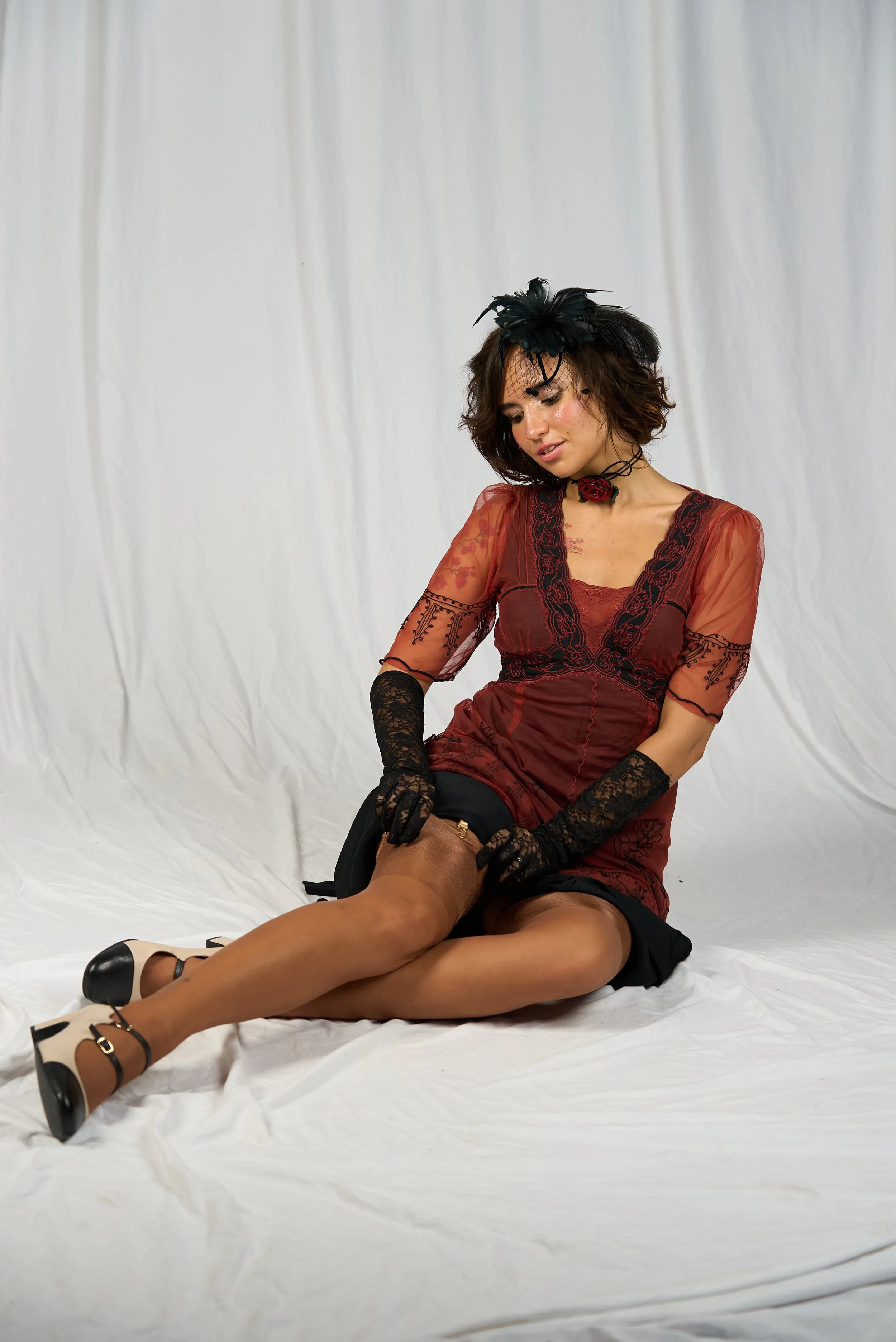
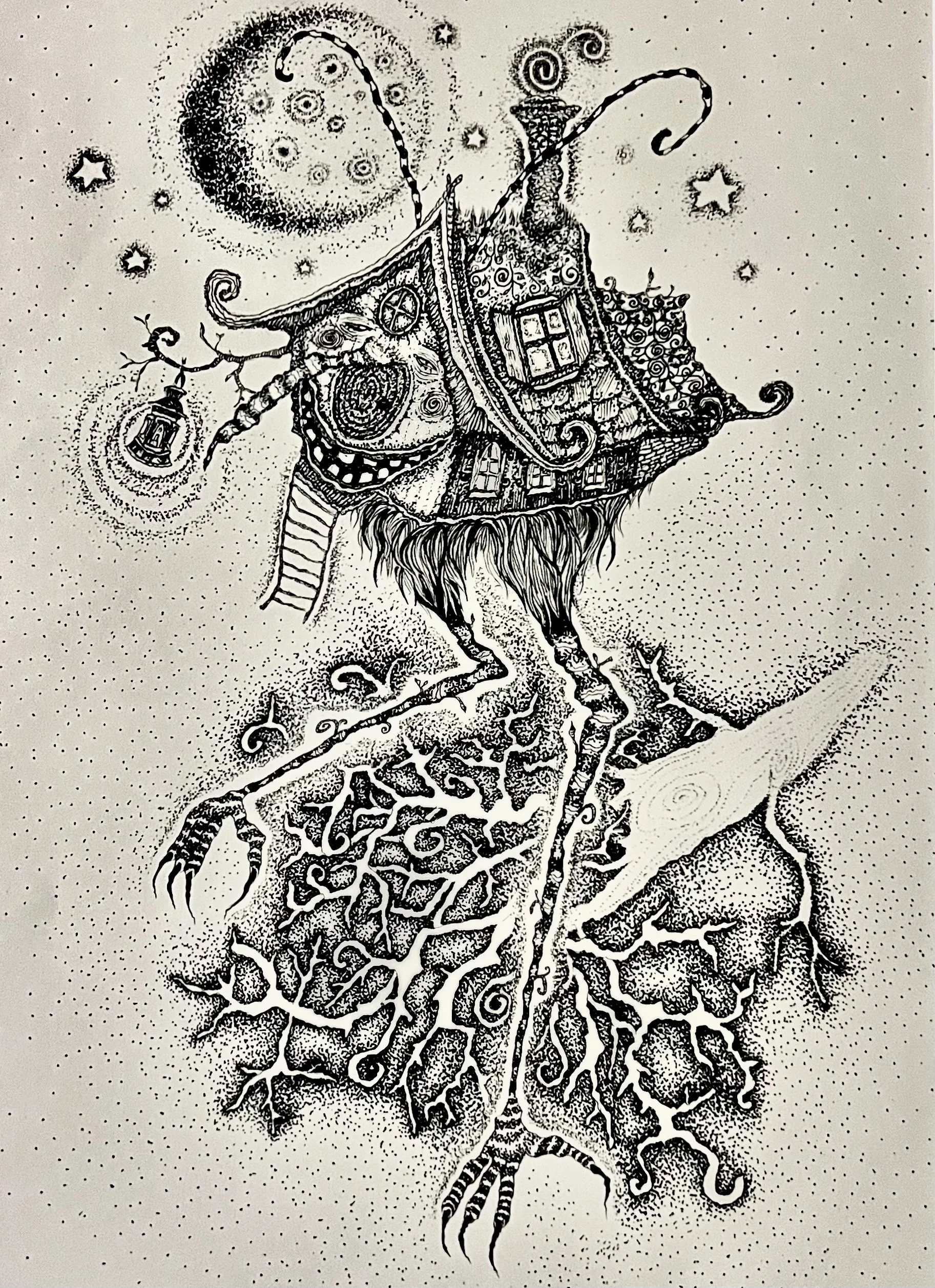
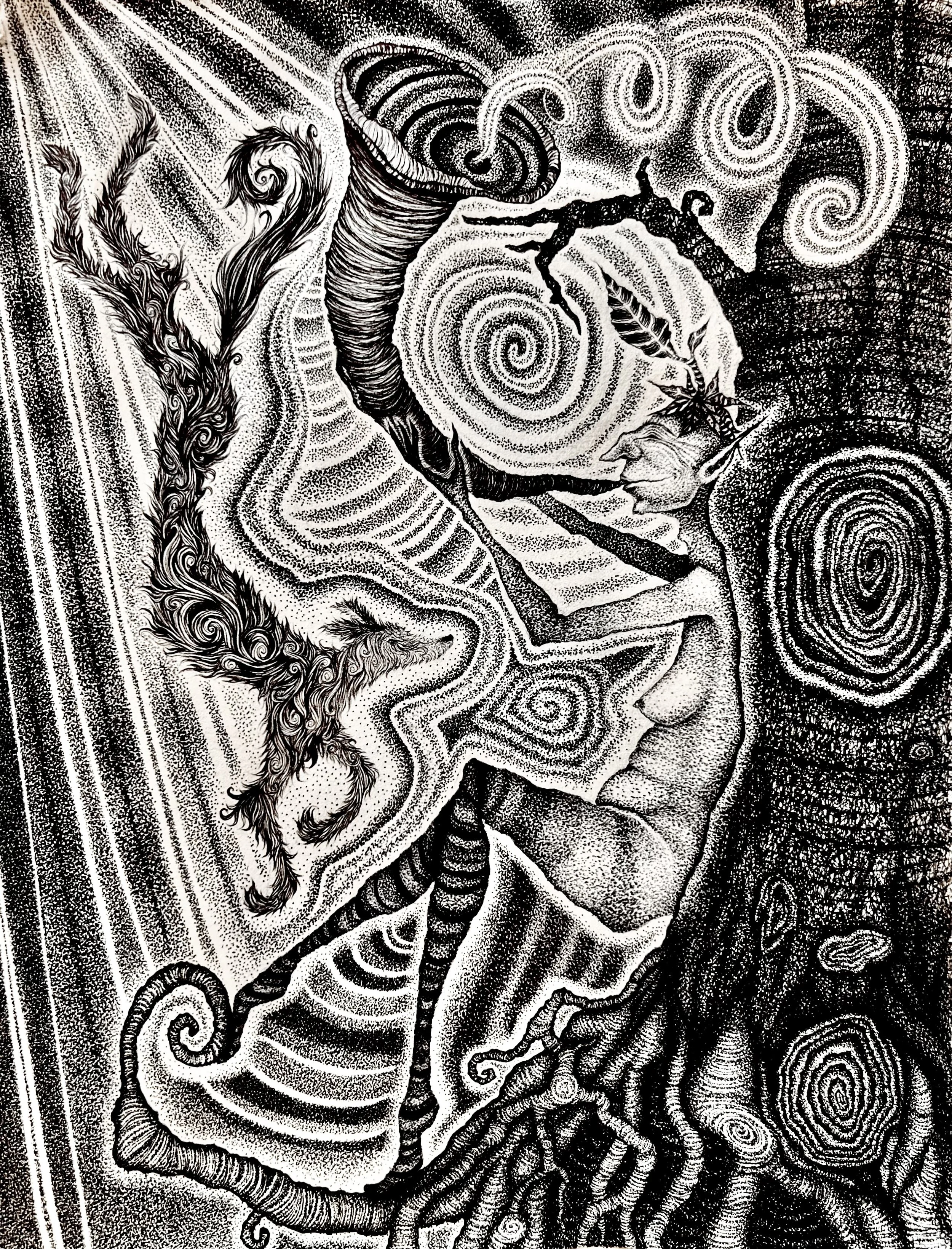
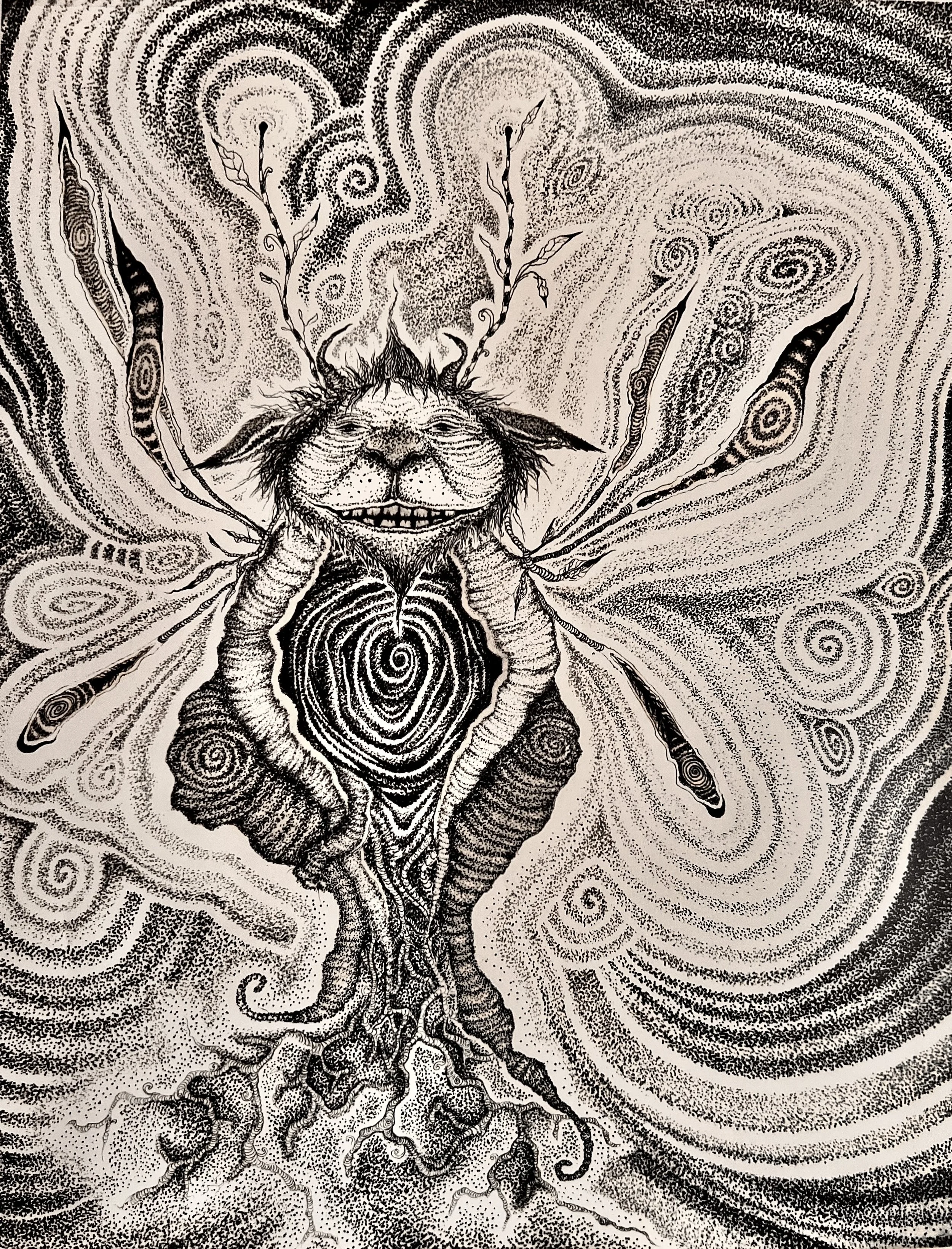
Tatiana is no artist creating works, rather the art itself might be creating her, and through that, revealing the absence of herself. Her practice lives and breathes through the ever-changing metamorphosis of our existence. It operates through repetition, layering, and mutation. Marks accumulate until they lose hierarchy. Lines return without memory of their beginning. Swirls re-emerge as residual motion rather than gesture. Each surface becomes a temporal sediment where presence is recorded as change, not as identity. Composition drifts toward states where figure and ground exchange roles, and perception can no longer fix a stable center. The work refuses resolution; it sustains duration. The viewer does not stand outside this process. Perception becomes another layer of the work, completing, disrupting, or extending its structures. Meaning is not delivered but co-formed in time, as attention moves and reorganizes what is seen. Fairytale, memory, and abstraction share the same topology: they are systems that persist through transformation. In this sense, the work is a continuation of what is always already unfolding - matter reorganizing itself through repetition and difference. Transformation is the constant. The self is not erased, but released making space for presence, acceptance, and the freedom to simply be.
What is your background and how did you start your journey in the art world?
“My journey in art began long before I had language for it. Creating has always felt less like a decision and more like a condition of being. Art was never simply a hobby or an interest to me. It was a way to survive the intensity of existence, to translate what I could not peacefully hold inside myself into something visible, physical, and alive. I was born in Russia, raised in Spain, and later moved to the United States, so my life has been shaped by movement, displacement, reinvention, and different systems of meaning. Because of that, I never developed a very stable relationship to identity as something fixed. My understanding of self has always been shifting, layered, and uncertain. That naturally became the foundation of my work. Over time, I studied and practiced through different forms, including drawing, painting, ceramics, and tattooing, but beneath all of those mediums was the same need: to give form to metamorphosis. My work grew out of sensitivity, doubt, longing, contradiction, and the feeling that reality is far too immense and unstable to ever be reduced into one clean truth. Art became the place where I could stop forcing clarity and instead let everything exist.”
What inspires you?
“I am inspired by existence itself in its unbearable fullness. I am inspired by the fact that everything is happening at once: molecules, organisms, memory, shame, beauty, spirituality, decay, desire, science, suffering, love, illusion, tenderness, time, death, divinity, and contradiction. The world feels too layered to be explained, and that is what draws me to create. I am also deeply inspired by the instability of reality. I do not experience the world as something fixed or separate. I experience it as something constantly dissolving into itself, something where boundaries are unreliable and meaning is always moving. That inspires the way I build my worlds visually: through accumulation, repetition, swirls, dense surfaces, and forms that emerge as if they are still becoming. Emotion inspires me too, especially the emotions people are taught to hide or purify. Shame, longing, sensuality, fear, devotion, guilt, insecurity, adoration, emotional contradiction. I am interested in the parts of being human that do not fit neatly into purity, certainty, or control. Literature and artists who enter unstable inner worlds also resonate with me. Kafka is important to me because of the way he reveals estrangement, transformation, and the terrifying instability beneath ordinary reality. I also connect to artists and thinkers whose work carries dream logic, symbolic density, psychological intensity, and the collapse between beauty and disturbance.”
What themes do you pursue? Is there an underlying message in your work?
“The central theme in my work is metamorphosis, but not in a simple sense of growth or improvement. I mean metamorphosis as a condition of existence itself. Constant mutation. Internal mutation. The endless becoming and unbecoming inside a person, inside matter, inside reality, inside meaning. I pursue themes of unstable identity, illusion, emotional totality, sensuality, shame, love, suffering, longing, and the collapse of opposites. I am deeply interested in the possibility that joy and suffering are not truly separate, that beauty and discomfort may belong to the same substance, that perfection may have less to do with flawlessness and more to do with wholeness. Another essential truth within my work is the understanding that everything is one. Not metaphorically, but fundamentally. Every person, every creature, every form, every emotion, every fragment of existence is part of the same whole. There is no real separation, only the illusion of it. What we experience as ‘self’ and ‘other’ are simply different expressions of the same continuous existence.
A major underlying message in my work is that everything belongs. Not in a passive or decorative sense, but in a radical sense. The beautiful, the grotesque, the loving, the afraid, the desiring, the childish, the guilty, the pure, the impure, the spiritually elevated, the animal, the fractured, the uncertain. My universe does not exile these things. It allows them to exist together. Because of this, my work is not only about me. It is not a closed personal narrative. It is an extension of the same existence that forms everything and everyone. The work is me, but it is also you. It is the viewer. It is every living and non-living thing at once. When someone enters my world, they are not observing something separate from themselves — they are encountering another form of what they already are. I do not create work to deliver one final truth. I do not believe there is one. My work resists fixed conclusions. Instead, it invites people into a state where they can encounter themselves without immediate judgment. A place where they might feel acceptance toward the parts of themselves they were taught to suppress. A place where meaning can arise, disappear, and arise again.”
How would you describe your work?
“I would describe my work as deeply layered, immersive, sensual, psychological, and in a constant state of becoming. It moves between fairytale, dream, emotional landscape, and philosophical inquiry. It is intricate and dense, but also intimate. Wild, but quiet in its own way. Visually, I often build through tiny marks, pointillism, varied brushstrokes, swirls, and accumulated textures. That method is not only aesthetic to me. It reflects how I understand existence: nothing arrives all at once. Everything is formed through endless layering, endless motion, endless transformation. Dot by dot. Layer by layer. My worlds often feel alive, but not in a conventional sense. They breathe, fold, dissolve, expand, disappear, and re-emerge. Space and body are not clearly separate. Background and figure bleed into one another. Emotional states become creatures, structures, atmospheres. What appears external is often internal, and what appears fantastical is often the most honest thing. Because everything is one, there is no clear boundary between myself, the work, and the viewer. The piece is not something that exists independently from the person experiencing it. It continues to transform through them. It reflects them, absorbs them, and becomes something new through their perception. At the center of it all is permission. My work creates a world where intensity is allowed, where contradiction is allowed, where innocence and darkness coexist, where the inner child remains present, and where the self is not forced into one stable shape.”
Which artists influence you most?
“I am drawn to artists, writers, and makers who create entire realities rather than simply images. I love work that feels like entering a psyche, a fever dream, a metaphysical space, or a moral instability rather than viewing a resolved statement from the outside. Kafka is deeply important to me because of his relationship to transformation, uncertainty, estrangement, and the unstable architecture of existence. His world does not offer comfort through clarity, and I feel connected to that. There is something profoundly true in the way he exposes the surreal inside what appears ordinary. Tim Burton is also meaningful to me, especially in the way he allows tenderness, melancholy, misfit-ness, theatricality, and darkness to exist in the same world. But my connection is less about surface style and more about emotional permission: the right for the strange, the fragile, and the haunted to remain visible. Historically, I feel resonance with figures like Hieronymus Bosch for his symbolic density and surreal moral ecosystems, Francisco Goya for the way darkness, fear, and human truth can become image, Egon Schiele for psychological exposure and raw interiority, and Gustav Klimt for ornamental immersion and the fusion of sensuality, symbolism, and surface. I also feel close to artists and movements that honor dream states, myth, inner fragmentation, and the subconscious. More than influence in a direct stylistic sense, I am influenced by those who understand that art can hold contradiction without resolving it.”
What is your creative process like?
“My creative process is both intuitive and obsessive. I usually begin from a feeling, a psychological atmosphere, a contradiction, or an inner state that I cannot fully explain. I do not always begin with certainty. In fact, uncertainty is often the most honest starting point for me. As I work, the piece reveals itself through accumulation. Repetition is very important to me. Dot by dot, mark by mark, layer by layer, the work slowly forms its own internal logic. This process feels meditative, but also existential. I am not simply constructing an image. I am staying with a transformation long enough for it to become visible. I often feel that I am changing while the piece is changing. The work carries the exact life I am living in that moment. Every detail contains the state of being I was inside while making it. Because of that, the piece does not feel separate from me. It becomes an extension of my interior movement. And because I see existence as one continuous whole, that extension does not stop at me. The work becomes part of the same shared existence as everything else. It continues through the viewer, through their perception, through their emotional response. It is not owned. It is participated in. Poetry is also part of my process, whether directly or indirectly. My writing and visual work come from the same source. Both are ways of allowing emotion, contradiction, longing, fear, sensuality, and philosophical uncertainty to take form. I do not want to overcontrol that process. I want to let it breathe enough to become something alive.”
What is an artist’s role in society and how do you see that evolving?
“I think an artist’s role is to make space for what society tries to flatten, censor, simplify, or exile. Art can hold ambiguity where culture demands certainty. It can hold contradiction where people want clean categories. It can return depth to a world that is constantly trying to speed past it. For me, the artist is not simply a decorator, commentator, or entertainer. The artist is someone who enters the instability of being and brings something back from it. Not necessarily an answer, but a world, a feeling, a confrontation, a permission. Art gives people a place to experience themselves differently. Part of that role, for me, is also to remind people — not through explanation, but through experience — that they are not separate. That what they feel, what they fear, what they hide, what they long for, is not isolated within them. It is part of a shared existence. A shared substance. I think this role becomes even more important as the world becomes more performative, more polished, more algorithmic, and more afraid of complexity. There is increasing pressure to brand the self, simplify emotion, and present a coherent identity at all times. Art can resist that. It can remind us that we are not singular, not fixed, not pure, not finished. I think the role of the artist is evolving toward something that is both more vulnerable and more necessary: to protect depth, to protect strangeness, to protect the interior life, and to remind people that being human is not the same as being easily explained — and not something that exists separately from everything else.”
Have you had any noteworthy exhibitions you'd like to share?
“What feels most noteworthy to me at this point is not only exhibition in the formal sense, but the gradual formation of an entire universe across my works. I see my practice as an evolving body rather than isolated pieces. Each drawing, painting, poem, and image is part of a larger metamorphosis. My path has also been shaped by tattooing, which I consider deeply meaningful. Tattooing has allowed me to create intimate, lasting work directly on the body. That experience has sharpened my sensitivity to image, ritual, permanence, vulnerability, and emotional presence. It has been an important part of how I developed as an artist. As I continue building my body of work, I am especially interested in exhibiting in ways that preserve immersion and psychological atmosphere. I want the viewer to feel that they are entering a living world, not just viewing separate objects on a wall. The most meaningful future exhibitions for me will be the ones that allow the work to function as an environment of transformation, where the viewer can feel both overwhelmed and accepted inside it.”
Website: tatianafrolenko.com
Instagram: @tatiana.frolenko.creations