Interview
Jason Brian Fox
The imaginative shapes and vivid colors that define Jason Brian Fox’s paintings are the result of a lifetime spent taking refuge in art. His work has been exhibited up and down the East Coast and attracted attention from collectors and aficionados around the world. If there is a unifying theme in his work, that theme is healing; using art to take shelter from the traumas of the modern world. Jason was born in New Brunswick, New Jersey in December 1973. He spent most of his youth in Edison, NJ, where he showed a keen interest in the arts as a high school student. After graduating, he enlisted in the United States Air Force.
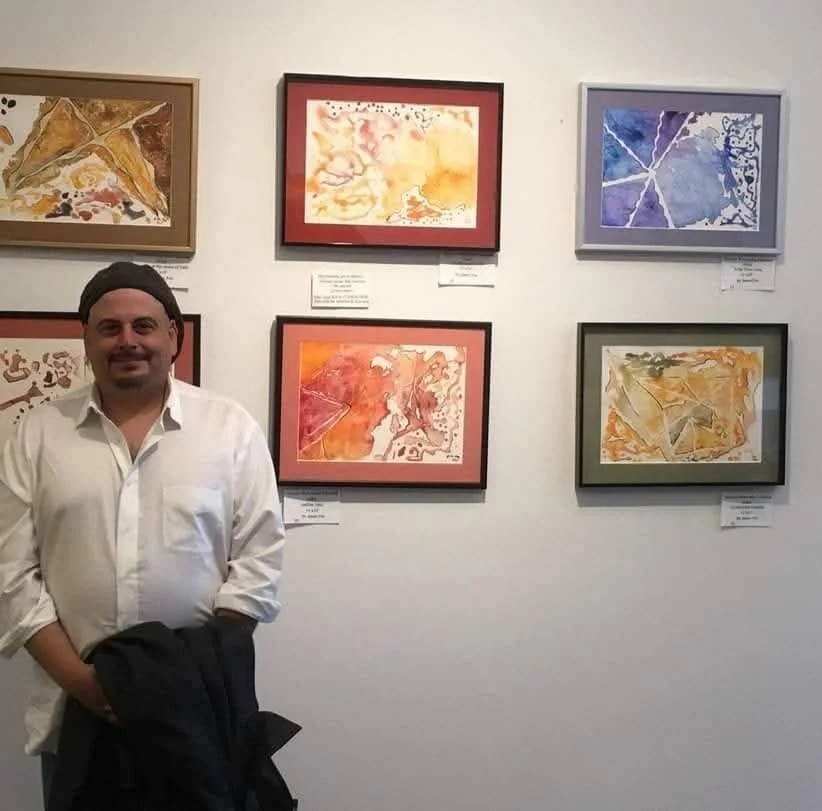
He was deployed to Saudi Arabia during Operation Desert Storm and was decorated for his service. However, he would face many of the challenges that many veterans have when returning home from war. Art would prove to be a pivotal part of Jason’s return to normalcy. Seeking an outlet for his emotions, he enrolled at the Art Students League in New York City. He dabbled in several mediums before deciding to focus on watercolor and acrylic painting and before long, he began to develop the abstract style that he is known for today. Many of his paintings are named after the songs he listened to during their composition. And just like a great song, his paintings bring disparate elements together to create something unique, harmonious, and moving. Because of the unusual life he has led, Jason is a man with many stories to tell. His paintings express the subconscious part of those stories, the part that cannot be explained in words. Evocative and thought-provoking, these images represent an individual coming to terms with his own existence.
What is your background and how did you start your journey in the art world?
“My path into the art world wasn’t linear, and it certainly wasn’t predictable. I grew up with creativity around me—my mother encouraged my artistic instincts early on, and I was drawing and experimenting from a young age—but life took me in a very different direction first. I served in the United States Air Force during Operation Desert Storm, an experience that profoundly shaped how I see the world, motion, and time.
After returning home, like many veterans, I struggled with the transition back into civilian life. Art became less of a hobby and more of a lifeline. It was a way to process experience, memory, and emotion when language fell short. That period marked the real beginning of my artistic journey—not as a career decision, but as a necessity. I later studied at the Art Students League of New York, where I immersed myself in the traditions of drawing, painting, and experimentation. There, I began to understand that what I was searching for wasn’t just technique, but a visual language that could capture movement, impermanence, and emotional energy.
That exploration eventually led me to develop my own philosophy, which I call Motionism—an approach centered on spontaneity, fluidity, and the use of water and motion as active collaborators in the creative process. My professional art career began to take shape much later. I emerged on the New York City art scene in 2019, and from there my work found a broader audience through exhibitions, juried shows, and gallery representation. Looking back, the journey feels less like a straight line and more like a series of accumulated moments—service, struggle, study, experimentation—all converging into a practice that continues to evolve. For me, art has always been about movement: between past and present, chaos and control, stillness and transformation. That tension is where my work lives, and it’s where my journey truly began.”
What does your work aim to say? Does it comment on any current social or political issues?
“My work isn’t meant to deliver a fixed message or a political statement in a literal sense. Instead, it aims to create a space for reflection—on movement, impermanence, and the emotional undercurrents that shape our lives. I’m interested in what happens beneath the surface, where experience is felt rather than explained. That said, the work is inevitably shaped by the world we’re living in. We exist in a time defined by constant motion—information overload, rapid change, environmental uncertainty, and emotional fragmentation. My work responds to that condition by slowing things down, by allowing water, gesture, and chance to play an active role. In that way, it quietly resists rigidity and control, offering an alternative to the hyper-structured pace of modern life.
Rather than addressing specific political events, the work engages with broader human concerns: displacement, resilience, memory, and transformation. These themes are deeply connected to my own experiences, including military service and the process of reintegration, but I leave the interpretation open. I want viewers to bring their own histories, emotions, and questions into the work. If there is a social dimension to my practice, it lies in its insistence on presence—on feeling rather than reacting. In a culture that often demands instant conclusions, my work invites pause, ambiguity, and emotional honesty. For me, that invitation is both personal and quietly radical.”
Do you plan your work in advance, or is it improvisation?
“My process lives somewhere between intention and improvisation. I rarely begin with a fixed image or outcome in mind. Instead, I start with a set of conditions—materials, surface, water, and a general emotional or physical state I want to explore. From there, the work unfolds in real time. Water plays a central role in my process, not as a tool to control, but as an active collaborator. Once movement enters the surface, I respond to what’s happening rather than forcing it in a predetermined direction. There’s a constant dialogue between decision and accident, between what I initiate and what the material gives back. That improvisational quality is essential. It mirrors how experience actually works—unpredictable, layered, and often shaped by forces outside our control. At the same time, the work isn’t random. Years of experimentation, discipline, and repetition inform every gesture, even when the outcome remains unknown. In that sense, each piece becomes a record of motion and response. Planning sets the stage, but improvisation brings the work to life. I’m less interested in mastery over the surface than in staying present long enough to let the work reveal itself.”
Are there any art world trends are you following?
“I pay attention to what’s happening in the art world, but I try not to let trends dictate my work. I think it’s important to stay aware—especially of how artists are responding to technology, environmental concerns, and shifts in how work is shown and experienced—but my practice isn’t driven by what’s currently fashionable. That said, I’m interested in a broader return to materiality and process. There’s a renewed appreciation for work that emphasizes physical presence, tactility, and the evidence of the hand, particularly as digital and AI-generated imagery become more pervasive. I see many artists reasserting the value of direct engagement with materials, and that resonates deeply with my own approach.
I’m also watching how boundaries between abstraction, figuration, and conceptual work continue to blur. Artists seem less interested in fitting neatly into categories and more focused on hybrid practices that reflect the complexity of contemporary experience. That openness feels healthy and necessary. Ultimately, trends come and go, but authenticity endures. I’m less concerned with keeping pace than with staying honest to the evolution of my own work. If my practice connects with the moment, it’s because it’s grounded in lived experience rather than external expectations.”
What process, materials and techniques do you use to create your artwork?
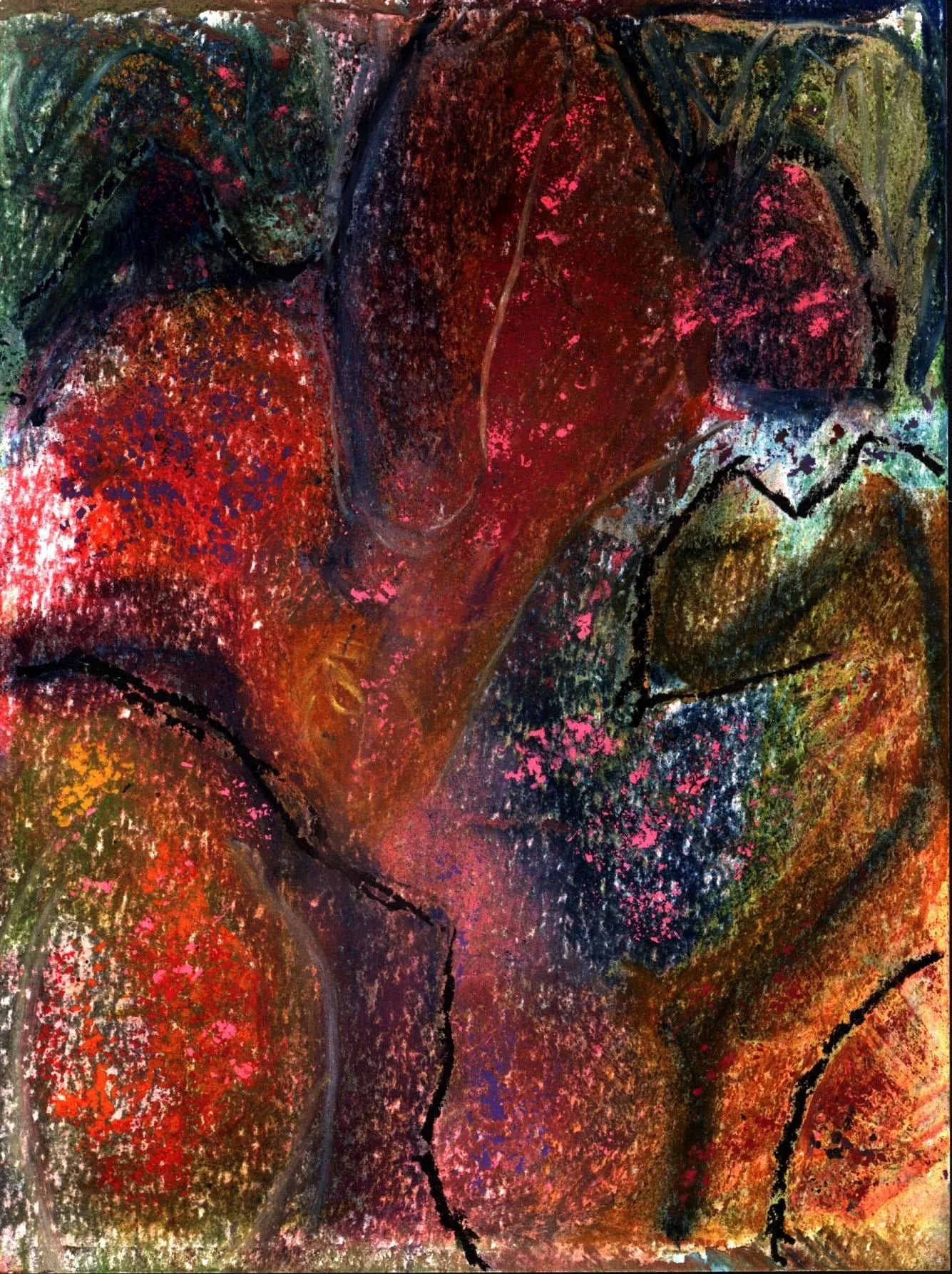
“My process is rooted in physical engagement with materials and an openness to motion and chance. I primarily work with watercolor and acrylic, often combining the two on both paper and canvas. Water is not just a medium in my work—it’s an active force that shapes the outcome, guiding pigment, creating tension, and introducing unpredictability. I begin by preparing the surface and selecting a limited palette, often influenced by mood, environment, or a particular emotional state.
From there, I introduce water and pigment in layers, allowing gravity, absorption, and evaporation to determine how the work evolves. I tilt, rotate, and sometimes physically move the surface, responding intuitively to the way the materials behave in real time. Rather than building images through controlled brushwork alone, I rely on flow, interruption, and accumulation. Some marks are deliberate, others are allowed to emerge through natural movement. I work in stages—engaging, stepping back, then re-entering the piece—until a sense of balance or resolution reveals itself. Technically, the work draws from watercolor’s transparency and acrylic’s density, creating depth through contrast rather than illusion. Conceptually, the process reflects my broader philosophy of Motionism: an emphasis on spontaneity, presence, and the idea that motion itself can become a form of structure. Each finished piece is less a depiction than a record—of time, movement, and the moment in which it was made.”
What does your art mean to you?
“My art is, first and foremost, a form of survival and understanding. It began as a way to process experience when words weren’t enough, and it continues to serve that purpose. Each piece functions like a record of a moment in time—emotional, physical, and psychological—captured through motion and material. On a personal level, the work represents continuity. It’s how I track growth, change, and resilience over the years. There’s no separation between who I am and what I make; the work reflects lived experience, memory, and the quiet work of making sense of both chaos and stillness.
Art also gives me a sense of presence. When I’m working, time slows, distractions fall away, and I’m fully engaged with what’s happening in front of me. That state of focus is rare and essential. It’s where honesty enters the process, and where the work becomes less about control and more about listening. Ultimately, my art is a way of staying connected—to myself, to the natural forces I work with, and to others who encounter the work. If it offers viewers a moment of pause, recognition, or emotional resonance, then it’s doing what it’s meant to do. For me, that connection is the true measure of its meaning.”
What’s your favourite artwork and why?
“I don’t think I have a single favorite artwork in the traditional sense. My relationship with art has always been more about moments than monuments—about how a piece meets you at a particular point in your life. There are works that have stayed with me because of how they handle space, motion, and emotional restraint—especially within abstraction. I’m drawn to pieces that don’t try to explain themselves, but instead ask the viewer to slow down and engage on a sensory level. Those are the works I return to, not for answers, but for presence.
When it comes to my own work, each piece reflects a specific moment in time, and my connection to it changes as I change. Some works resonate because they represent a breakthrough in process, others because they mark a period of struggle or clarity. In that sense, my ‘favorite’ is always shifting. I think that fluidity is important. Art, at its best, isn’t static—it evolves with us. The works that matter most are the ones that continue to reveal something new, long after they’re finished or first encountered.”
Have you had any noteworthy exhibitions you'd like to share?
“One particularly meaningful upcoming exhibition is Visual Voice: Freedom to Create, an international juried exhibition at the Cape Cod Museum of Art, running from January 29 through April 26, 2026. The exhibition celebrates artistic freedom and the courage to communicate through visual language—an ethos that aligns closely with my own practice. The show drew 551 submissions from 318 artists across 34 U.S. states, the District of Columbia, and eleven countries, including Canada, Germany, France, Italy, Spain, Mexico, Malaysia, and Kuwait. From that field, only 74 artworks were selected, making inclusion in the exhibition especially significant. The exhibition is juried by David Henry Perry and includes multiple awards.
Earlier in my career, I emerged on the New York City art scene in 2019 and have since participated in juried exhibitions and group shows throughout New Jersey and New York, including award-winning exhibitions at The Medford Art Center and representation through YES Gallery in Hoboken, New Jersey. These exhibitions have been instrumental in shaping the evolution of my work and expanding its public reach. Together, these experiences reflect a practice that continues to grow through both regional and international exposure, while remaining rooted in experimentation and process.”
Website: www.jasonbrianfoxart.com
Instagram: @jasonbrianfox
Other links: www.facebook.com/Jasonbrianfoxart