Interview
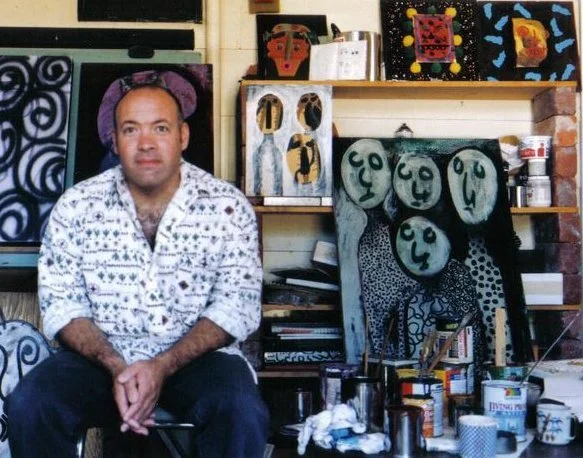
Graeme Tresidder
Graeme was born in Glenhuntly, Victoria. He received his Bachelor of Fine Art Degree with Distinction from the Victoria College. His solo exhibitions include: 2016 - The Landscape And It’s Creatures Elizabeth Arthur Fine Art Hamilton, 2015 - Recent Paintings Waterfalls, Gardens and Dreams, 2011 - The Gardens and Beyond Elizabeth Arthur Fine Art Hamilton and among others. His group exhibitions include: 2018 - Bayside Local Bayside Gallery, 2017 - 30th Anniversary Exhibition Elizabeth Arthur Fine Art Hamilton, 2016 - Christmas Show Elizabeth Arthur Fine Art Hamilton, among others.
What is your background and how did you start your journey in the art world?
“I have enjoyed drawing since childhood and art was always my favourite subject at school. It was only after attending a Sidney Nolan retrospective at the National Gallery of Victoria in 1987 that I considered that being an artist was a possibility. In the exhibition they had a recreation of Nolan's Melbourne studio from the 1940's that included his bed. Seeing it had a great impact me. Several of his paintings on show including Moon Boy, Luna Park and the Ned Kelly suite were also inspiring. On the way home from the gallery, I went to an art supply shop and bought my first two canvas boards and art materials and completed my first painting that night, which was a basic view looking out the open door of my flat. The next year, I completed an art and design course and finished with a portfolio that took me into a 3 year Bachelor of Art degree from which I graduated in 1991, where I was the fortunate recipient of the Roger Kemp Painting Award. While at art school, I met the late Howard Arkley. We became friends and I was his studio assistant for a couple of years, which was an invaluable experience of learning what life as an artist was like.”
What inspires you?
“Long ago, I became aware that I was a visually inspired person with a spiritual outlook. Nature and humanity's relationship with nature have always been an interest. Finding a visual language in my paintings, that reflects that interest while also factoring in popular culture and imagery has taken me a long time. I take great inspiration from modern art history and I am continually leafing through art books. I went from doing pop-oriented work out of art school into about a decade of painting gardens and waterfalls. It was great way to build a working method and an art practice but the work was mostly decorative and I felt it was lacking in depth of meaning. I decided not long after graduating that I was not going to depend on art to make a living and so, I earned income by other means. This decision enabled me to make work that was not compromised by financial considerations. During the Covid 19 lockdowns, I was able to give more time to my painting practice and I began working on imagery that incorporated ancestral and subterranean themes often including a cross section view of the underground. Since then, I have continued this imagery and I believe I can draw from it well into the future.”
What themes do you pursue? Is there an underlying message in your work?
“For several years, the themes I have been exploring have included ancestry, memory, time and humanity's relationship with the earth. It is not easy to put my message or intent into words and ultimately, I take the modernist view that the meaning of a work of art lies with the viewer. If one of my paintings prompts someone to reflect on the idea of a collective consciousness, past lives and/or empathise with the natural world then it was worth the effort.”
How would you describe your work?
“In my paintings, I attempt to utilise simple forms and imagery to suggest unseen energy within the earth - memory, spirits, ancestral layers, ecological elements and how these play into our human existence. My use of colour is instinctive and I often include the mundane in combination with mystical elements in the hope that viewers are prompted to contemplate the unseen forces of nature and the human psyche. I endeavour to put into visual form concepts of our relationship with the environment, our past and our collective future. I try to create paintings that at best, resonate on an emotional level that might invite the viewer to connect with their own subconscious thoughts and feelings and at the very least, give consideration to the connection between humanity and our natural world.”
Which artists influence you most?
“I think the best way to answer this question is to provide a list of artists that I most admire. Some of them are an influence visually and some conceptually, and some both. In no particular order. Paul Gauguin, Philip Guston, Egon Shiele, Arshile Gorky, Vincent Van Gogh, Jackson Pollock, Frida Kahlo, Tony Tuckson and Odilon Redon, Jordan Marani and Damian Bisogni to name a few.”
What is your creative process like?
“I start with a blank, white primed canvas and delineate a composition with grey water. Once I have a sense of how it should be, I use a dark, thin acrylic wash to lay down a permanent structure to build on. Usually an image from a sketchbook drawing is the starting point and the painting develops from there. The finished painting often has no resemblance to the sketch. I sometimes start with a colour combination taken from an image in on of my many art books. At some point, all reference material is put aside and the painting develops a life of its own. Colour choice becomes instinctive and it can bare no resemblance to the initial colour reference.”
What is an artist’s role in society and how do you see that evolving?
“Throughout history the role of an artist in society has changed many times serving different needs. Religious painting/sculpture, history painting, court painting, society portraiture and many others. Since the advent of photography, art was liberated from representation and evolved rapidly through many movements. Contemporary artists serve various roles in society, advertising, CGI cinema, public/urban sculpture etc. Not least of all, the artists role is feeding the current fine art market as an investment option. I have come to understand that being an artist for me was not a choice, it was a means of expression that I was always going to come to. Being an artist was never a career option for me, it is just what I am.”
Website: www.graemetresidder.com
Instagram: @graeme_tresidder_paintings
Other links: www.facebook.com/graeme.tresidder.paintings