Interview
Ema Sintamarian
Ema is an artist originally from Romania, but she lives and works in Oakland, CA. Her work is informed by the relationship between her identity to her sense of displacement, and the ways she has devised to reconcile those incongruous elements. Ema's work has been shown in solo and group shows at Sunny Art Center, London, UK; Museum of Contemporary Arts, Constanta, Romania; Museum of Art, Arad, Romania; Triton Museum in Santa Clara, CA; Jack Fischer Gallery, San Francisco, CA; the Delaware Center for the Contemporary Arts, DE; Rosenfeld Gallery in Philadelphia; Niklas Belenius Gallery in Stockholm, Sweden; Institute of Contemporary Art, CA and Angel Orensanz Foundation, New York, NY. She was the recipient of the Leigh Weimer Award, (2021), the Artist Award SVCreates, San Jose, CA (2020), the Golden Foundation Fellowship, Golden Foundation, New Berlin, NY (2018), the Eureka Fellowship, Fleishhacker Foundation, San Francisco, CA (2013), ArtShift Award (2008) and the Silicon Valley Arts Council Award (2010). She was the finalist for the Sunny Art Award (2021), and has been nominated for SECA-SFMOMA-History Art Award, SF, CA. She earned her MFA in printmaking from University of Delaware and her MFA in Painting from San Jose State University. Currently is ia an Adjunct Professor at San Jose City College.
What is your background and how did you start your journey in the art world?
“I am a Romanian-born artist currently living and working in Oakland, California. I began my journey in the visual arts growing up under a totalitarian regime, an experience that deeply shaped my understanding of structure, containment, and identity. In that environment, drawing functioned less as a hobby and more as a private language—something I could do quietly, almost instinctively, as a way of processing the restrictions and visual austerity that surrounded me. I didn’t initially think of it as ‘art’; it was closer to observation, repetition, and a need to map the world as I was allowed to see it. My background in art began quite modestly, with a constant habit of drawing and observing long before I understood it as a potential career path. Paper, scraps, margins of notebooks—anything became a surface for translation. That early reliance on limited means continues to influence my sensitivity to line, structure, and economy of gesture. Over time, I pursued formal art training, beginning in Romania at the Nicolae Tonitza Fine Arts High School and the National University of Arts in Bucharest. I then continued at the University of Delaware, where I earned my first MFA in printmaking, followed by a second MFA in painting from San José State University, where I began to see how those early foundations could be expanded and reinterpreted in my practice. For me, the real foundation of my practice has always come from sustained studio work and teaching, where I learned to think through making rather than focusing solely on outcomes. Teaching and making remain deeply intertwined in my life—one keeps me honest, the other keeps me curious. My work reflects the cultural and personal dichotomies I navigate and continue to reconcile through visual expression: control and collapse, structure and instability, memory and immediacy. In many ways, I am still working through the same foundational questions that first emerged in childhood—only now through expanded materials, processes, and contexts.”
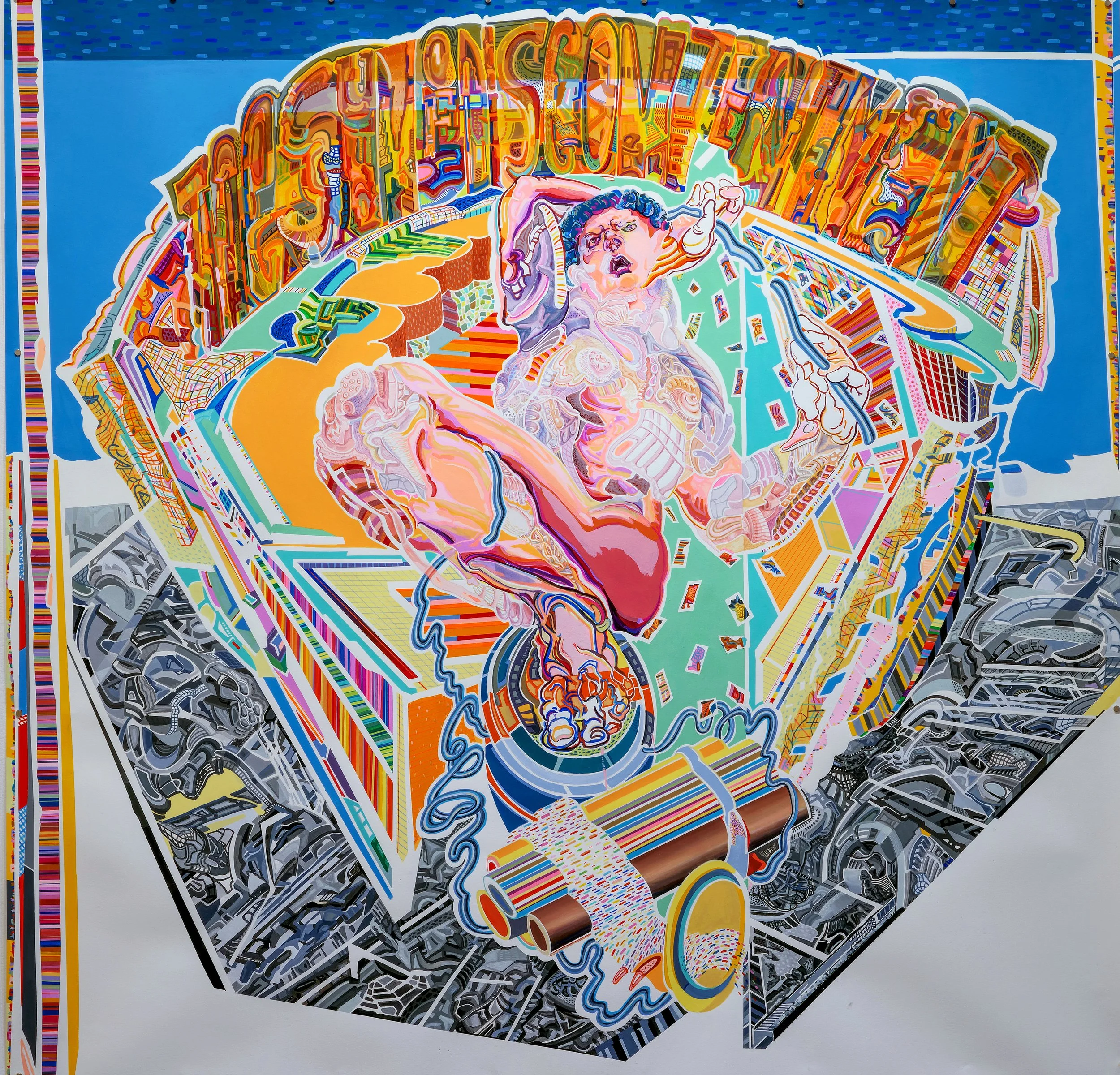
What inspires you?
“What inspires me most are the subtle, often overlooked details embedded in everyday life—the quiet visual information that reveals itself only through sustained attention. I’m drawn to the way light travels across surfaces, how it softens edges, sharpens contrasts, and transforms even the most ordinary objects into shifting fields of value and form. I’m equally interested in how perception changes with observation. Familiar objects begin to lose their certainty once they are carefully studied; they become strange, almost abstract structures of shape, proportion, and shadow. This shift—between recognition and ambiguity—is where I find the most compelling visual tension. I also embrace mistakes as a generative force in my process. What might initially appear as an error often disrupts expectation in productive ways, opening up alternative directions that intention alone would not have produced. These moments of deviation frequently lead to more honest and unexpected outcomes in the work. Beyond the visual world, I find inspiration everywhere and in anything—a sound that suddenly triggers a memory, a passing conversation fragment, or an unexpected connection between a book I’m reading and something I see moments later. These moments of association feel almost like visual cross-talk between experiences, where unrelated elements briefly align and generate new ways of seeing. Overall, my inspiration comes from paying close attention—to others, to their stories, to small details around me, to light, to form, to memory, and to the constant, shifting relationships between perception and experience.”
What themes do you pursue? Is there an underlying message in your work?
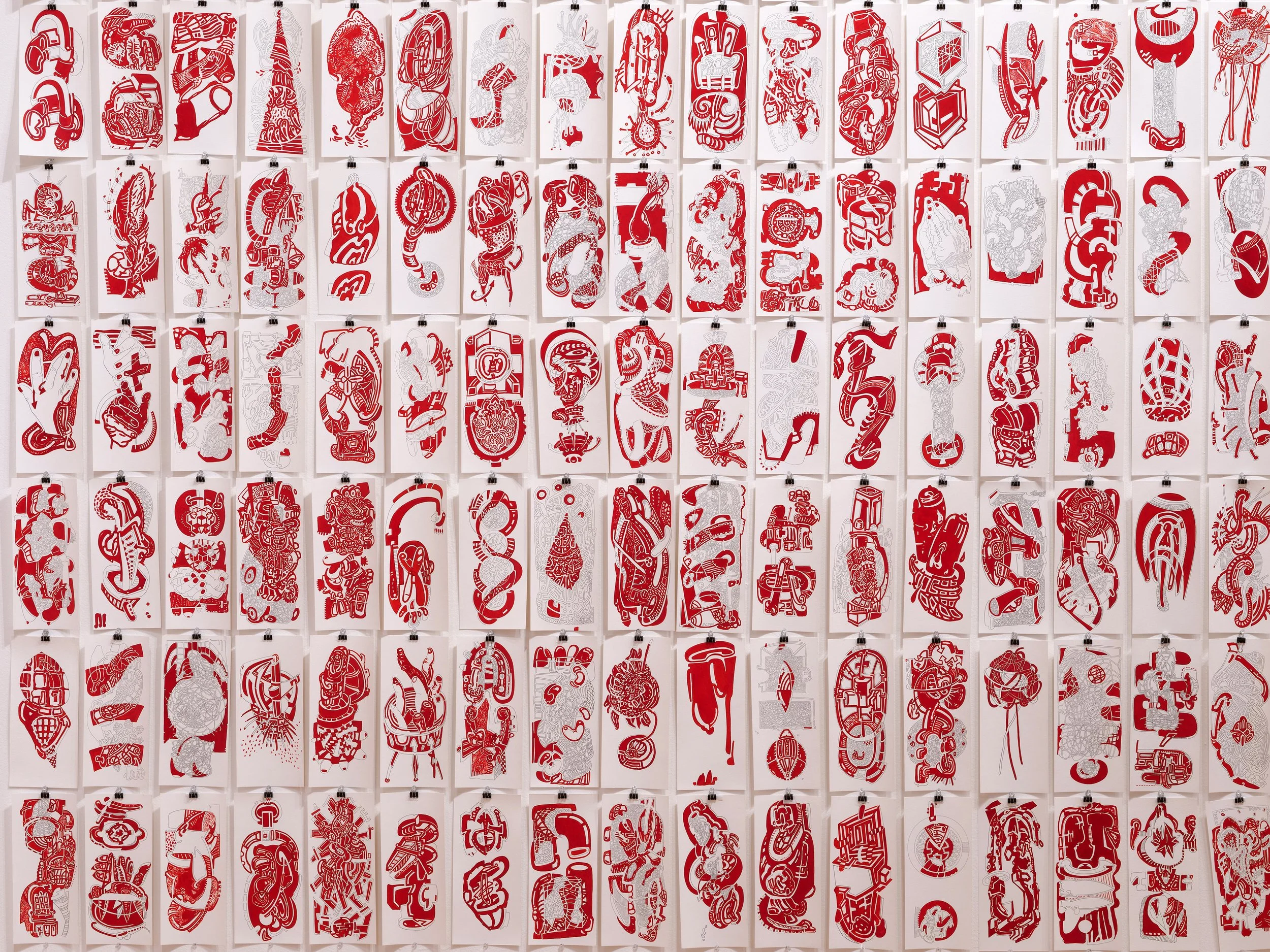
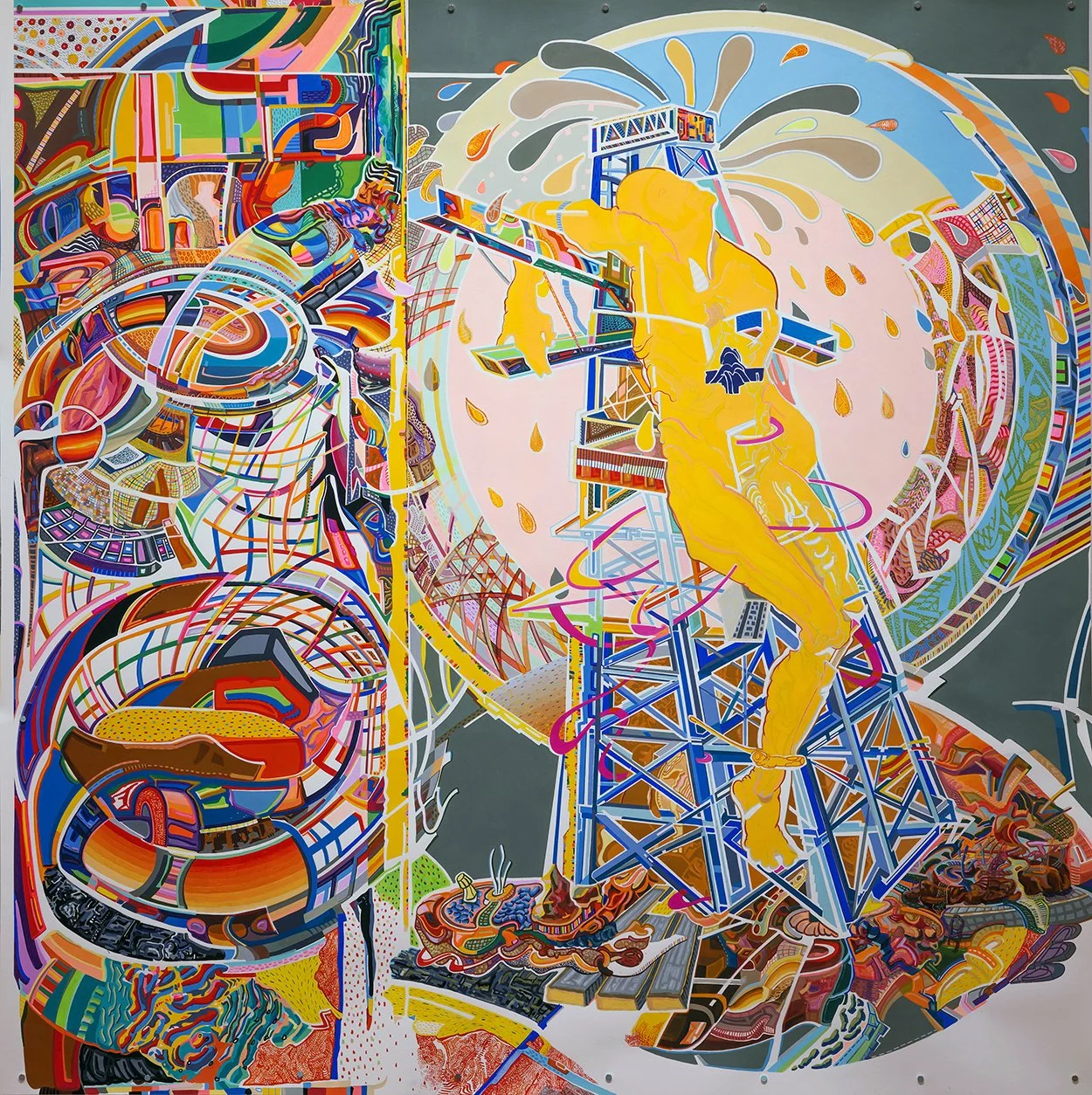
“Although my interests vary, my theoretical agenda hinges on concepts such as memory, fragmentation, consumerism, identity and motion. My work does not aim to deliver a single fixed message, but it consistently returns to questions of displacement, and the transformation of space. For example, in one of my most recent bodies of works, Jesus Popcorn and other details, I examine how faith, appetite, and identity are shaped within environments of constant stimulation. I embed figures within structures of industry, advertising, and ritualized consumption, resisting clear hierarchy or resolution. Rather than offering singular critique, the series holds tension between devotion and distraction, abundance and grief, asking how meaning survives when everything is multiplied and intensified. I tend to work in series, developing distinct conceptual themes that, while seemingly separate, remain deeply interconnected. Across projects, ideas, visual language, and formal concerns evolve in dialogue with one another, creating a layered and continuous investigation of my practice. My process is part excavation, part improvisation. I treat memory as a speculative site—less about what is found than what is missing, and how those gaps are filled. I’m interested in motion, both physical and conceptual, and in how we navigate time through unstable internal maps. Questions of territory—how it is claimed, erased, and redrawn—also recur throughout my work, where maps are understood as inherently political. Across my practice, I return to perception, structure, and uncertainty—the gap between what we think we see and what is actually there. There is an ongoing balance between control and surrender in my process. I often like to work in a space of not knowing. Ultimately, my work suggests that looking is never neutral, and certainty is always more fragile than it appears.”
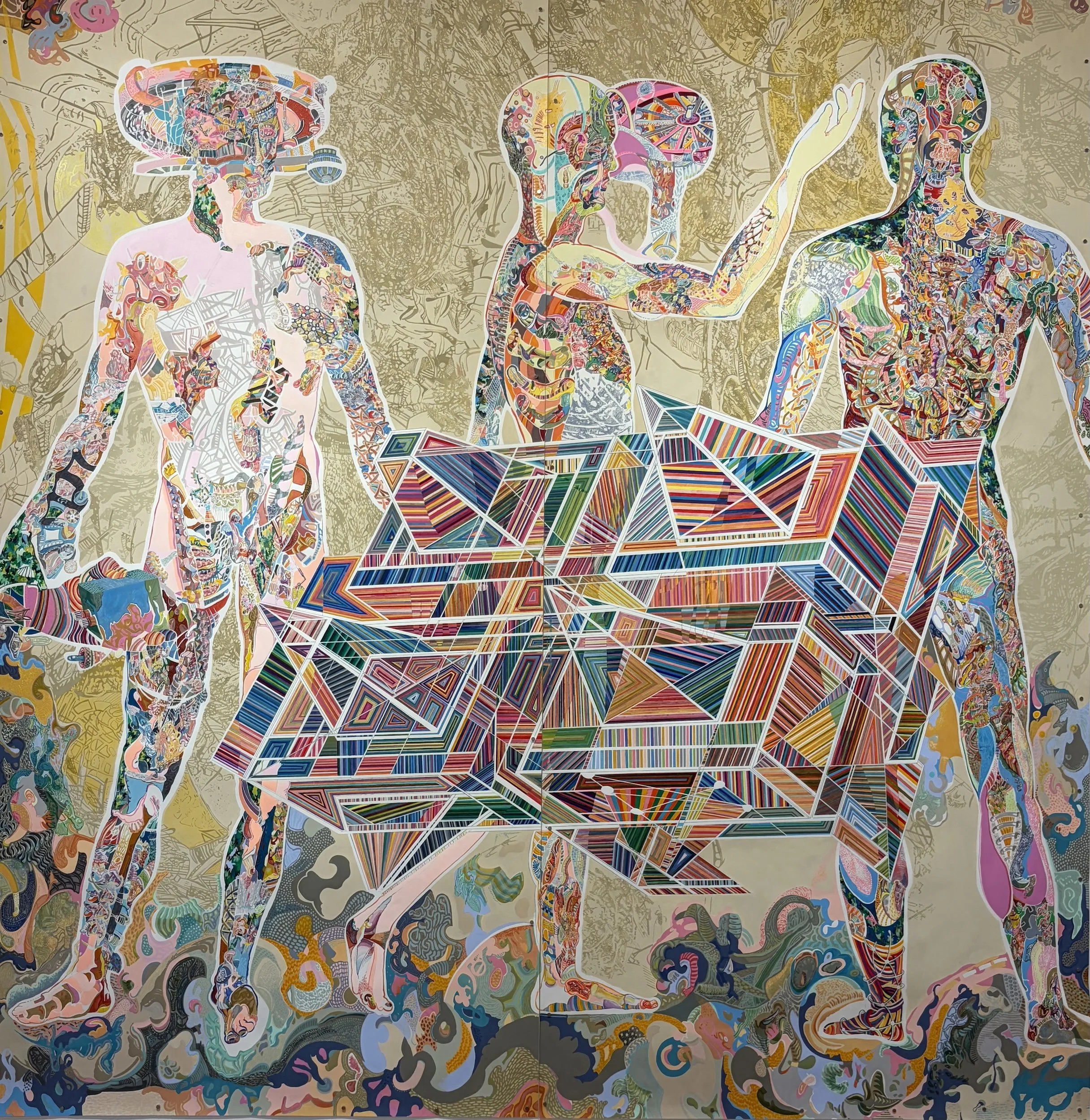
How would you describe your work?
“I would describe my work as maximalist, built on contradiction, and deliberately structured with a slightly obsessive attention to detail. It often begins with clarity and precision, but over time reveals hesitation, interruption, and change embedded within the process. I am interested in work that initially appears restrained or controlled but slowly unfolds into something more complex the longer it is experienced. Conceptually, my work sits in a space between poetry, critique and immersion. I am not simply representing systems like capitalism, religion, or cultural memory—I am embedding the viewer inside them. This creates a productive tension in which my work resists clarity or fixed hierarchy, instead staging conditions where meaning is constantly forming and dissolving. At its core, my practice is about seeing under strain. I am interested in what happens to perception when everything is amplified, repeated, and overlaid—when images stop functioning as singular statements and instead become environments.”
Which artists influence you most?
“So many, I am drawn to artists who treat process as visible thinking, who allow structure and intuition to coexist, and who understand that a drawing or painting can function as a record of decision-making rather than just a finished image. I tend to return to artists who make me reconsider what a line, a form, or a space can do rather than what it should represent. My work is informed by artists who treat the image as a system rather than a surface—where meaning is built through accumulation, contradiction, and instability. I am drawn to historical and contemporary practices that merge psychological intensity with structural complexity, and that use visual density as a way to think through memory, history, and perception. Influences such as Hieronymus Bosch and Pieter Bruegel the Elder inform my interest in layered narrative and the embedding of social systems within image worlds. The emotional and existential tension in the work of Francisco Goya and Francis Bacon resonates with my own exploration of instability, rupture, and psychological pressure. At the same time, I am attracted to artists like Gerhard Richter, Julie Mehretu, and Anselm Kiefer, whose practices move between clarity and abstraction, structure and collapse. What connects these influences is not style, but a shared engagement with images as contested spaces—where history, perception, and meaning are continuously constructed and undone.”
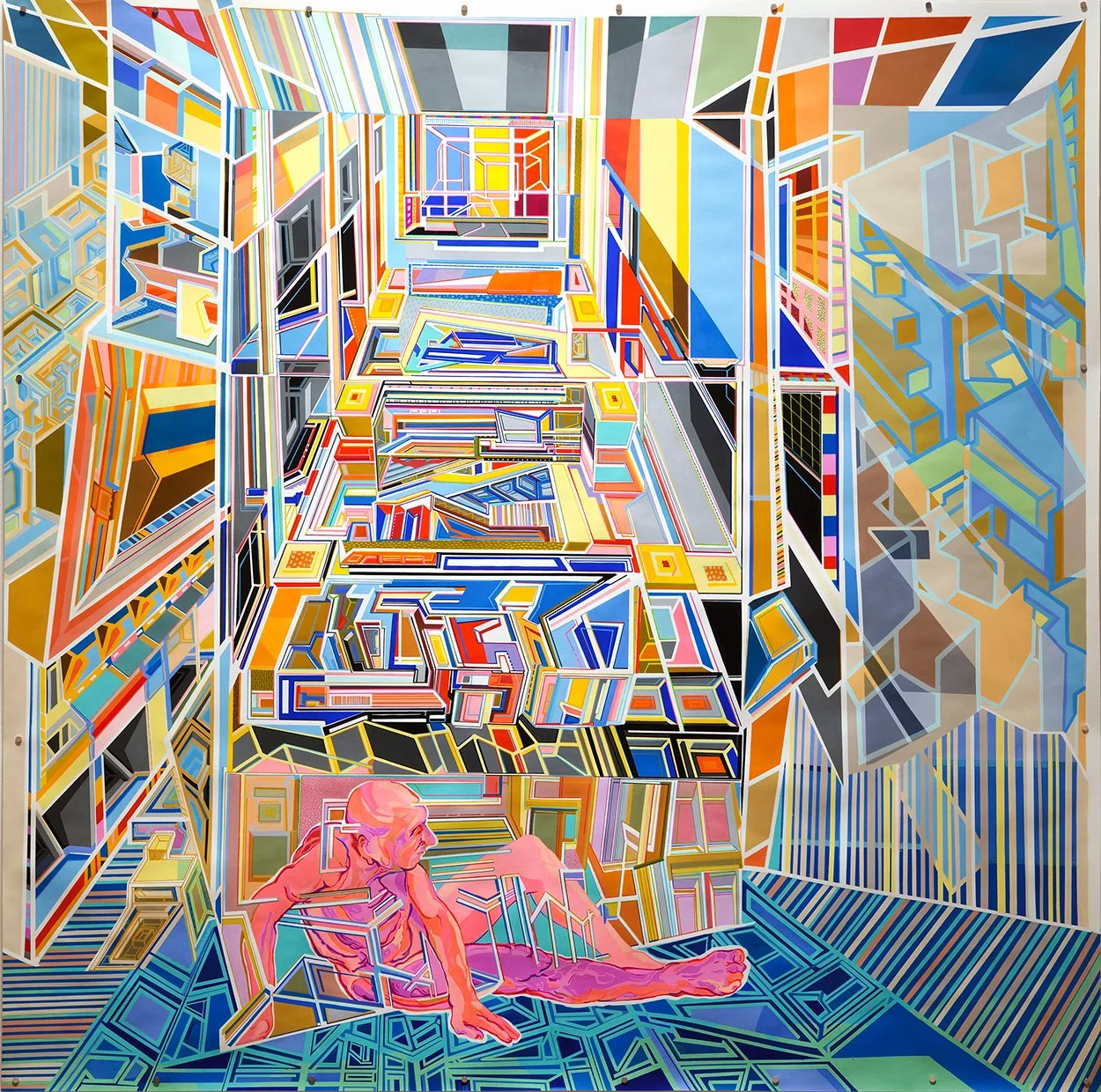
What is your creative process like?
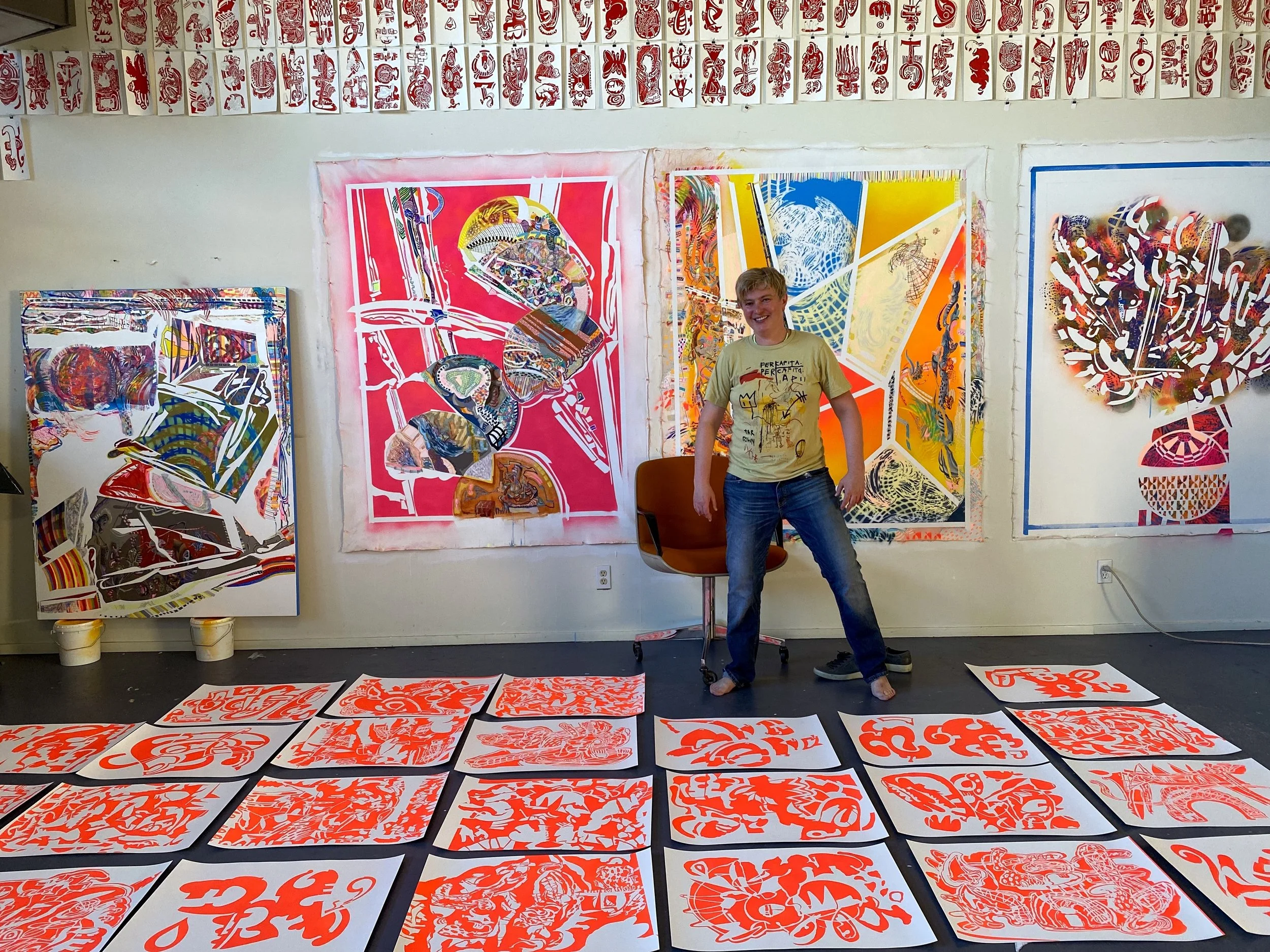
“It all starts with a coffee and cigarette. My creative process is intuitive, serial, and sometimes deeply process-driven. I often begin with structure and observation, breaking things down into basic forms, mapping relationships, and building an internal scaffolding before committing to detail. These starting points—architectural diagrams, topographic maps, anatomical sketches, or even an existing drawing repurposed as a scaffold—suggest order and containment, but I rarely stay there long. They quickly open into a more responsive phase, where adjustments, corrections, and unexpected shifts begin to guide the outcome. From there, the process becomes less about accuracy alone and more about sustained attention—staying alert to what is emerging and allowing the work to redirect itself. I move fluidly across media—drawing, painting, printmaking, digital work, mixed media, muralism, and installation—so each medium informs the others rather than existing as separate disciplines My studio practice is guided by open-ended prompts like ‘What if?’ and ‘Just do it,’ which help me bypass fixed outcomes and stay in a state of productive uncertainty. I often think of the process as an ‘engaged abandonment,’ where intuition leads and decision-making happens in real time. Spontaneous, gestural marks—often influenced by graffiti language and automatism—introduce controlled chaos into the structure, allowing the work to evolve organically. Only after stepping back do I begin to analyze what has formed—looking at compositional logic, visual systems, and the underlying structure that emerged through making. Each work becomes both a record of its own construction and a foundation for what follows across all media, I treat the surface as a terrain to be mapped, excavated, cut, layered, and reassembled. Fragmentation, transformation, and recomposition become ways of thinking through memory, identity, and displacement. Ultimately, my process is about balancing control with improvisation—allowing structure and intuition to coexist so the work remains open, shifting, and emotionally resonant.”
What is an artist’s role in society and how do you see that evolving?
“An artist’s role in society has never been fixed—it shifts depending on cultural pressures, historical moment, and the tools available for making and distributing work. At its core, though, I see the artist as someone who produces alternative ways of seeing: someone who interrupts habitual perception and offers new frameworks for understanding experience. Traditionally, artists have functioned as recorders, critics, storytellers, and makers of symbolic systems. But just as importantly, they act as translators of what is not yet fully articulated—emotions, tensions, collective memory, or social contradictions that exist but haven’t yet taken form in language. In that sense, art operates as a kind of perceptual research.
Today, that role is expanding. With the saturation of images, algorithms, and fast-moving information, artists are increasingly positioned not just as image-makers, but as editors of attention. The question is less about producing more visuals and more about slowing perception down, reordering it, or resisting its automation. There’s also a growing responsibility around fragmentation—how we hold identity, memory, and history in a time when everything feels dispersed and unstable. I also see the artist’s role as increasingly interdisciplinary and porous. The boundaries between art, design, digital culture, and social practice are dissolving. This means artists are no longer confined to objects or galleries—they are operating within systems, environments, and communities. The work can exist as installation, but also as process, intervention, or mapping of relational structures. In my own practice, this connects directly to ideas of mapping, layering, and reconstruction—treating visual language as a way to process memory, displacement, and cultural inheritance. The artist becomes someone who holds tension between structure and instability, between archive and transformation. Looking forward, I think the artist’s role will continue to shift toward navigating complexity rather than resolving it. Not offering answers, but constructing spaces where uncertainty, contradiction, and multiplicity can be held without collapse.”
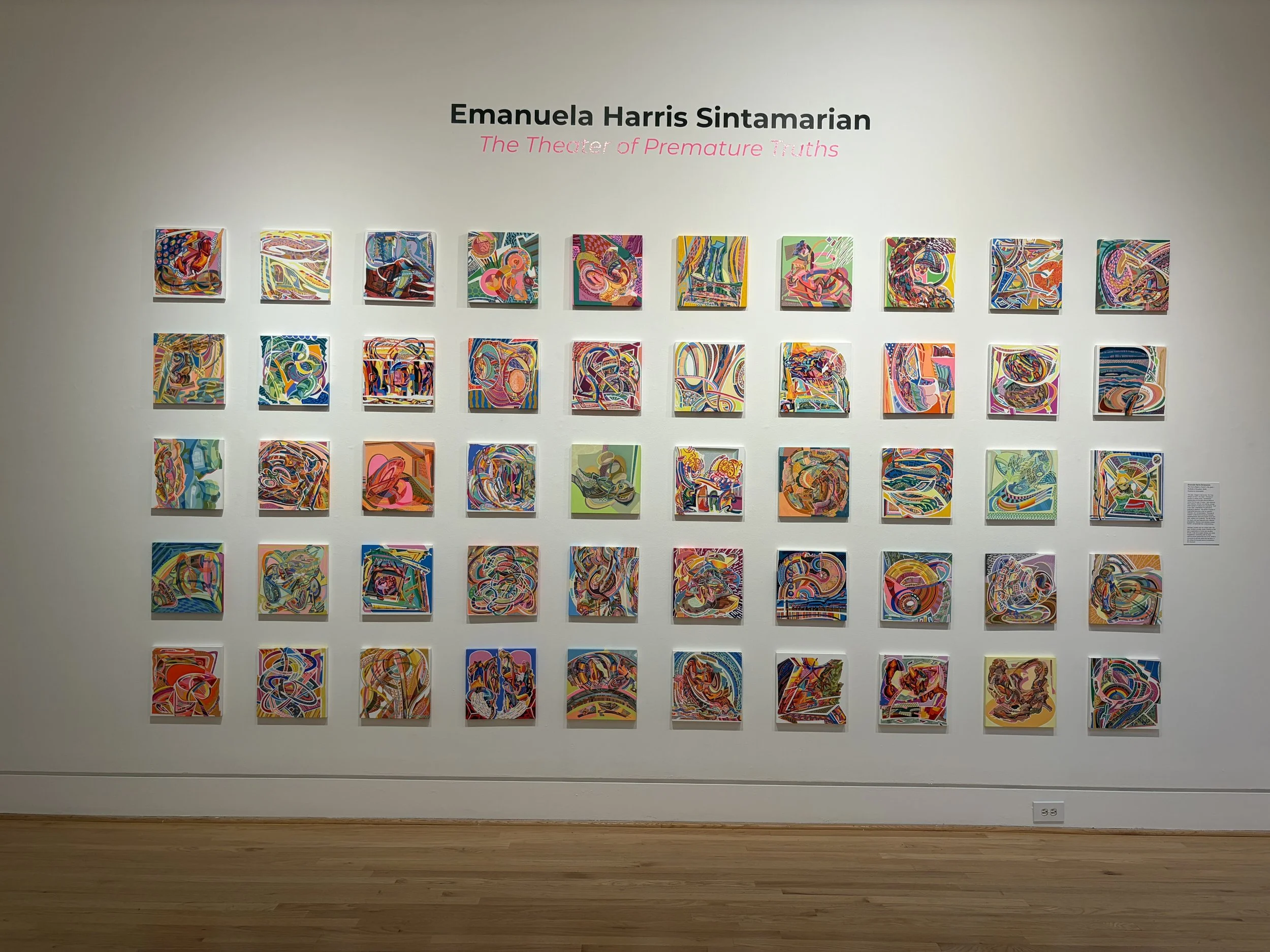
Have you had any noteworthy exhibitions you'd like to share?
“One of my most recent and noteworthy exhibition experiences was at the Triton Art Museum, Santa Clara CA (2026), where I presented works drawn from several different bodies of work. This context gave me the opportunity to revisit pieces that had been developed across different stages of my practice and to see how they behaved when placed in a larger, more public spatial environment. What was especially meaningful about this exhibition was the shift in scale and perception. Works that were originally conceived in a more intimate studio setting began to operate differently when installed together—they created new relationships, tensions, and rhythms across the space. This allowed me not only to reflect on the evolution of each individual series, but also to observe how the work continues to transform once it enters a broader context and encounters viewers. The exhibition became a kind of feedback system for my practice: a moment to see what holds across time, what shifts in meaning, and how different strands of my work begin to connect when placed in dialogue with one another.”