Interview
Darling Graham
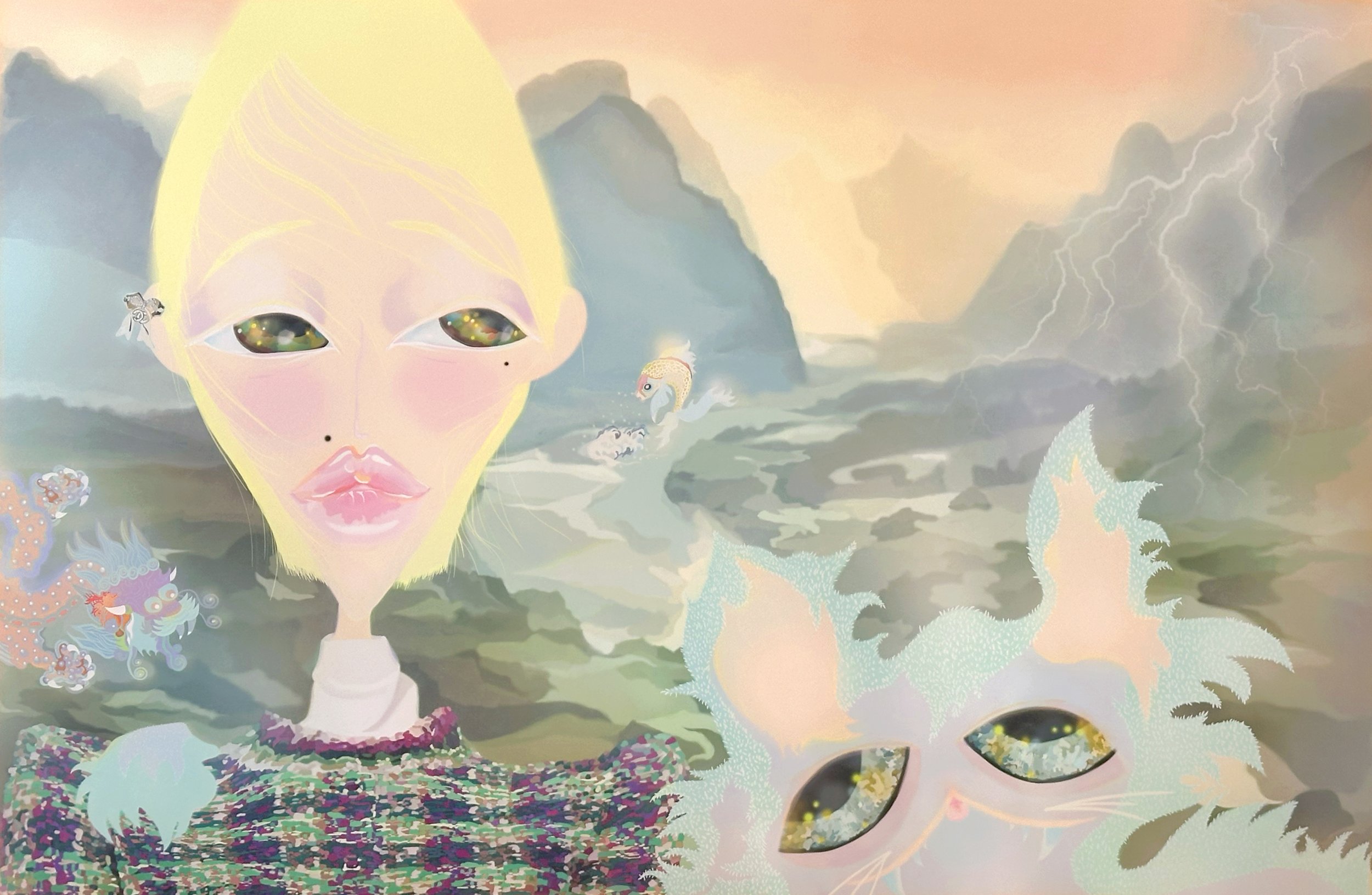
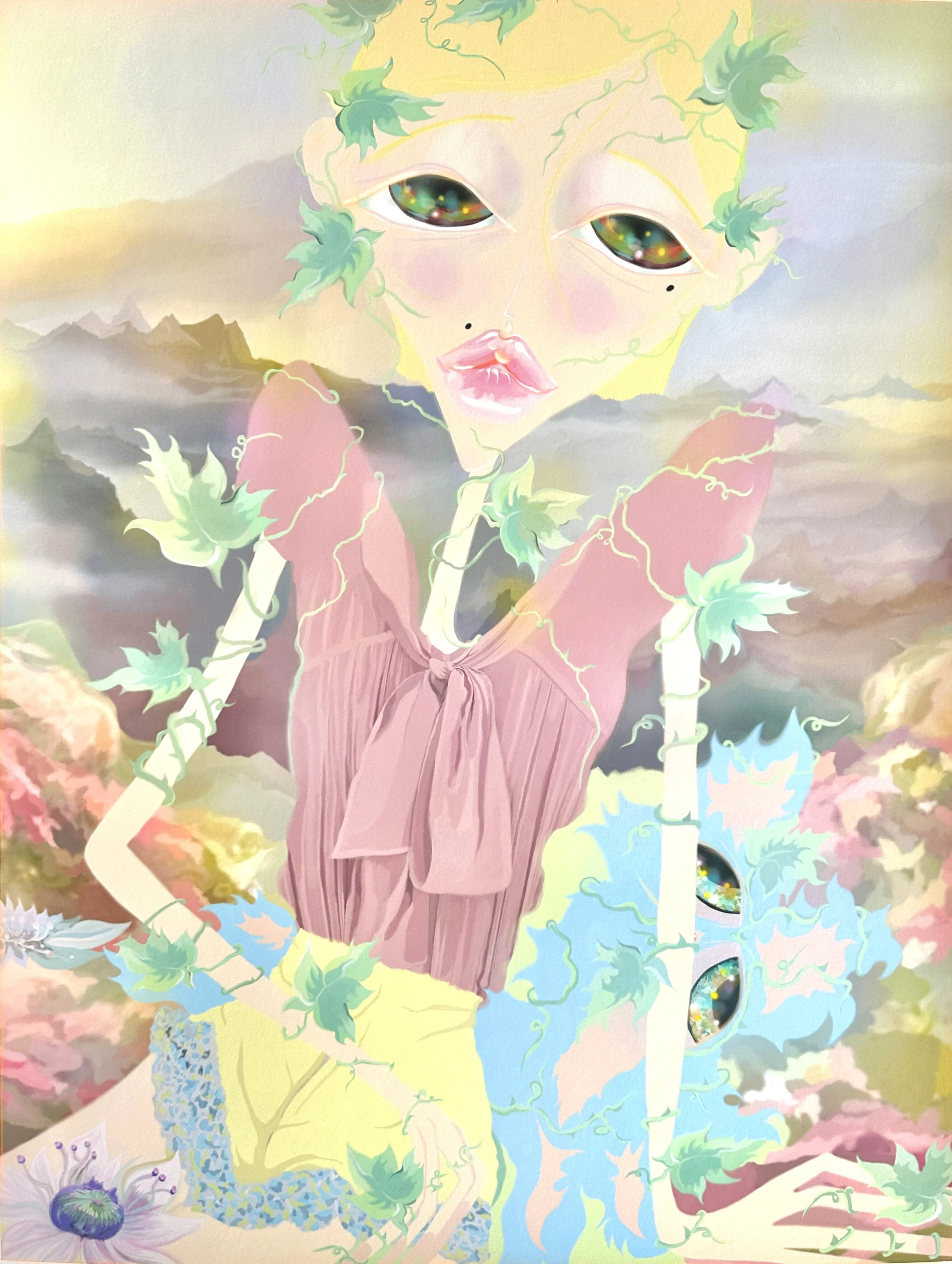
Darling Graham, born in Rome, Italy, is a contemporary visual artist working between Canada and the United States. Her multidisciplinary practice includes drawing, photography, and digital media, forming a poetic visual language rooted in emotional resonance, daily observation, and personal mythology. Darling considers her work a personal journal and an existential library in which each image becomes a page filled with reflection, feeling, and dreamlike narrative. Her creative process begins with photographs captured in her everyday life, such as self portraits, skies, oceans, and flowers. She transforms these moments into atmospheric and imaginary landscapes through a hybrid method that combines delicate graphite drawing with soft pastel and digital painting. A recurring female figure and a cat appear throughout her compositions and serve as symbolic companions and extensions of her inner world.
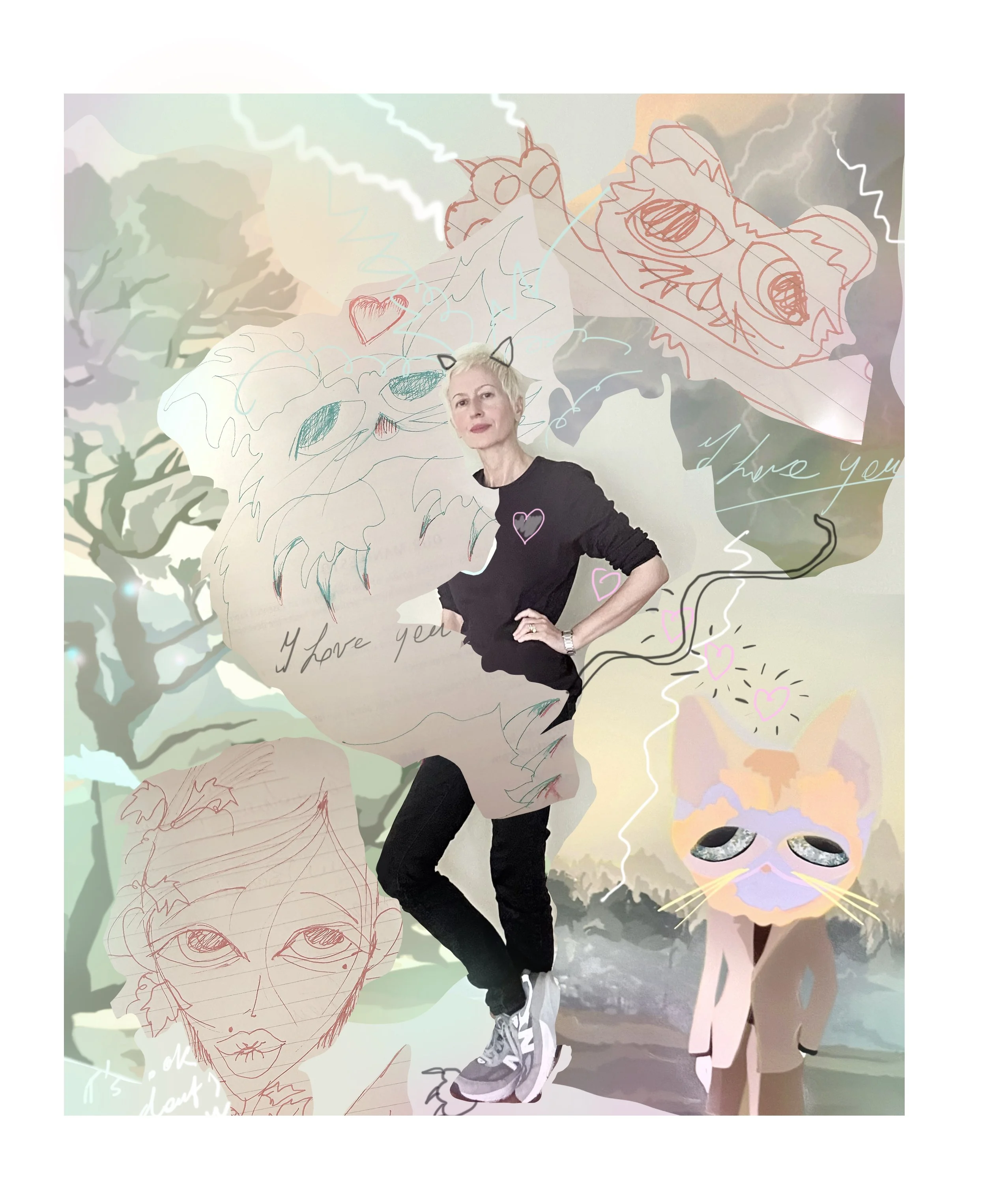
Darling studied at the historic Liceo Artistico Via Ripetta in Rome and earned a Bachelor of Fine Arts from the University of Ottawa. She has exhibited her work across the United States, including Art Basel Miami in 2024, The Hole Gallery in New York in 2025, and multiple venues in Miami and Richmond. Her forthcoming projects include a large scale digital billboard presentation in Times Square in January 2026 and a spring 2026 group exhibition at The Hole Gallery in New York. These upcoming presentations continue to expand the visibility and reach of her practice. Darling’s work reflects a contemporary sensibility grounded in softness, introspection, and emotional depth. She creates spaces in which everyday experience becomes poetic and the boundary between reality and imagination gently dissolves.
What is your background and how did you start your journey in the art world?
“My artistic background began in Rome, where I studied at the Liceo Artistico, receiving a classical foundation in the visual arts. I later continued my studies at the University of Ottawa in Canada, specializing in visual arts. Following my academic training, I developed a long and successful career as a fashion photographer based in Canada. For over twenty years, my work brought me across the world, collaborating internationally and engaging deeply with image-making in a commercial and editorial context. A decisive turning point occurred when I relocated to the United States. At that moment, I chose to close my fashion photography studio and to dedicate myself entirely to contemporary art. This transition marked a return to my first artistic language and earliest passion—one that had initially shaped my creative identity. After years of working globally and across disciplines, my practice has come full circle. Today, my work is rooted in contemporary art, informed by a lifetime of visual research, movement, and experience across cultures and industries.”
What inspires you?
“My work is driven by emotional states and existential inquiry. I am particularly interested in questions surrounding happiness, desire, fear, sadness, and the fragile nature of dreams. These themes form the psychological and emotional foundation of my practice. The work is deeply rooted in personal experience, yet it aims to transcend autobiography by engaging with universal human conditions. Through this process, I am developing a highly personal mythological language—one that allows emotional and internal realities to take symbolic form. This evolving visual mythology serves as a framework through which lived experience, memory, and introspection are transformed into images. The result is an existential body of work that reflects the complexity of inner life while inviting viewers to project their own emotional narratives onto the work.”
What themes do you pursue? Is there an underlying message in your work?
“The themes I pursue in my work emerge from elements of life that I consider fundamental: happiness and dreams, loneliness, love and friendship, as well as the presence and influence of money. These forces shape both individual identity and collective experience, and they occupy a central place within my practice. My work is inherently personal, grounded in lived experience and emotional observation. Each theme is approached not as an abstract concept, but as something felt, encountered, and negotiated within everyday life. Through this personal lens, I explore how these conditions intersect, conflict, and coexist. By translating intimate experiences into visual form, the work seeks to create a space where personal narrative becomes a shared emotional terrain, allowing viewers to recognize fragments of their own lives within the imagery.”

How would you describe your work?
“The themes I pursue in my work emerge from elements of life that I consider fundamental: happiness and dreams, loneliness, love and friendship, as well as the presence and influence of money. These forces shape both individual identity and collective experience, and they occupy a central place within my practice. My work is inherently personal, grounded in lived experience and emotional observation. Each theme is approached not as an abstract concept, but as something felt, encountered, and negotiated within everyday life. Through this personal lens, I explore how these conditions intersect, conflict, and coexist. By translating intimate experiences into visual form, the work seeks to create a space where personal narrative becomes a shared emotional terrain, allowing viewers to recognize fragments of their own lives within the imagery.”
Which artists influence you most?
“Leonardo Da Vinci inspires me.”
What is your creative process like?
“My creative process unfolds through a progression I describe as pencil, pixel, and charcoal. Each work begins with drawing, often figurative elements such as cats, human figures, landscapes, clouds, mountains, rivers, and oceans. These initial drawings serve as the emotional and compositional foundation of the work. The drawings are then translated into a digital format, where I continue to develop the imagery through pixels. This digital phase allows for transformation, layering, and reconfiguration, extending the work beyond its original hand-drawn state. In the final stage, I return to physical materials, working with pastel color and charcoal. This reintroduction of the hand restores tactility and imperfection, grounding the digital image in material presence. Through this hybrid process, each artwork becomes unique, a synthesis of drawing, photography and digital intervention, and physical mark-making.”
What is an artist’s role in society and how do you see that evolving?
“I see the artist as a mirror of society, one who reflects the conditions of their time across social, economic, political, and emotional dimensions. Artistic practice has always been shaped by context, and today these contexts are increasingly complex and blurred, influenced by globalization and the pervasive presence of social media. In this environment, the role of the artist is to remain grounded and attentive. Through observation and interpretation, artists can offer moments of clarity, inviting viewers to reconsider what defines beauty, dreams, fear, and meaning in the contemporary world. Art becomes a space where reflection slows down perception, allowing deeper awareness to emerge. I believe this role is particularly vital today. We are living through dramatic and accelerated transformations—perhaps among the most profound shifts in human history. In such times, artists have an essential responsibility: to bear witness, to translate experience into form, and to help society see itself with greater honesty and sensitivity.”
Website: www.darlinggraham.com
Instagram: @darlinggraham.art