Crystal Hanton-Johnson
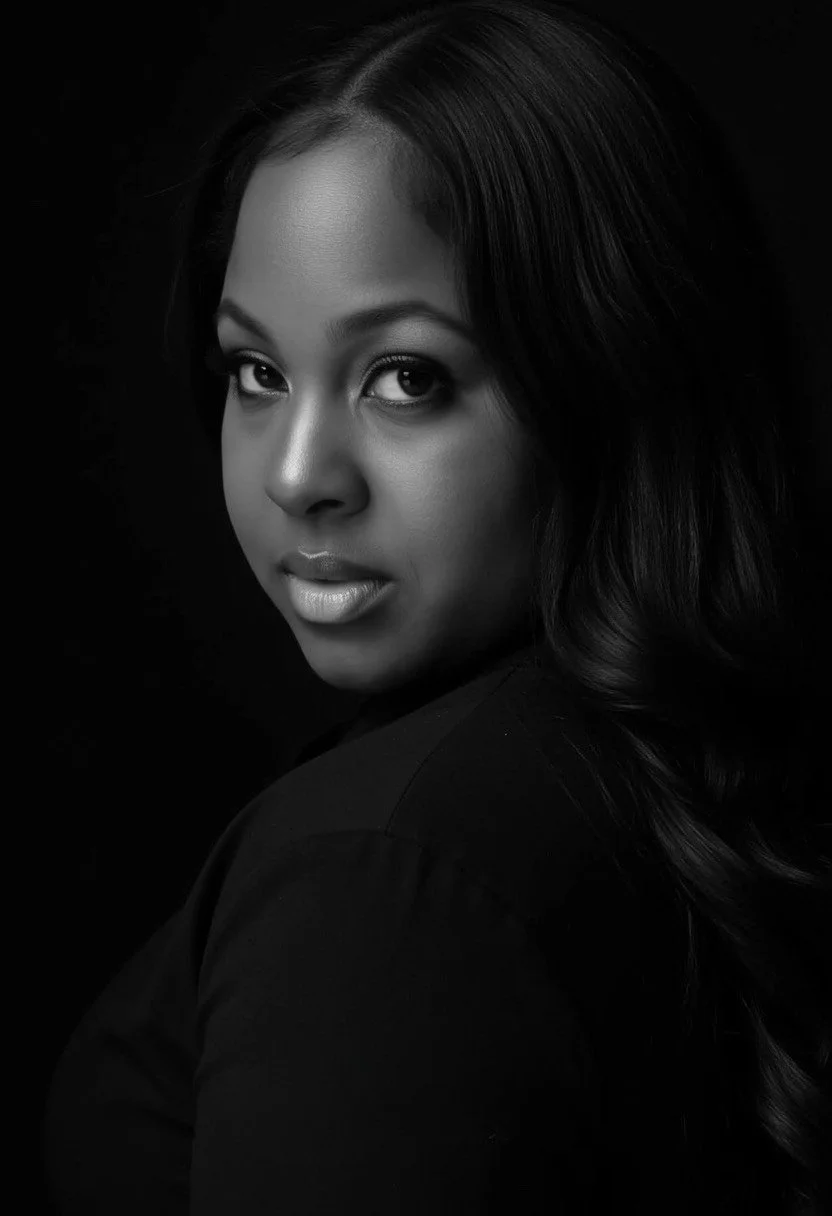
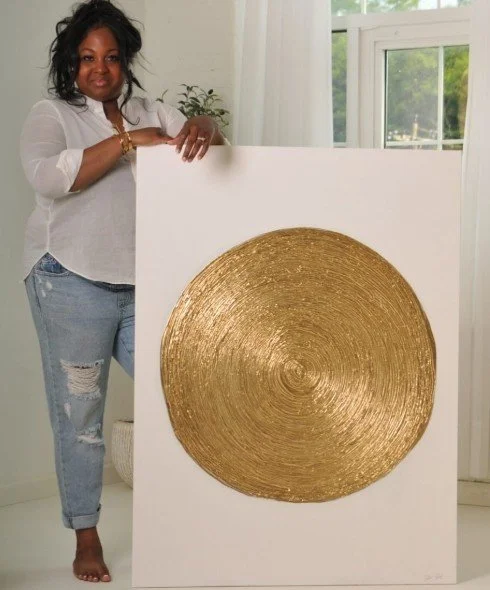
Crystal Hanton-Johnson is a visual artist whose work explores the harmony between mathematics, spirituality, and emotional experience. Working primarily on large-scale canvases with black and white backgrounds and luminous gold leaf, she creates immersive pieces centered around the Golden Spiral, inviting viewers to pause, reflect, and discover the patterns hidden in life and nature. Raised in Harlem, New York, Crystal was inspired by her father’s quiet attentiveness and the mentorship of her high school teachers, Ronald Jabradally and Dr. Evelyn Collins. She studied Theater with a minor in Studio Art at CUNY Hunter College and later earned a master’s in Early Childhood Education from Grand Canyon University. She is currently completing a second master’s in Art Education at Adelphi University. Over the years, Crystal has balanced motherhood and teaching while maintaining her artistic practice. Her work has been featured in Novum Artis and in exhibitions such as Curves – International Online Group Exhibition, Forms and Figures 2025, and her 2026 solo shows, Within the Spiral in Highland Falls and The Essence of the Golden Spiral in Brooklyn. Through her art, Crystal seeks to create connection, reflection, and presence, inviting viewers to experience the invisible rhythms and beauty of the world around them.
What is your background and how did you start your journey in the art world?
“My journey into art began long before I could articulate what it meant to be an artist. Growing up in Harlem, some of my earliest memories are of sitting quietly and watching my father paint landscapes. I remember the stillness of the room, the way he mixed colors slowly and intentionally, as if listening to something beyond the canvas. He wasn’t rushing. He wasn’t distracted. He was completely present. I didn’t realize it at the time, but he was teaching me a lesson I would carry for life: to truly see, to pay attention, and to let devotion emerge from that awareness. As I grew older, creativity became inseparable from my identity. I attended Wadleigh Secondary School of Performing Arts, where I was immersed in theater, visual arts, and performance. That environment nurtured my imagination and gave me permission to explore who I was. I was especially lucky to have the guidance of teachers who shaped not just my skills, but my understanding of the power of art.
My art teacher, Ronald Jabradally, supported me with patience and encouragement, pushing me to experiment and to trust my vision. Dr. Evelyn Collins inspired me through her leadership and dedication, showing me the value of hard work, discipline, and following your passion. These teachers made me feel seen and understood during a formative time in my life. After high school, I attended CUNY Hunter College, where I majored in Theater and minored in Studio Art. Theater taught me how to inhabit emotion, understand human experience, and tell stories with both presence and sensitivity. My Studio Art minor introduced me to new ways of expressing emotion, translating experiences into visual form, and experimenting with materials and techniques. These experiences laid the foundation for both my teaching career and my artistic practice. Even as life grew busier, I held tightly to my creative identity. Becoming a mother transformed me in ways I could never have predicted, it deepened my empathy, patience, and understanding of sacrifice.
At the same time, I was building my career as an educator, creating spaces for students to grow, explore, and feel safe. Yet, through all these roles, the artist inside me never disappeared. I was quiet, waiting, stirring when I saw patterns in nature, light moving across a surface, or the urge to create that would not be silenced. My path back to art was strengthened by mentorship. Collins Chuks became a vital guide and mentor in my journey as a professional artist. His guidance, insight, and encouragement helped me navigate the art world and see my potential in ways I hadn’t recognized before. He reminded me that devotion, persistence, and self-belief are just as important as technical skill. The lessons I learned from him, combined with the inspiration I had drawn from my high school mentors, crystallized my understanding that my artistic voice was worth cultivating and sharing. I earned my master’s degree in Early Childhood Education from Grand Canyon University, which strengthened my skills as a teacher and deepened my understanding of how children learn, create, and experience the world.
But it was the quiet realization, years later, that I needed to reclaim my art fully, that truly shifted my life. I remember the moment vividly: standing in front of my canvas after years of putting it aside, feeling both unfamiliar and completely at home. There was fear, but there was clarity. I began creating again, and it felt like returning to a part of myself that had been waiting patiently. In that moment, I realized that art had never left me, it had lived within me all along. Today, I am pursuing my second master’s degree in Art Education at Adelphi University. This represents both academic growth and a personal, spiritual return to the artist I was always meant to be. Art and teaching now exist together in my life, informing and strengthening each other. My journey has been shaped by mentorship, teaching, motherhood, patience, and rediscovery. Art waited while I became the person I needed to be, and when I returned to it, I returned with deeper understanding, intention, and devotion. Art is not just something I create, it is something I live.”
What inspires you?
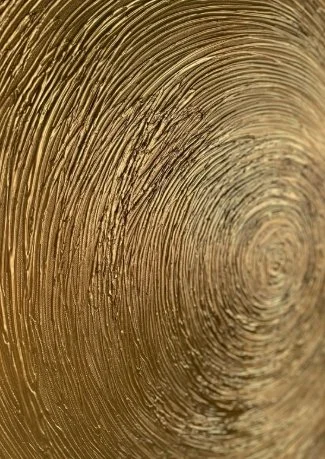
“What inspires me is the tactile experience of creation, the way gold leaf catches the light, the textures that emerge when I touch a canvas, and the sense of relief and connection I feel as my hands move across large-scale surfaces. There’s something meditative about physically interacting with my work, feeling each ridge and layer come alive beneath my fingertips. My children are also a constant source of inspiration. Watching them grow, learning, and exploring the world with curiosity reminds me of the beauty in discovery. When my daughter Artyst, shared that she wants to become an art teacher when she grows up, it moved me profoundly. It made me realize that my work is not just for myself, it is also a model for her, a representation of passion, dedication, and the courage to follow one’s calling. These experiences, these moments of touch, growth, and connection, fuel my creativity. They are the foundation for the Golden Spiral in my work, the harmony, balance, and movement that flows naturally from life itself. Inspiration, for me, is both intimate and expansive; it comes from the textures I can feel, the lives I hold dear, and the patterns that exist quietly all around us.”
What themes do you pursue? Is there an underlying message in your work?
“My work explores themes of balance, growth, transformation, and divine order. The Golden Spiral appears repeatedly in my work because it represents expansion without chaos. It represents evolution that is intentional, measured, and infinite. It is a reminder that growth is not abrupt, it unfolds. There is also a spiritual dimension to my work. The use of gold symbolizes illumination, divinity, and permanence. Gold does not decay. It reflects light. It holds presence. At its core, my work asks viewers to slow down. To become aware. To recognize that there is structure and meaning even in uncertainty. The underlying message is simple but profound: there is beauty in becoming.”
How would you describe your work?
“My work exists at the intersection of mathematics, spirituality, and emotional experience. It is both precise and intuitive, structured yet alive with feeling. I often work on large-scale canvases, immersing myself physically in the creation of each piece. I layer black and white backgrounds, letting them provide contrast and depth, and then I bring in gold leaf, delicate, luminous, and tactile. The gold becomes a living element on the canvas, catching light differently depending on where you stand and how you move. There is a quiet tension in that contrast, between the dark and the light, the known and the unseen. Visually, my pieces are bold, yet they ask for quiet reflection. The spirals I create command attention without shouting; they invite viewers to pause, to explore, and to notice the patterns that exist all around us but often go unseen. My work is less about representation and more about revelation, showing the hidden rhythms and harmony in life, in nature, and in ourselves. Each piece feels like both a discovery and a return. It is a meditation, a moment of devotion, and a way for me to feel connected, to the world, to my own experiences, and to the people I love. Working on these canvases, feeling the texture of gold leaf beneath my fingers, I am fully present, fully alive, and fully myself.”
Which artists influence you most?
“I have been deeply inspired by Wassily Kandinsky, whose belief that art expresses inner necessity taught me that abstraction can convey emotion and truth in ways realism cannot. Georgia O’Keeffe continues to influence me through her ability to distill forms and evoke emotion with such quiet power. Kim Rose inspires me with her abstract resin work, the way she explores texture, movement, and translucence informs how I think about layering and material in my own pieces. But above all, my first and most lasting influence has been my father. He taught me attentiveness without ever saying a word, showing me that seeing deeply and approaching creation with care is as important as the final work itself. These influences remind me to be present, to experiment fearlessly, and to trust that my own voice can communicate beauty and meaning in ways only I can.”
What is your creative process like?
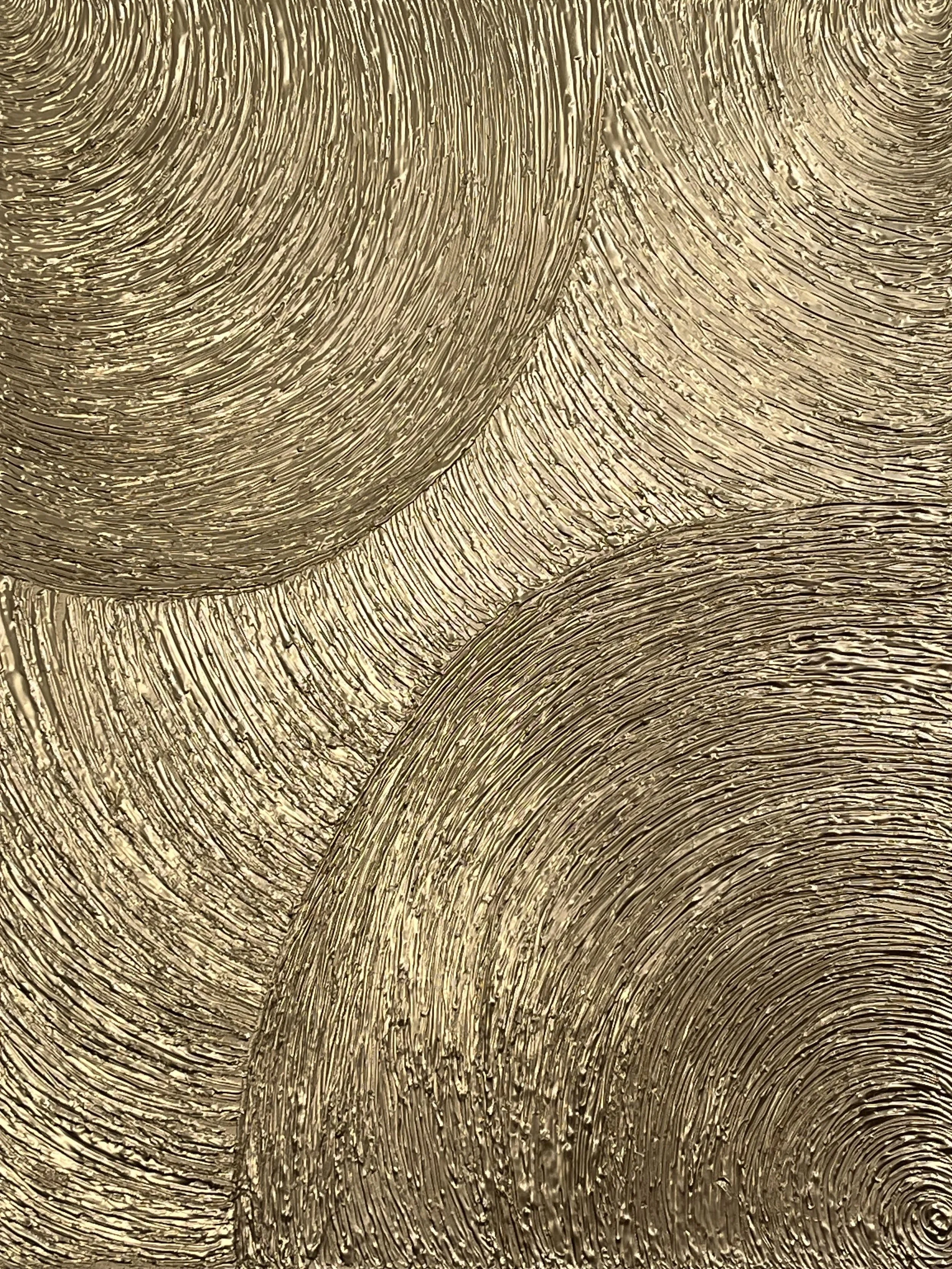
“My creative process begins with stillness. Before I touch a canvas, I spend time observing, not just the materials in front of me, but the world around me and the quiet space within me. Sometimes, I sit in silence, letting my mind wander and my senses attune to light, color, and texture. Sometimes, I look back at previous work, tracing the paths I’ve taken before, remembering the lessons embedded in every line and layer. Other times, I simply wait, until I feel a pull, a readiness, a sense that the moment is right. I never rush the beginning, because the energy I bring at the start shapes everything that follows. When I finally begin, I approach the spiral, the heart of my work, with intention and reverence. Each line is measured, each curve deliberate, yet the process is also intuitive. Working on large-scale canvases, I feel the physicality of the art; I move with it, almost as if the piece and I are in dialogue. Applying gold leaf, I experience texture, light, and reflection, letting the material speak back to me. The black and white backgrounds provide a quiet tension, a stage on which the spiral emerges, alive and luminous.
Time disappears in these moments. I am no longer thinking; I am listening. There is a sense of flow, a meditative rhythm, where every brushstroke and leafed detail feels like both discovery and conversation. There comes a moment in every piece when the spiral fully reveals itself, it is less something I made and more something I uncovered, something that has always been there, waiting for attention. This process teaches me patience, trust, and humility. It reminds me that creation is not only about control or skill, it is about presence, devotion, and allowing something greater than myself to emerge. It mirrors life itself: moments of intention, care, and attentiveness lead to profound revelations. Creating in this way feels like coming home to myself, reclaiming the artist I have always been, and honoring the curiosity and wonder I want to pass on to my children and students.”
What is an artist’s role in society and how do you see that evolving?
“An artist’s role is to help people see. Not just visually, but emotionally and spiritually. Artists slow the world down. We invite people to pause. To notice. To reflect. In a society driven by speed and distraction, artists preserve depth. Artists also document human experience, not just events, but feelings, transitions, and states of being that cannot be captured through language alone. As the world becomes increasingly fast and digital, I believe the artist’s role becomes even more essential. We remind people of presence. Of humanity. Of the sacredness of observation. Artists help people remember what they already know but have forgotten how to feel.”
Have you had any noteworthy exhibitions you'd like to share?
“Every exhibition I’ve participated in has marked a unique chapter in my journey as an artist , not just in terms of exposure, but in how I see my work, myself, and my purpose. Each one has shaped me in subtle, lasting ways. One of the most meaningful milestones in my career was seeing my work published in Novum Artis. It was the first time my art existed beyond my private studio and entered a broader conversation. To see people engage with my work in print opened my heart in a way nothing else had, it affirmed that my voice, my vision, and my perspective truly have a place in the world.
In 2025, I was honored to participate in international online exhibitions such as Curves and Forms and Figures, which brought my work into conversation with artists from around the world. These experiences reminded me how universal the language of form, texture, and emotion can be, even when the inspiration is deeply personal. This year, 2026, marked a particularly special moment for me. My solo exhibition Within the Spiral in Highland Falls allowed me to fully immerse viewers in the patterns, textures, and movement of my work, highlighting the Golden Spiral as both a visual and spiritual concept.
On the same day, I also participated in another exhibition in Brooklyn, The Essence of the Golden Spiral, which expanded the conversation about balance, growth, and interconnectedness in art. Experiencing the response of viewers, seeing them pause, lean closer, reflect was deeply moving and reminded me that art has the power to connect people without words. Each exhibition, whether online, local, or international, represents a chapter of growth, persistence, and transformation. To see my work displayed in these spaces is not just about recognition; it is about sharing a part of myself, inviting others into my creative world, and continuing the conversation between artist, viewer, and the patterns that quietly shape our lives.”