Interview
Aria Artis
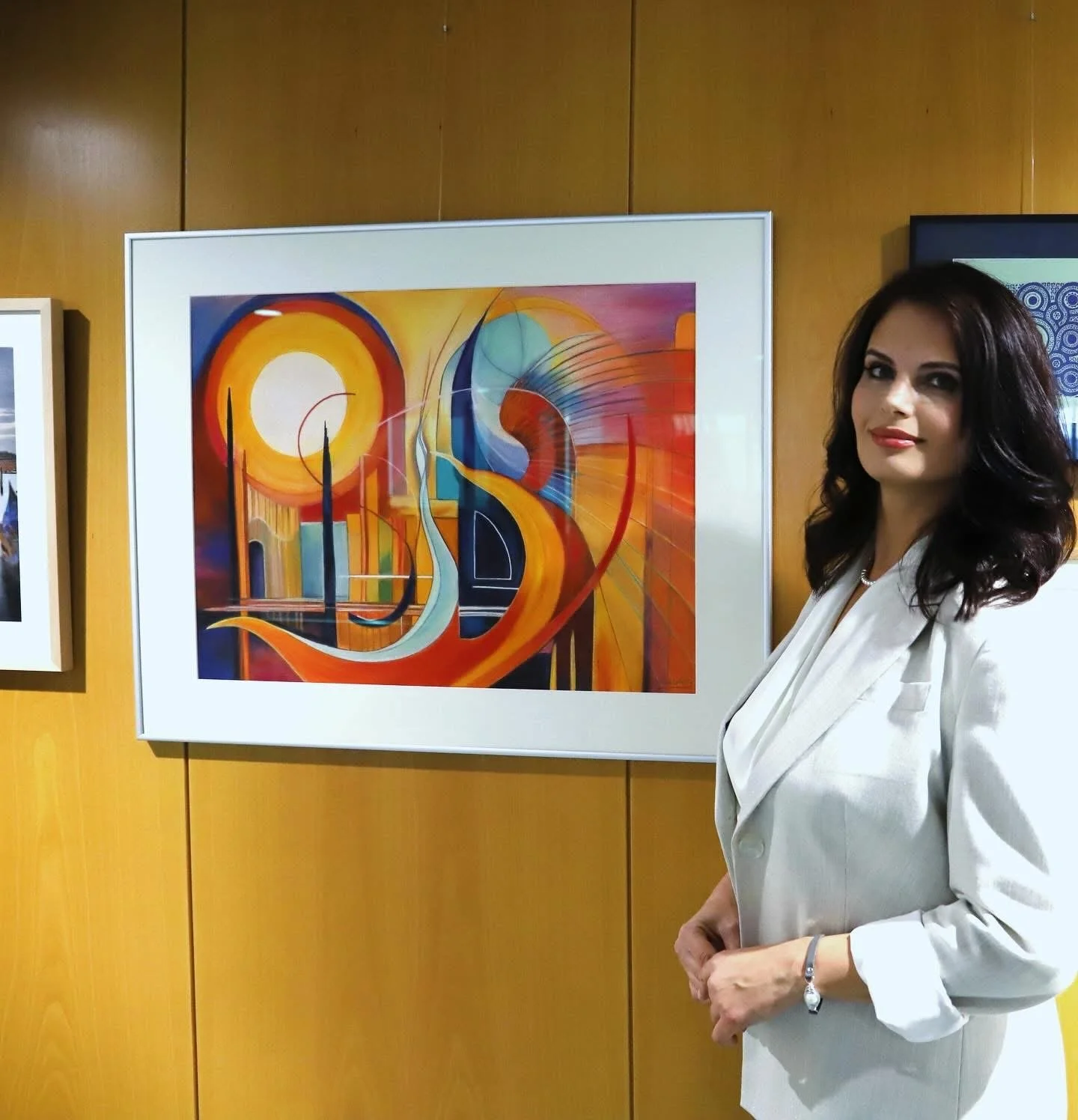
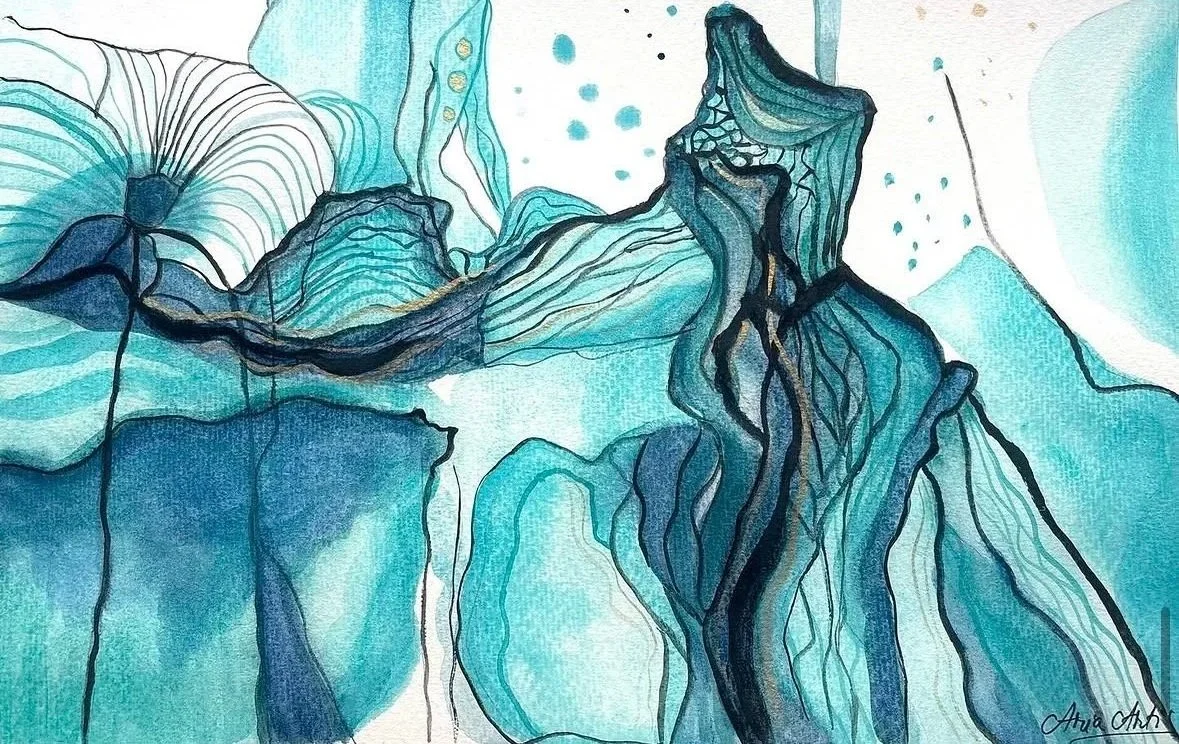
Aria Artis is a Romanian-born contemporary abstract artist based in Germany. She completed her studies with top honors at the Hamburger Akademie für Fernstudien – Kreative Malschule under the direction of Prof. Meinhardt. Her practice explores the intersection of fluidity and structure, creating layered compositions that oscillate between organic movement and geometric precision. While her earlier works evolved through watercolor and flowing linear forms, her recent works are executed in pastel, emphasizing softness, luminosity, and spatial rhythm. Inspired by travels to cities such as Paris, Venice, Florence, Rome, and Barcelona, her work reflects a dialogue between architectural forms and natural transformation. Through fluid geometries and luminous transitions, she creates visual spaces suspended between abstraction, memory, and emotion. Aria Artis has exhibited internationally in Germany, Italy, and Spain, including exhibitions in Munich, Lucca, and Barcelona. Her painting The Spirit of the Forest was selected among the top 12 works for the Art Talent Fair Prize at Lucca Art Fair in Italy. She was also featured in the publication 100 Artists of Europe, released by Cultural Lab, Italy.
What is your background and how did you start your journey in the art world?
“I started painting as a child, inspired by my mother, who also painted. Creativity was always present in my life, even though my academic path initially followed a different direction. I studied International Economic Relations in Bucharest, Romania, and later worked in finance, which gave me a strong sense of structure and discipline — elements that, in a way, still influence my artistic language today. In 2011, I decided to focus more seriously on painting and began an intense period of exploration and study. I experimented with many styles and techniques before gradually developing the fluid visual language that defines my current work. I attended numerous courses in drawing, perspective, and painting, always searching for deeper technical understanding. Wanting to expand my artistic education further, I enrolled at the Hamburger Akademie für Fernstudien – Kreative Malschule in Germany, where I completed my studies with top honors. Over the years, I have worked with oil, acrylic, watercolor, and pastel, and each medium has contributed to my artistic evolution. Travel is also an important source of inspiration for me. Large cities, museums, architecture, and nature continuously shape the atmosphere and spatial rhythm of my work.”
What inspires you?
“Inspiration comes to me from many different directions, and I don’t think it can be reduced to one single source. I am deeply inspired by travel, especially large cities, architecture, museums, and the atmosphere of places with history and cultural depth. At the same time, nature has a strong influence on me — movement, light, organic forms, and the rhythm that exists naturally in the world. I also enjoy reading psychology, which makes me reflect a lot on emotion, perception, and inner states. Sometimes inspiration comes from something very visible, like a building or a landscape, and other times from something intangible — a feeling, a memory, or an emotional tension. For me, inspiration is less about a fixed idea and more about remaining open and sensitive to what resonates internally.”
What themes do you pursue? Is there an underlying message in your work?
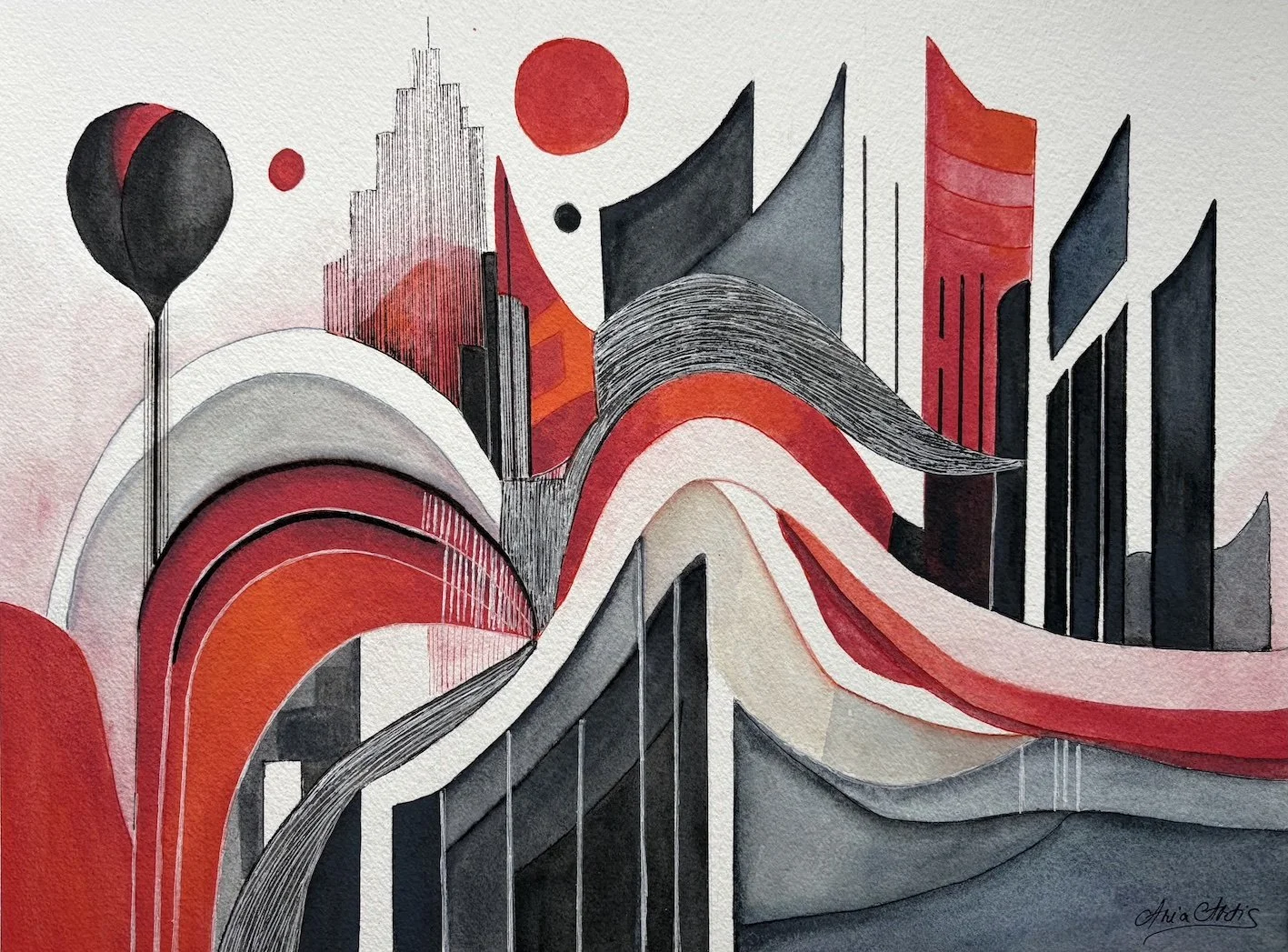
“I often explore themes connected to transformation, balance, emotion, and the relationship between structure and fluidity. My work moves between architecture and organic movement — between what is constructed and what is felt internally. I am interested in the tension between order and freedom, geometry and intuition, stillness and movement. There is also a strong idea of space in my paintings — not only physical space, but emotional and psychological space. Through transparency, layered forms, and flowing lines, I try to create compositions that feel open, breathable, and contemplative. I would not say that my work carries a direct message in a literal sense. Instead, I want to create an atmosphere or an emotional resonance. I am interested in how a viewer feels when experiencing the work. For me, painting is a way of translating emotions and inner states into visual rhythm, light, and movement.”
How would you describe your work?
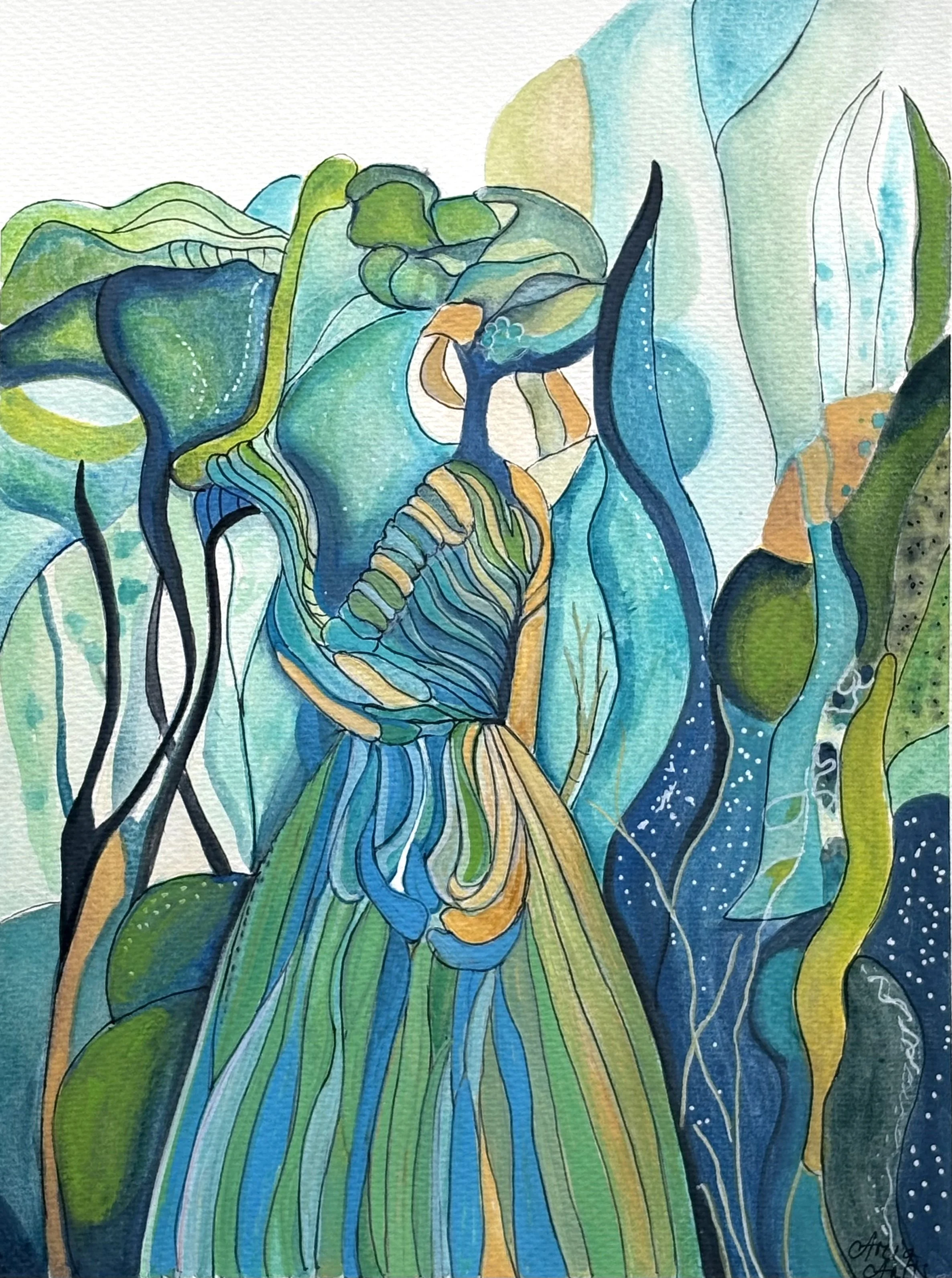
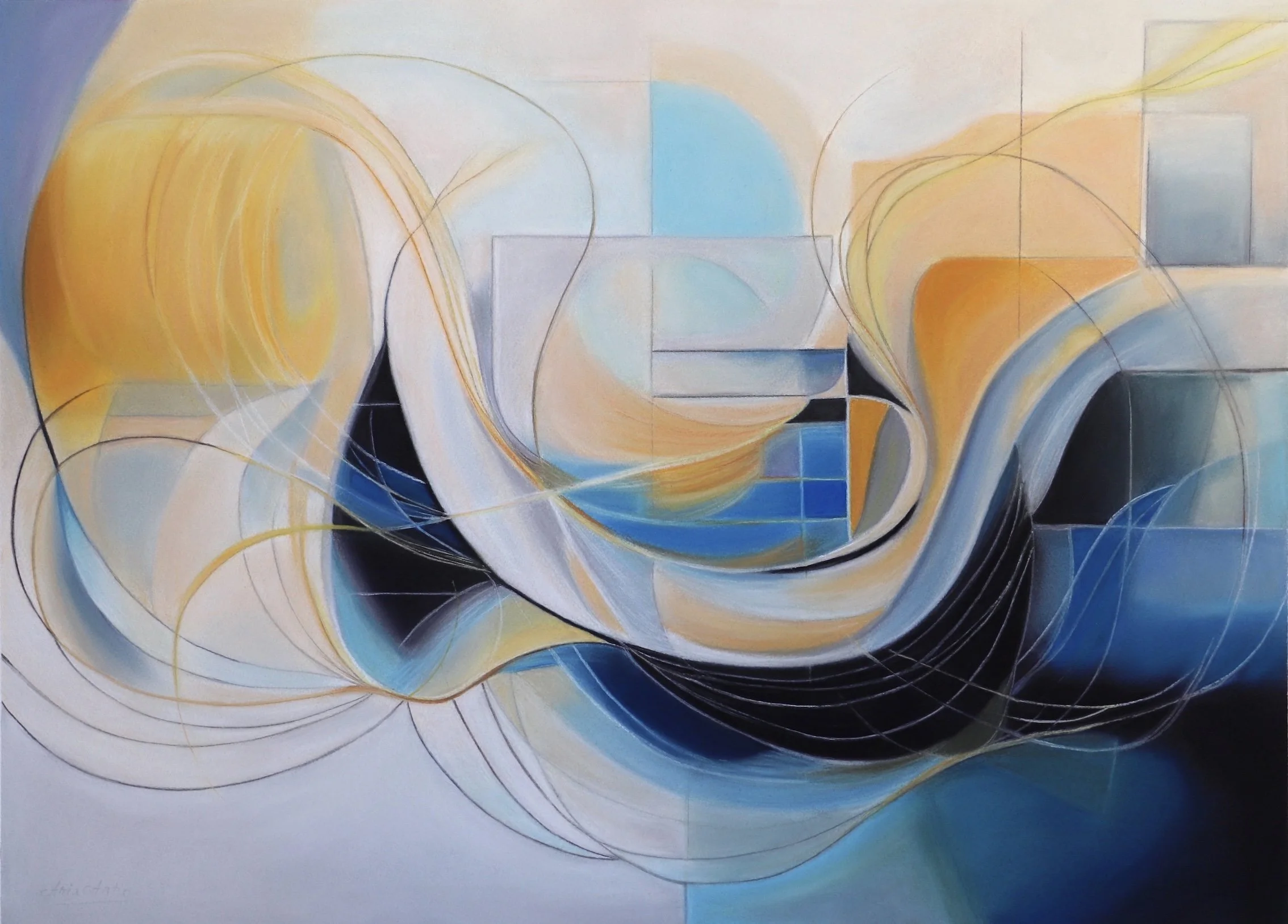
“I would describe my work as fluid architectural abstraction. My paintings combine organic movement with geometric structure, creating layered spaces that feel both emotional and spatial. I work with rhythm, transparency, light, and flowing lines to build compositions that are suspended between architecture, nature, and inner perception. Although my work is abstract, it is deeply connected to emotion and atmosphere. I am interested in creating visual balance while still leaving space for intuition and imperfection. The compositions often evolve very intuitively, almost like a dialogue between control and freedom. In my recent pastel works especially, I explore softness, luminosity, and the idea of breathable space — places where the viewer can pause, reflect, and emotionally enter the painting rather than simply observe it.”
Which artists influence you most?
“I am inspired by artists who combine imagination, emotion, and strong visual language. Salvador Dalí has always been one of my favorite artists because of his freedom of thought and his ability to transform inner worlds into powerful visual experiences. I also feel very connected to the spiritual abstraction of Wassily Kandinsky and the poetic sensitivity of Georgia O’Keeffe. Beyond painting, I am deeply inspired by architecture and contemporary design. I greatly admire Zaha Hadid for her fluid architectural language and the way her structures seem to move organically through space. This relationship between fluidity and structure strongly resonates with my own visual approach.”
What is your creative process like?
“My creative process is both intuitive and structured at the same time. Everything begins with drawing. I spend a long time developing the initial composition and spatial balance through pencil sketches, because the structure of the image is essential for me. From there, I gradually build the painting through layers, transparency, movement, and rhythm. The choice of medium depends on the emotional atmosphere and spatial quality I want to create. I work across watercolor, pastel, acrylic, and oil painting, exploring how each medium allows different forms of movement, depth, transparency, and structure. Watercolor introduces fluidity and spontaneity, pastel allows softness and subtle layering, while acrylic and oil open possibilities for larger formats, stronger contrasts, and more architectural compositions. Music is also an important part of my process. I usually paint while listening to calm music — French jazz, classical music, or atmospheric soundscapes — because it helps me enter a concentrated and intuitive state while working. Although there is structure in my process, intuition also plays a very important role. Sometimes a painting changes direction while I work on it, and I try to remain open to that transformation. I can also be very demanding with myself. I remember one particular work in pastel that I continued reworking because I felt something was still missing, until I eventually ruined it and decided to start again completely from zero. In the end, rebuilding the piece became an important part of the creative journey itself. I am interested in creating spaces that feel emotional, fluid, and alive rather than perfectly controlled. Painting is a dialogue between discipline and freedom, and I think that tension is present throughout all of my work, independent of medium or scale.”
What is an artist’s role in society and how do you see that evolving?
“I believe an artist’s role is not only to create images, but also to create reflection, emotion, and connection. Art has the ability to slow people down in a world that moves very quickly. It can open emotional spaces, ask questions without giving fixed answers, and allow people to experience something beyond everyday routine. For me personally, art is a way of translating inner experiences into visual form. I do not see painting as decoration alone, but as a form of communication that works through atmosphere, rhythm, and feeling. Sometimes a work can express something that words cannot fully explain. I also think the role of the artist is evolving constantly. Today, artists are more connected internationally than ever before, and we are influenced by many cultures, technologies, and visual languages at the same time. At the same time, in an increasingly digital and fast-paced world, I feel there is an even stronger need for authenticity, sensitivity, and human connection in art. In the future, I think art will continue to become more interdisciplinary and global, but emotional honesty will remain essential. No matter how much the world changes, people will always need beauty, meaning, and spaces for reflection.”
Have you had any noteworthy exhibitions you'd like to share?
“Several exhibitions and experiences have been especially meaningful in my artistic journey so far. One of the most important was my solo exhibition in Munich, where I presented 47 works. It was a significant moment for me because it allowed viewers to experience the evolution and coherence of my visual language on a larger scale. I was also very honored to participate in Lucca Art Fair in Italy, where my painting The Spirit of the Forest was selected among the top 12 works for the Art Talent Fair Prize. Exhibiting in Italy was particularly special because of the country’s deep artistic tradition and cultural atmosphere. Another memorable experience was exhibiting in Barcelona, a city that has inspired me greatly through its architecture, artistic energy, and sense of movement. Travel and cultural exchange have always played an important role in my creative development. I was also invited by the Romanian Consul General to exhibit at the Romanian Consulate in Munich, which was a meaningful recognition of my work and cultural background. In addition, I was selected and featured across two pages in the publication 100 Artists of Europe by Culturale Lab (Italy), which was a valuable acknowledgement of my artistic practice within a broader European context.”