Interview
Alexa Ashton
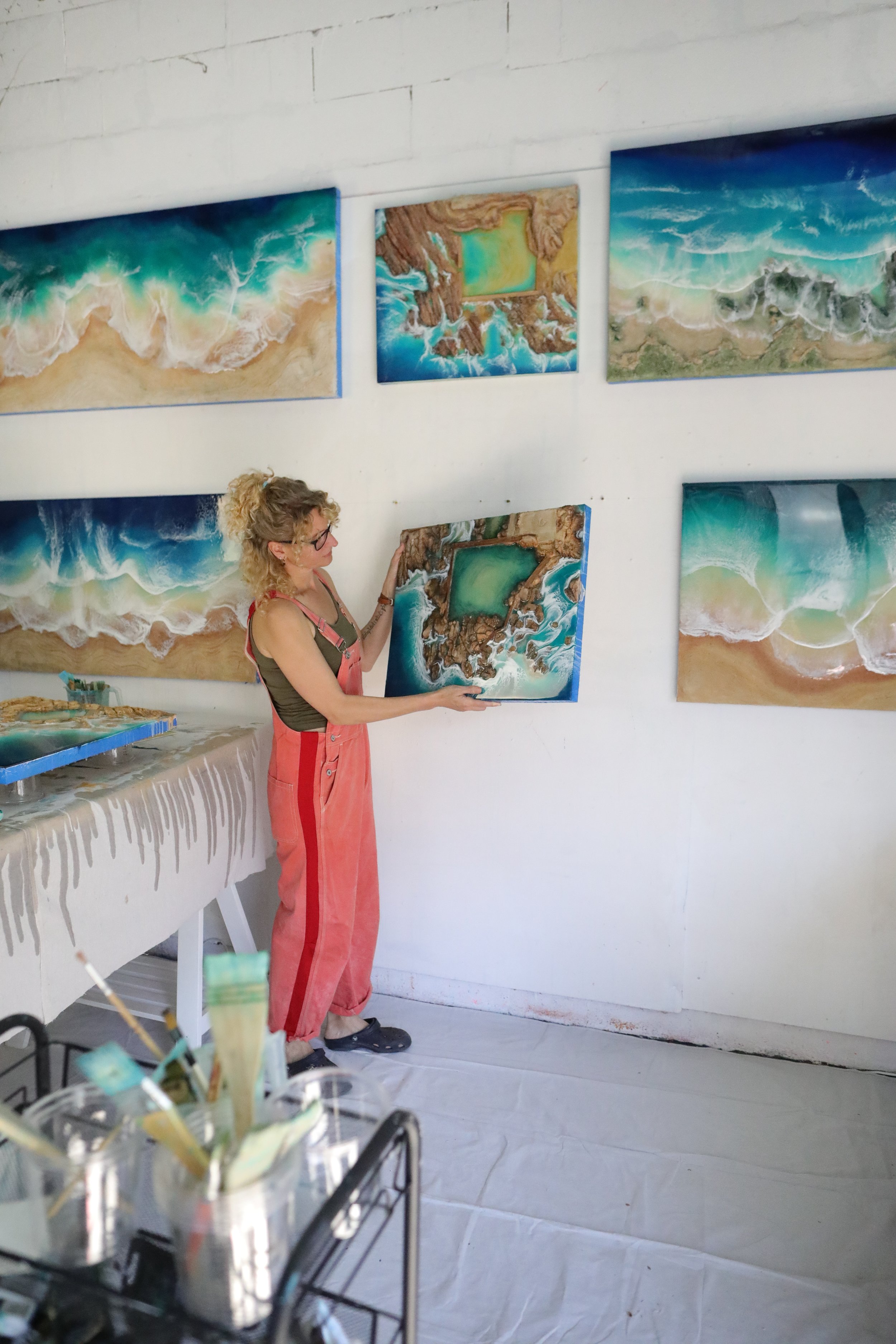
Alexa Ashton is a contemporary mixed media artist working and living on Bundjalung Country in the Northern Rivers of New South Wales. Her creative background spans painting, sculpture and special effects makeup artistry; disciplines that continue to shape her highly tactile artistic practice. Inspired by Australia's coastline, her work explores the powerful meeting place of land and sea through richly textured surfaces and luminous epoxy resin. Working with site specific sand, clay, acrylic mediums, and resin, on wood panels and canvas, she creates sculptural landscapes that capture the elemental energy of the shoreline. Alexa’s current body of work emerged following a life-altering cancer diagnosis at the age of 41.
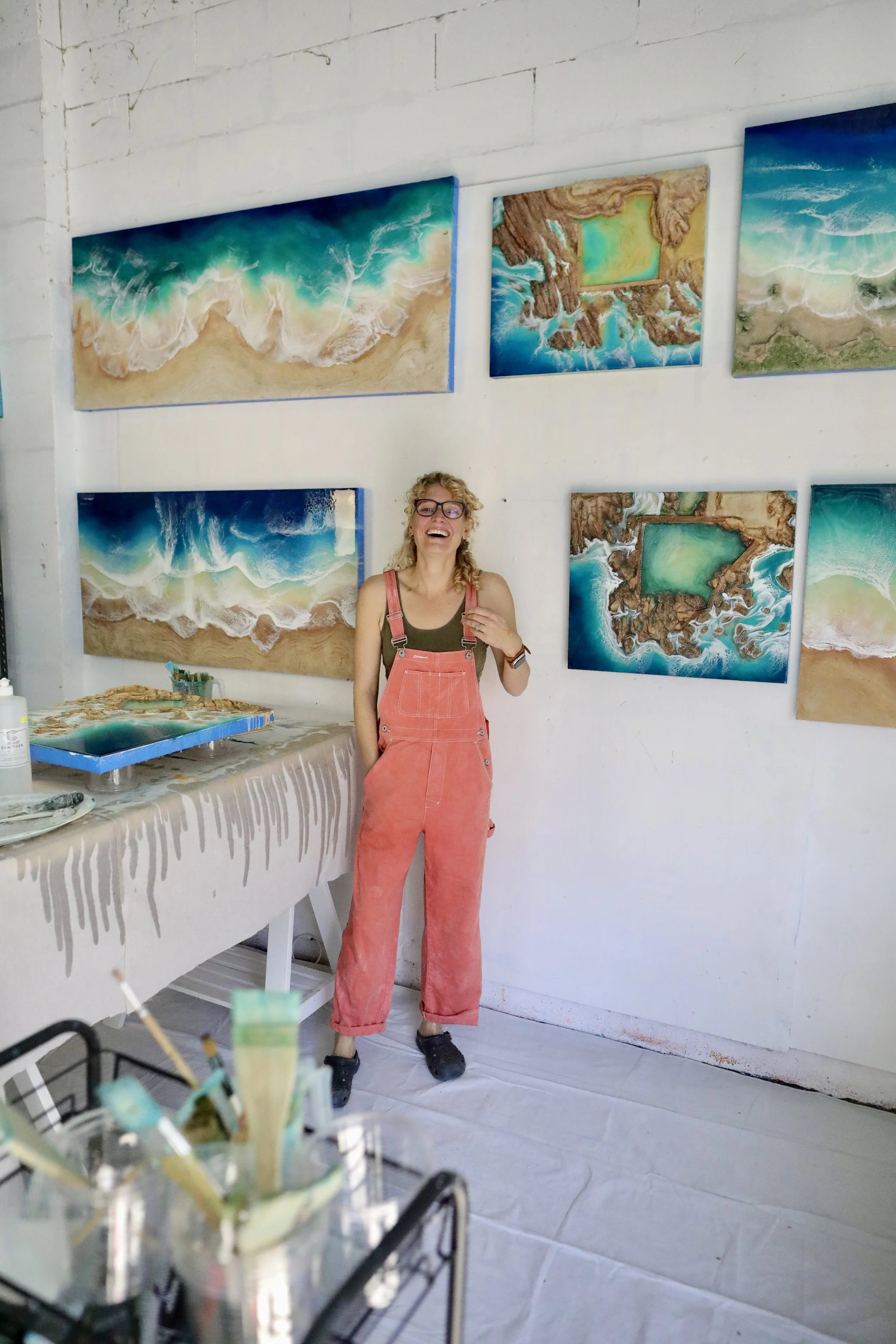
Cancer being both a confrontation and a catalyst she relocated with her young family from Canberra to the Northern Rivers, where the region's abundant waterways profoundly influenced her work. Believing in the restorative power of water, her practice reflects themes of healing, resilience and transformation. Each artwork is an exploration of the balance between control and surrender, from process to execution, echoing the ever-changing relationship between the ocean and the shore.
What is your background and how did you start your journey in the art world?
“I am a contemporary mixed-media artist, educator, and mother living and creating in South Golden Beach, on Bundjalung Country in the Northern Rivers. My path through the creative world has never been a straight line; it has been a wild, multifaceted current. I began diving headfirst into dramatic art at the Victorian College of the Arts then immersed myself in fine art, life drawing, and sculpture at UNSW (COFA) and the Australian National University. The thirst for visceral storytelling drew me deep into the physical crafts of performance, special effects, and prosthetics, training in Canberra and at the Cinema Makeup School in Los Angeles and the Protégé Artist Program at Weta Workshop in New Zealand. Working on film and television sets gave me an obsession with anatomy, mold-making, and transforming synthetic materials into lifelike flesh and form.
Yet everything shifted when I became a mother to my two spirited little girls. Motherhood stripped away artifice; it grounded me in the messy beauty of life and gave my practice an urgency, well, that and the big ‘C’! I found myself drawn to my studio, to water and to healing by creating tactile, dimensional work that my daughters can see, touch, and feel. Living in the Northern Rivers, water has become my constant muse and sanctuary. I grew up longing for the ocean, and here, surrounded by relentless coastal swells, tidal estuaries, and freshwater creeks, water became an elemental mirror of my own life. Merging my background in sculpting and prosthetics with raw earth, pigments, and fluid resin, I began building high-relief mixed-media landscapes. For me, making art is as vital, I have an instinctual need to make things. These days authenticity, creating and the fierce love of raising my children are my driving forces.”
What does your work aim to say? Does it comment on any current social or political issues?
“My work explores the meeting place of land and water as a landscape of resilience, somatic healing, and transformation. It doesn’t make broad partisan statements; rather, it speaks directly to the profound clarity that comes from confronting serious adversity. This body of work was born out of a cancer diagnosis—an experience that drastically altered my relationship with time and stripped away the luxury of hesitation. If my work makes a political statement, it is a deeply personal one about reclaiming agency over my life and environment. Facing the reality of my own mortality, I felt an urgent need to relocate somewhere I could truly heal, fully dedicate myself to my art, and exist without compromise. Just in case my time is shorter than I hoped, I needed to show my two young daughters what it looks like to live courageously and authentically as an artist. Drawn to the restorative waters, estuaries, and ocean swells of the Northern Rivers, I use coastal geography as a living metaphor for survival. Through textured earth, sculptured relief, and fluid resin, my pieces capture that ongoing dialogue between vulnerability and endurance, offering a quiet, tactile testament to choosing truth, presence, and life.”
Do you plan your work in advance, or is it improvisation?
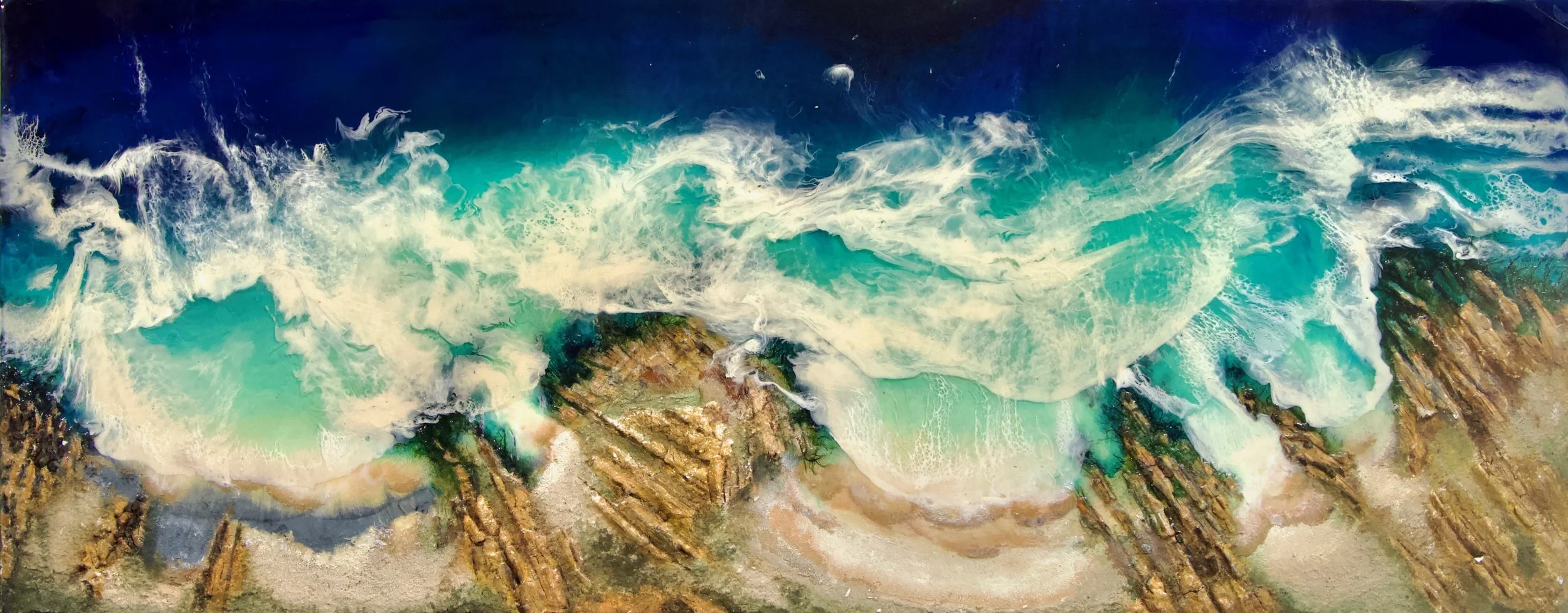
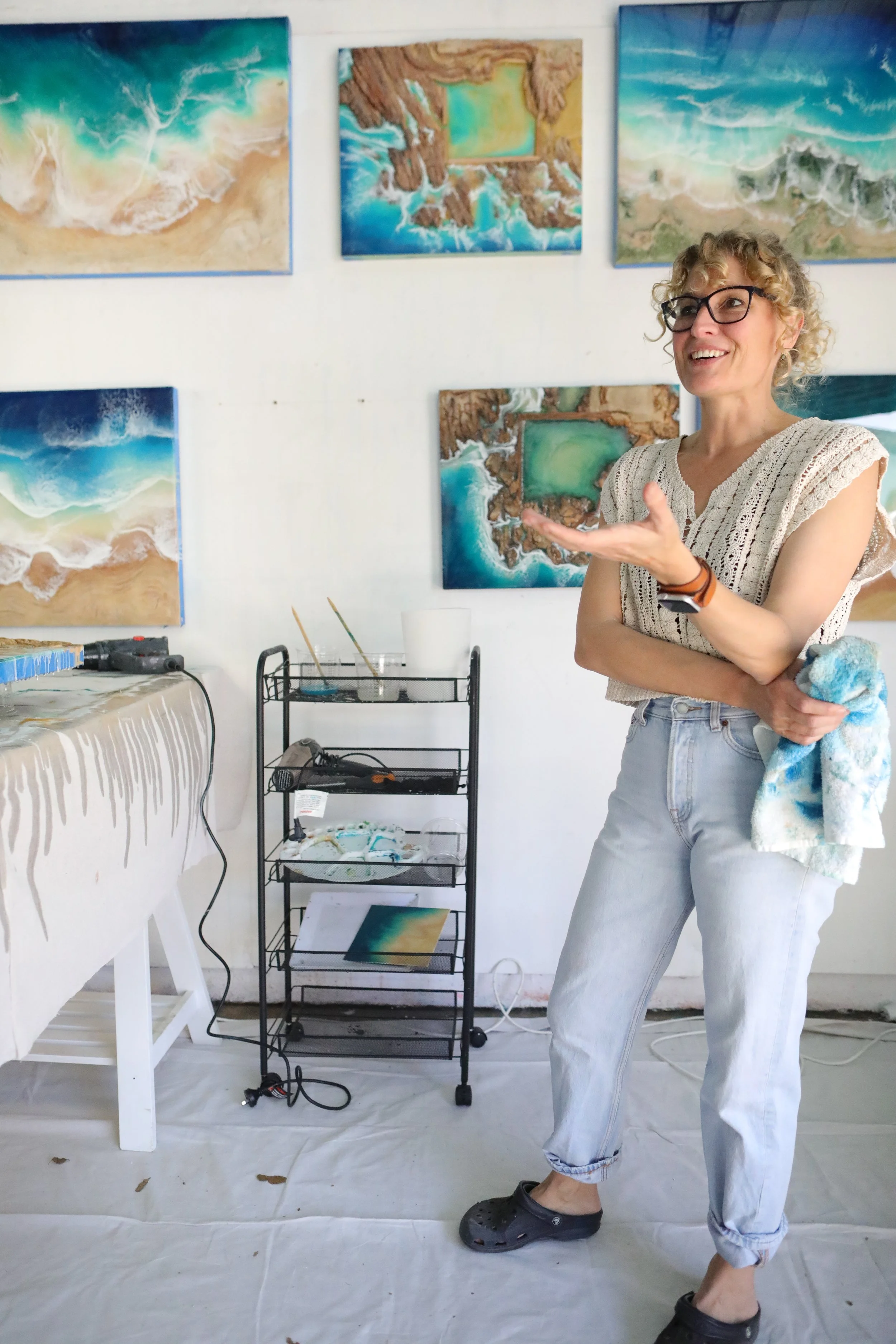
“My work is an intense, deliberate dance between obsessive control and surrender. The initial phase demands hours of deeply focused, labor-intensive discipline. I begin with highly detailed observational studies of the landscape, from video, photos and always hopefully in person. Walking the beach gives me a sense of place and I collect sand and other elements to use in the piece. I then translate those organic forms into delicate, intricate sculptural structures. Using fine modeling techniques honed from my special effects days, I spend days hand-sculpting every crevice, crag, and eroded contour of the rock formations, carefully engineering and feathering the underlying mediums to keep the finished work surprisingly light and refined. It is painstaking, quiet, and hyper-detailed work where my ADHD hyperfocus brain thrives. And then comes the resin—which immediately upends every illusion of control. The moment I begin pouring, the process explodes into raw, intuitive improvisation. Liquid resin has its own mind; it mimics living water, governed by viscosity, surface tension, chemical warmth, and gravitational pull. You cannot bully it into place. The sculptural rock structures collide with an unpredictable wave of liquid pigment and I have to react in real time with heat tools, coaxing translucent tides across the surface, creating foam lacing as it runs unpredictably over the edges, and yielding to whatever the cure reveals. This dialogue is the entire heartbeat of my practice: the friction between days of hyper-detailed, observational hand-sculpting and the heart-stopping rush of surrendering to the cure.”
Are there any art world trends are you following?
“To be completely honest, I’m not really a ‘trends’ kind of person. I’m mostly just forcing myself to maintain an online presence, but the upside has been discovering truly inspiring artists working all over the world in ways I can only long to emulate. Rather than chasing broad market movements, I find myself drawn to creators who fearlessly push the boundaries of texture, form, and medium. I’m endlessly inspired by artists like Sandrine Torredemer (La Filoterie), whose narrative stitch-work, and hyper-tactile details prove just how much evocative a meticulous craft can be.
Rooted in my SFX and prosthetics background, I have enormous admiration for Patricia Piccinini. Her breathtakingly lifelike, vulnerable sculptures that blend anatomical precision and detail kill me. What also excites me most right now is seeing artists completely dismantle traditional rules about what belongs in fine art. A brilliant example is Emy Oikawa—her incredible plasticine clay works fearlessly challenge what we deem ‘acceptable’ materials on canvas. Seeing someone take an everyday, non-traditional medium like plasticine and transform it into a rich, dimensional fine art resonates deeply with my own urge to push boundaries.”
What process, materials and techniques do you use to create your artwork?
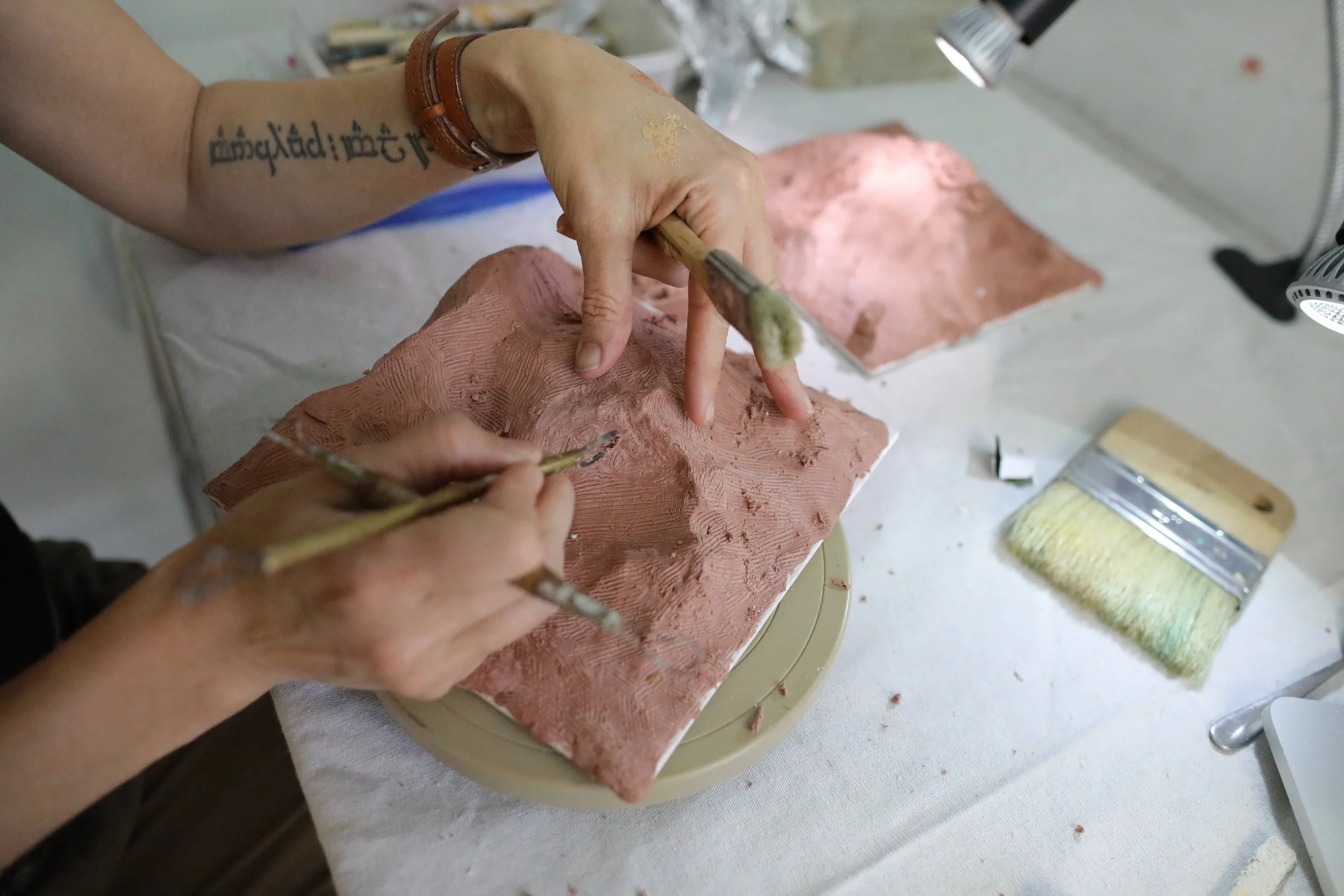
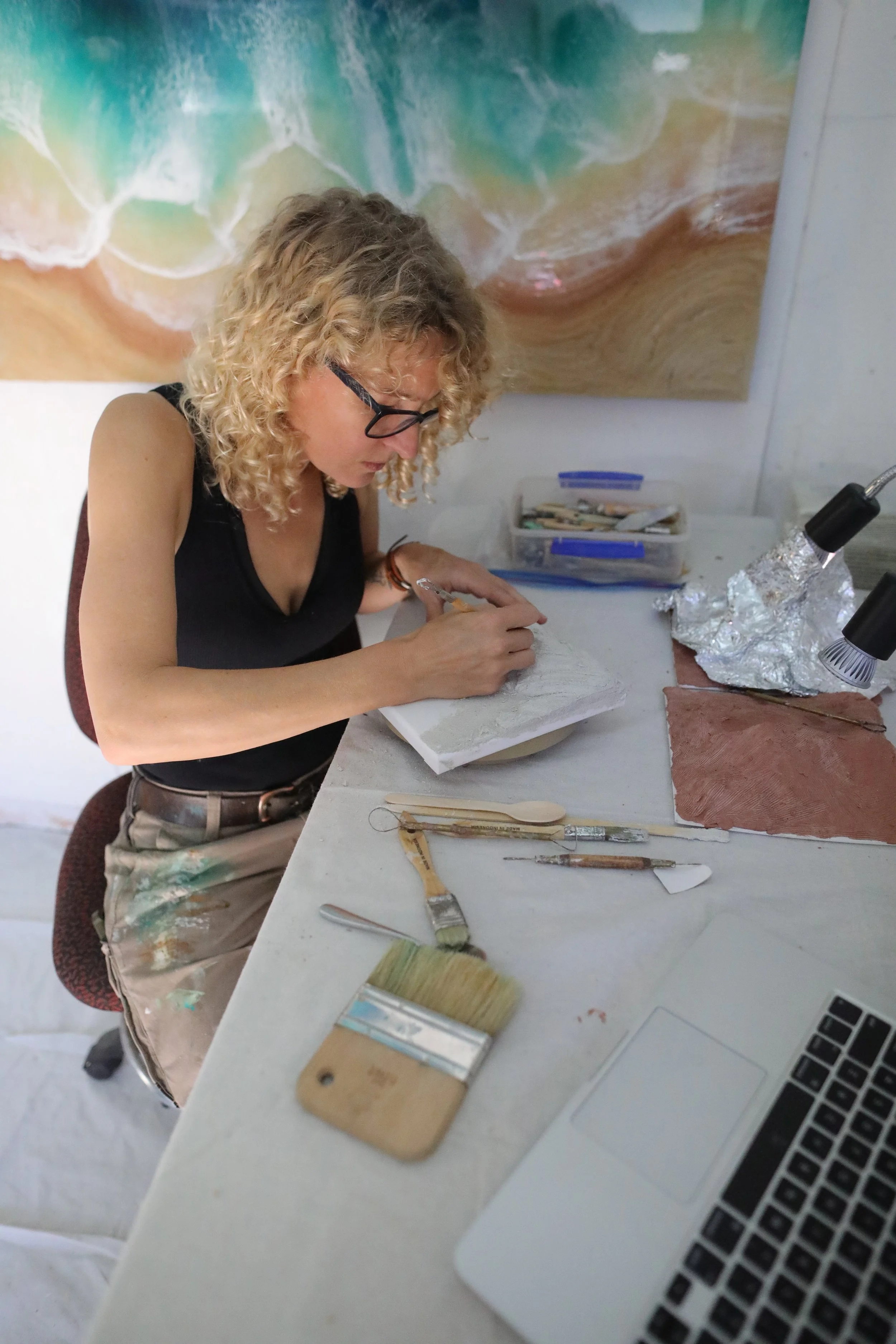
“Base: Wood panels and supported canvas designed to support high-relief dimensional forms. Sculptural Mediums: Acrylic modeling pastes, structural compounds. Epoxy Resin: Luminous, high-gloss resin pours. Pigments and Textures: Blended acrylics, raw pigments, and granular textures engineered to mimic coastal sandbanks, shoreline erosion, and tidal foam. My work is an intense, deliberate dance between obsessive control and surrender. The initial phase demands hours of deeply focused, labor-intensive discipline. I begin with highly detailed observational studies of the landscape, from video, photos and always hopefully in person. Walking the beach gives me a sense of place and I collect sand and other elements to use in the piece. I then translate those organic forms into delicate, intricate sculptural structures.
Using fine modeling techniques honed from my special effects days, I spend days hand-sculpting every crevice, crag, and eroded contour of the rock formations, carefully engineering and feathering the underlying mediums to keep the finished work surprisingly light and refined. It is painstaking, quiet, and hyper-detailed work where my ADHD hyperfocus brain thrives. And then comes the resin—which immediately upends every illusion of control. The moment I begin pouring, the process explodes into raw, intuitive improvisation. Liquid resin has its own mind; it mimics living water, governed by viscosity, surface tension, chemical warmth, and gravitational pull. You cannot bully it into place. The sculptural rock structures collide with an unpredictable wave of liquid pigment and I have to react in real time with heat tools, coaxing translucent tides across the surface, creating foam lacing as it runs unpredictably over the edges, and yielding to whatever the cure reveals. This dialogue is the entire heartbeat of my practice: the friction between days of hyper-detailed, observational hand-sculpting and the heart-stopping rush of surrendering to the cure.”
What does your art mean to you?
“For me, art is an essential vehicle for narrative, clarity, and grounding. Making and creating is my every day. Having navigated diverse roles as an actor, educator, makeup trainer, and mother, creative practice serves as the central lens through which I view my life and experiences. My work represents an ongoing dialogue with nature—specifically the calming and transformational presence of the Northern Rivers waters—translating personal endurance and transition into tangible, tactile expressions of resilience.”

What’s your favourite artwork and why?
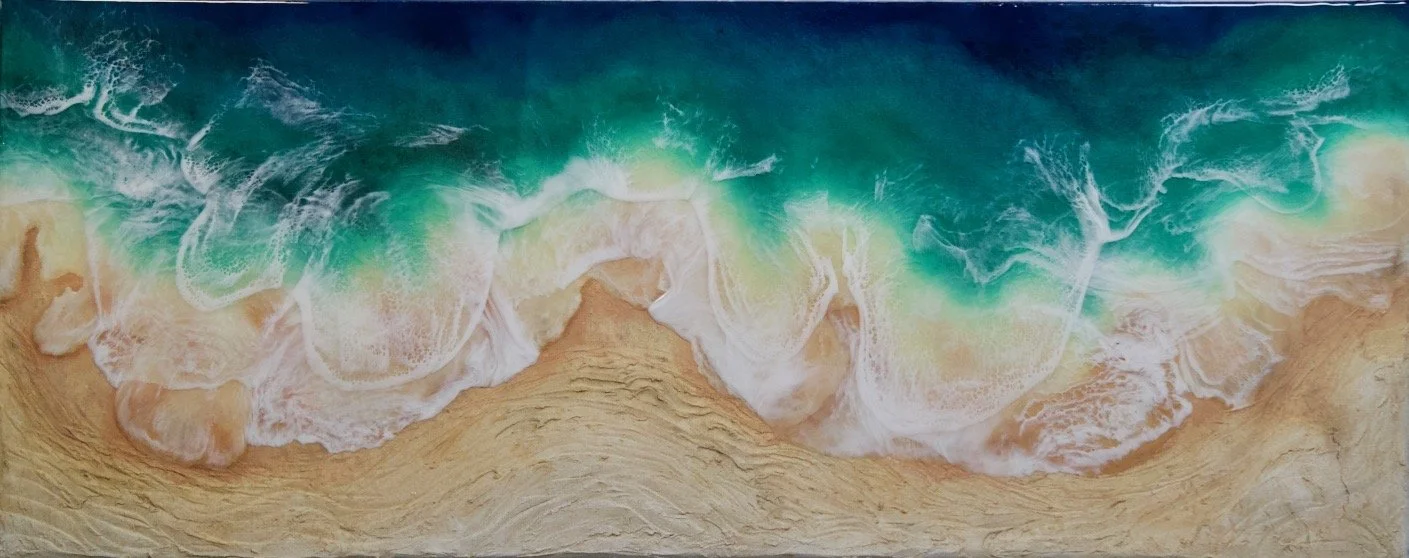
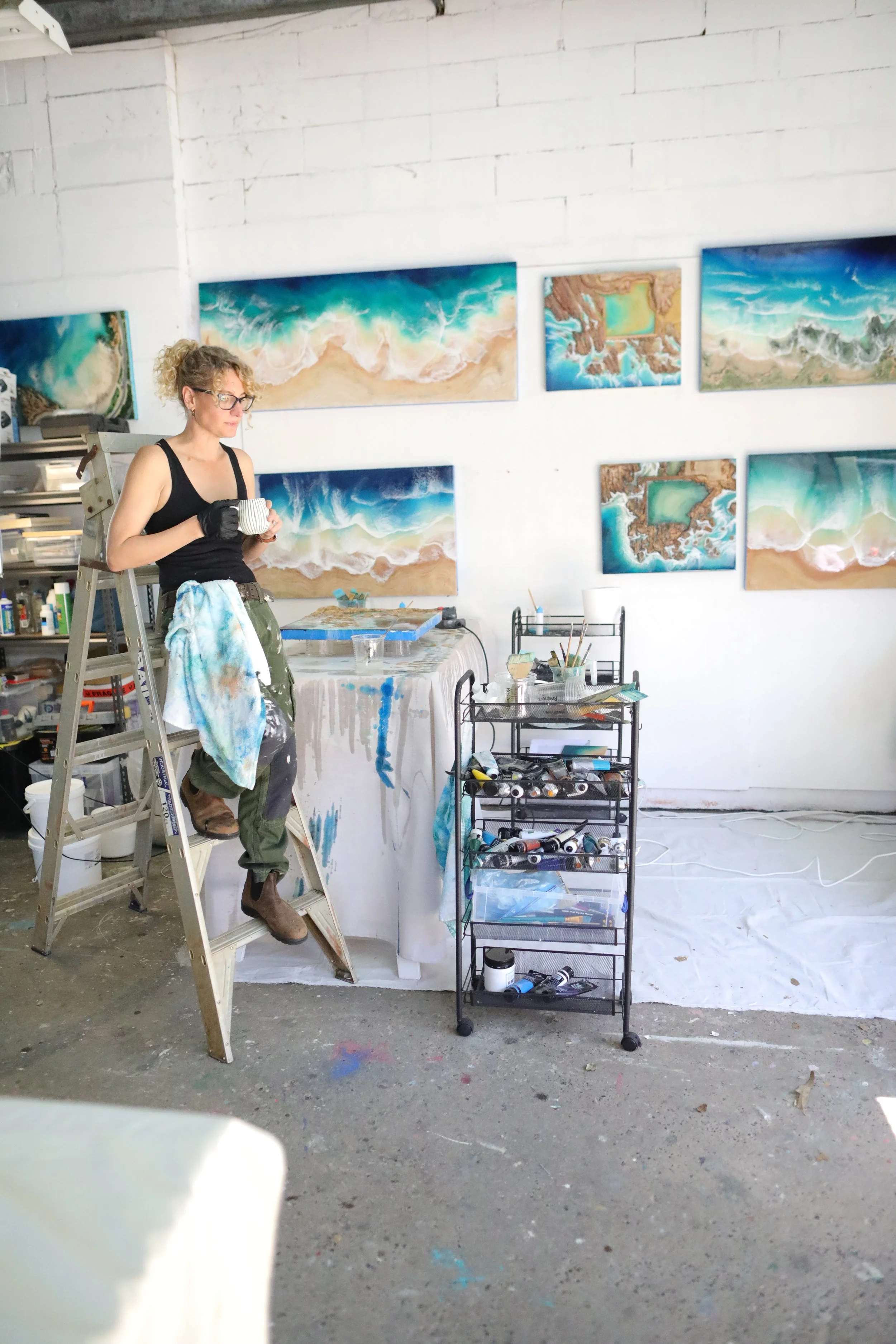
“My favorite piece is one I created for my mother from the South Coast of NSW where she owns a home. The beach there holds a special significance as I brought my babies there and retreated there to find solace for many years. It is one of my larger scale works, 60cm x 152cm and incorporates many different elements; contrasting colours in sand from a black pebbly beach to a white sandy beach.. I even used small amounts of dark green wool to mimic the seaweed. When pouring this piece I had an issue with the temperature and it cooked a bit unusually. Whatever happened the ‘happy accident’ created an unpredictability to the wave structure that i love and often attempt to repeat! It is currently hanging in my home.”
Website: alexaashton.art
Instagram: @alexashtonartistry
Other links: www.facebook.com/AlexaAshtonArtistry